
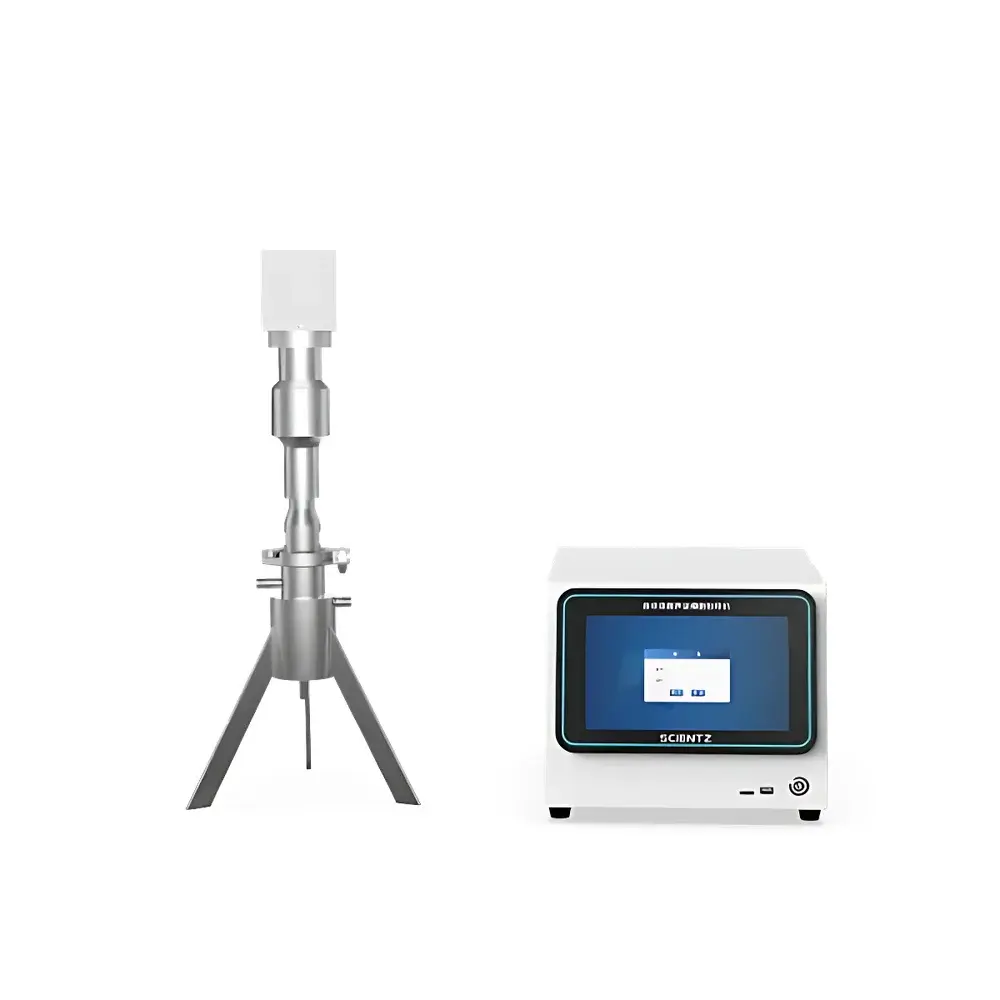
Scientz CFU-750W-M1 Continuous-Flow Ultrasonic Cell Disruptor
| Brand | Scientz |
|---|---|
| Origin | Zhejiang, China |
| Manufacturer Type | Direct Manufacturer |
| Product Category | Domestic (China-made) |
| Model | CFU-750W-M1 |
| Instrument Type | Ultrasonic Cell Disruptor |
| Operating Frequency | 20 kHz ± 1 kHz |
| Ultrasonic Power Output | 750 W |
| Sample Throughput | 5–50 L/h |
Overview
The Scientz CFU-750W-M1 is a continuous-flow ultrasonic cell disruptor engineered for scalable, reproducible, and temperature-controlled processing of biological and chemical suspensions in industrial and regulated laboratory environments. It operates on the principle of acoustic cavitation—generating transient microbubbles in liquid media under high-intensity ultrasound (20 kHz ± 1 kHz), whose rapid collapse imparts localized shear forces, microstreaming, and shockwaves sufficient to disrupt cellular membranes, deagglomerate nanoparticles, or homogenize immiscible phases. Unlike batch-mode sonicators, the CFU-750W-M1 enables true continuous operation via integrated peristaltic or centrifugal circulation, allowing uninterrupted treatment of volumes ranging from 5 to 50 liters per hour. Its dual-jacketed reactor vessel supports active cooling to maintain process temperatures within ±2 °C during extended runs—critical for preserving thermolabile biomolecules (e.g., monoclonal antibodies, viral vectors) and preventing thermal denaturation or oxidative degradation.
Key Features
- Continuous-flow architecture with integrated circulation pump, thermostatically controlled reactor, and high-efficiency ultrasonic transducer assembly
- 750 W nominal ultrasonic power output delivered via titanium alloy horn and converter—resistant to corrosion, erosion, and fatigue under prolonged duty cycles
- ARM-based embedded control system with 7-inch capacitive touch interface; intuitive workflow navigation and real-time parameter visualization
- Full audit trail capability: timestamped records of operator ID, setpoints, runtime, power delivery, temperature logs, and alarm events—stored locally and exportable as CSV/Excel
- Three-tier role-based access control (Administrator, Technician, Operator) compliant with ALCOA+ data integrity principles
- Modbus-TCP protocol support for seamless integration into plant-wide SCADA, MES, or DCS infrastructures
- Hygienic reactor design: seamless, electropolished 316L stainless steel interior; zero dead-leg geometry; validated CIP/SIP compatibility (steam-in-place up to 121 °C / 2 bar for 30 min)
Sample Compatibility & Compliance
The CFU-750W-M1 accommodates aqueous, organic, and viscous suspensions—including mammalian cell cultures, bacterial lysates, nanoparticle colloids (e.g., Fe3O4, TiO2, SiO2), emulsion precursors, and catalytic slurries. It meets mechanical and electrical safety requirements per IEC 61010-1 and EMC compliance per IEC 61326-1. For pharmaceutical applications, its firmware architecture supports 21 CFR Part 11-compliant electronic signatures and data retention protocols when deployed with validated software configuration. The system is suitable for GLP and GMP environments where traceability, change control, and equipment qualification (IQ/OQ/PQ) are mandated.
Software & Data Management
All operational parameters—including ultrasonic amplitude (%), flow rate (L/h), jacket coolant temperature (°C), real-time power draw (W), and cumulative exposure time—are logged at 1-second intervals. Data files are encrypted and stored on internal industrial-grade SSD with automatic rollover and backup via USB or Ethernet. Export formats include CSV (for statistical analysis in JMP or Minitab), PDF reports (with digital signature fields), and XML (for LIMS ingestion). Optional cloud gateway module enables remote monitoring and predictive maintenance alerts based on transducer impedance drift and thermal gradient trends.
Applications
- Vaccine manufacturing: In-line emulsification of oil-in-water adjuvant systems (e.g., MF59 analogs); disruption of insect or mammalian host cells for viral vector harvest
- Nanomaterial synthesis: Deagglomeration and surface functionalization of metal oxides, quantum dots, and carbon nanotubes in polar/nonpolar solvents
- Biocatalysis & synthetic biology: Enhanced mass transfer in immobilized enzyme reactors; lysis of engineered E. coli or Pichia pastoris strains expressing recombinant proteins
- Fine chemical production: Acceleration of heterogeneous catalytic reactions (e.g., Suzuki coupling) via improved solid dispersion and interfacial contact
- Food-grade emulsification: Cold-process stabilization of dairy-free creamers, plant-based beverages, and nutraceutical delivery systems without thermal degradation
FAQ
What is the maximum allowable inlet pressure for the circulation pump?
The integrated pump supports inlet pressures up to 3 bar (gauge); backpressure must remain below 1.5 bar to ensure stable cavitation zone formation within the reactor.
Can the system be validated for sterile processing?
Yes—the reactor, fluid path, and ultrasonic horn interface are designed for full-cycle SIP (121 °C, 30 min, saturated steam); validation protocols including thermocouple mapping and biological indicator challenge tests are supported.
Is third-party calibration available for power output verification?
Scientz provides factory calibration certificates traceable to NIM (National Institute of Metrology, China); ISO/IEC 17025-accredited external calibration services are available upon request.
How is temperature uniformity maintained across the reactor volume?
Dual-jacket cooling with PID-regulated glycol/water mixture ensures axial and radial ΔT ≤ 1.2 °C at steady-state operation (50 L/h flow, 750 W output).
Does the system support programmable multi-step protocols?
Yes—up to 99 sequential steps can be defined, each with independent settings for amplitude, dwell time, flow rate, and cooling setpoint, enabling complex reaction cascades or gradient-based dispersion protocols.




