
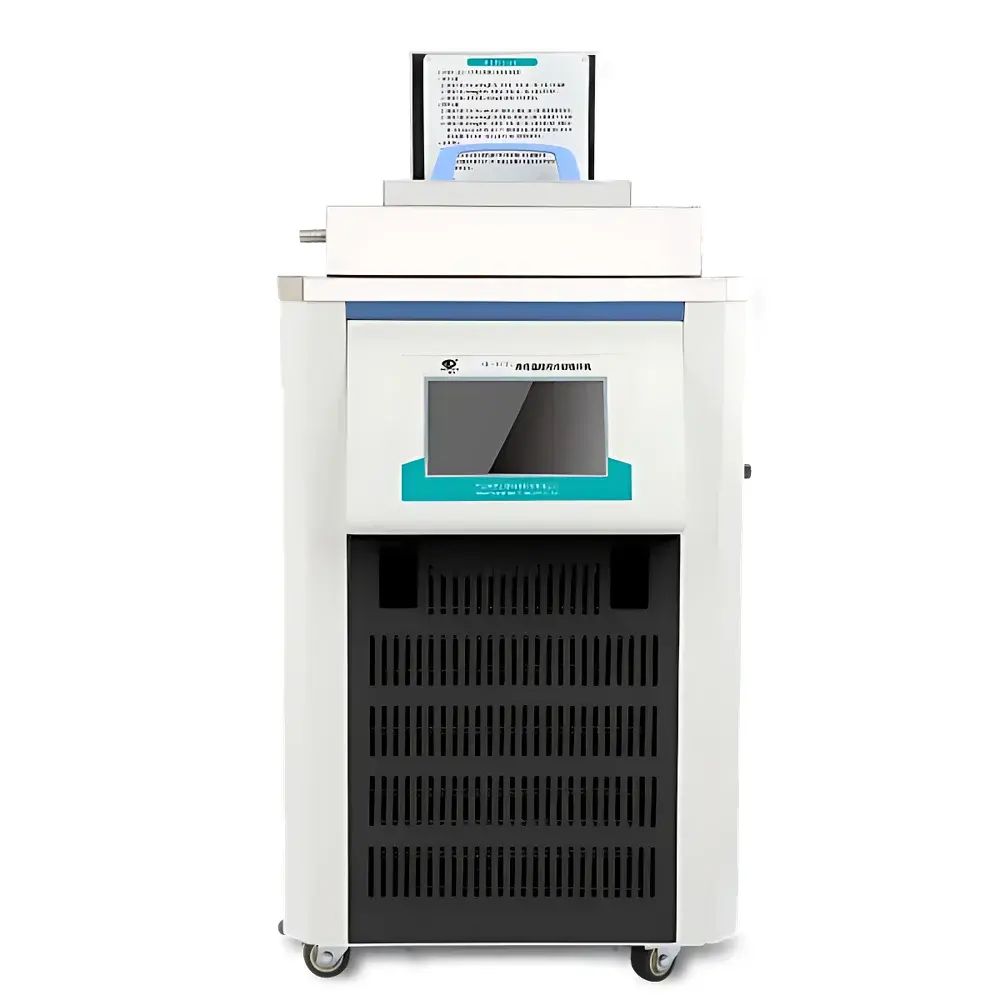
Scientz CK-4005GD Intelligent Programmable Refrigerated/Heating Circulating Bath
| Brand | Scientz |
|---|---|
| Model | CK-4005GD |
| Temperature Range | −40 °C to +200 °C |
| Bath Volume | 5 L |
| Temperature Stability | ±0.1 °C |
| Circulation Type | Internal & External |
| Cooling/Heating Mode | Dual-mode (Refrigeration + Heating) |
| Refrigerant | Environmentally Compliant (R-404A or R-507 Equivalent) |
| Compressor | Hermetically Sealed Imported Unit (Tecumseh/Taikang) |
| Control System | Microprocessor-Based PID with 32-Step Programmable Ramp-Soak Profile |
| Power Recovery | Auto-Restart with User-Configurable Power-On State |
| Safety Protections | Compressor Overheat & Overload Protection, Dry-Run Prevention, High-Temperature Cut-off |
Overview
The Scientz CK-4005GD is an intelligent, dual-mode refrigerated/heating circulating bath engineered for high-precision temperature control in demanding laboratory and industrial environments. Utilizing a closed-loop fluid circulation system based on the principles of convective heat transfer and active thermoelectric compensation, the CK-4005GD delivers stable thermal output across an exceptionally wide operating range—from −40 °C to +200 °C—within a compact 5-liter working chamber. Its core architecture integrates a hermetically sealed, low-noise imported compressor (Tecumseh/Taikang grade), high-efficiency plate-type heat exchanger, and a microprocessor-controlled PID algorithm optimized for dynamic load response. Unlike basic immersion baths, the CK-4005GD supports both internal bath temperature regulation and external process cooling/heating via its dual-port circulation pump—making it suitable as a standalone thermal environment source or as a remote temperature controller for reactors, viscometers, spectrophotometer cells, or calibration standards.
Key Features
- 32-segment programmable temperature/time profile capability, enabling complex ramp-soak sequences for reaction kinetics studies, accelerated aging tests, or thermal cycling validation.
- PID-based digital temperature control with real-time adaptive tuning, achieving ±0.1 °C stability over the full operating range under steady-state conditions (per ASTM E2234–22 methodology for thermal stability verification).
- Environmentally compliant refrigerant system (R-404A or R-507 equivalent), meeting current EU F-Gas Regulation (EU No 517/2014) and EPA SNAP program requirements for low global warming potential (GWP) alternatives.
- Integrated dry-run protection and overtemperature cut-off safeguards, compliant with IEC 61010-1:2010 safety standards for laboratory equipment.
- User-configurable power recovery mode: retains all setpoints and program states after mains interruption; optional auto-restart or standby-on-power-up behavior.
- Low-acoustic operation (<58 dB(A) at 1 m), enabled by vibration-damped compressor mounting and laminar-flow pump design—critical for noise-sensitive analytical labs.
Sample Compatibility & Compliance
The CK-4005GD accommodates aqueous, ethylene glycol/water mixtures, silicone oils, and other non-corrosive heat-transfer fluids compatible with stainless-steel (SUS304) bath construction and fluoropolymer-coated circulation lines. It meets essential regulatory expectations for use in GLP-compliant laboratories: audit-trail-capable parameter logging (via optional RS485/Modbus interface), traceable temperature calibration support (NIST-traceable reference probe input), and hardware-level safety interlocks aligned with ISO/IEC 17025:2017 clause 6.4.2 for environmental conditioning equipment. While not FDA 21 CFR Part 11–certified out-of-the-box, its firmware architecture supports third-party electronic signature integration when deployed with validated LIMS or ELN platforms.
Software & Data Management
The built-in 4.3-inch TFT LCD interface provides real-time display of bath temperature, setpoint, remaining program time, and system status (cooling/heating phase, pump speed, fault codes). Optional PC connectivity via RS485 enables remote monitoring and script-driven control using Scientz’s proprietary LabControl Suite (Windows-compatible, .NET-based), which exports timestamped CSV logs compliant with ISO/IEC 17025 data integrity requirements. All temperature profiles are stored in non-volatile memory with write-cycle endurance exceeding 100,000 cycles—ensuring long-term repeatability without configuration drift.
Applications
- Chemical synthesis requiring precise cryogenic initiation (e.g., Grignard reactions at −30 °C) or high-temperature reflux (e.g., esterification at 180 °C).
- Calibration of temperature-sensitive instrumentation—including RTDs, thermistors, infrared sensors, and DSC reference standards—per ISO 17025 Clause 6.5.2.
- Stability testing of pharmaceutical formulations under ICH Q1A(R3) accelerated conditions (40 °C/75% RH simulation via external humidity chamber coupling).
- Material property evaluation: coefficient of thermal expansion (CTE) measurements, polymer glass transition analysis (Tg), and rheological temperature sweeps.
- Biotechnology applications: enzyme activity profiling across thermal gradients, microbial growth rate assays, and cold-chain validation for diagnostic reagents.
FAQ
What types of heat-transfer fluids are compatible with the CK-4005GD?
Water, 30–60% ethylene glycol/water mixtures, and silicone oils (up to 200 °C viscosity limit: 500 cSt) are recommended. Avoid halogenated solvents or strong acids.
Does the unit support external temperature feedback control?
Yes—via optional PT100 input port, enabling jacketed reactor or sample-stage temperature feedback for cascade control configurations.
Is calibration documentation provided with shipment?
A factory calibration report (traceable to CNAS-accredited standards) is included; users may perform field verification using a NIST-traceable reference thermometer per ISO/IEC 17025 Annex A.3.
Can multiple CK-4005GD units be synchronized for parallel testing?
Via Modbus RTU protocol over RS485, up to 32 units can be daisy-chained and coordinated through a central SCADA or LabVIEW host.
What maintenance intervals are recommended for optimal performance?
Compressor oil inspection every 24 months; heat exchanger cleaning every 12 months (depending on fluid purity); annual verification of PID tuning parameters using step-response testing per ASTM E2234–22 Annex B.
Related Products



