
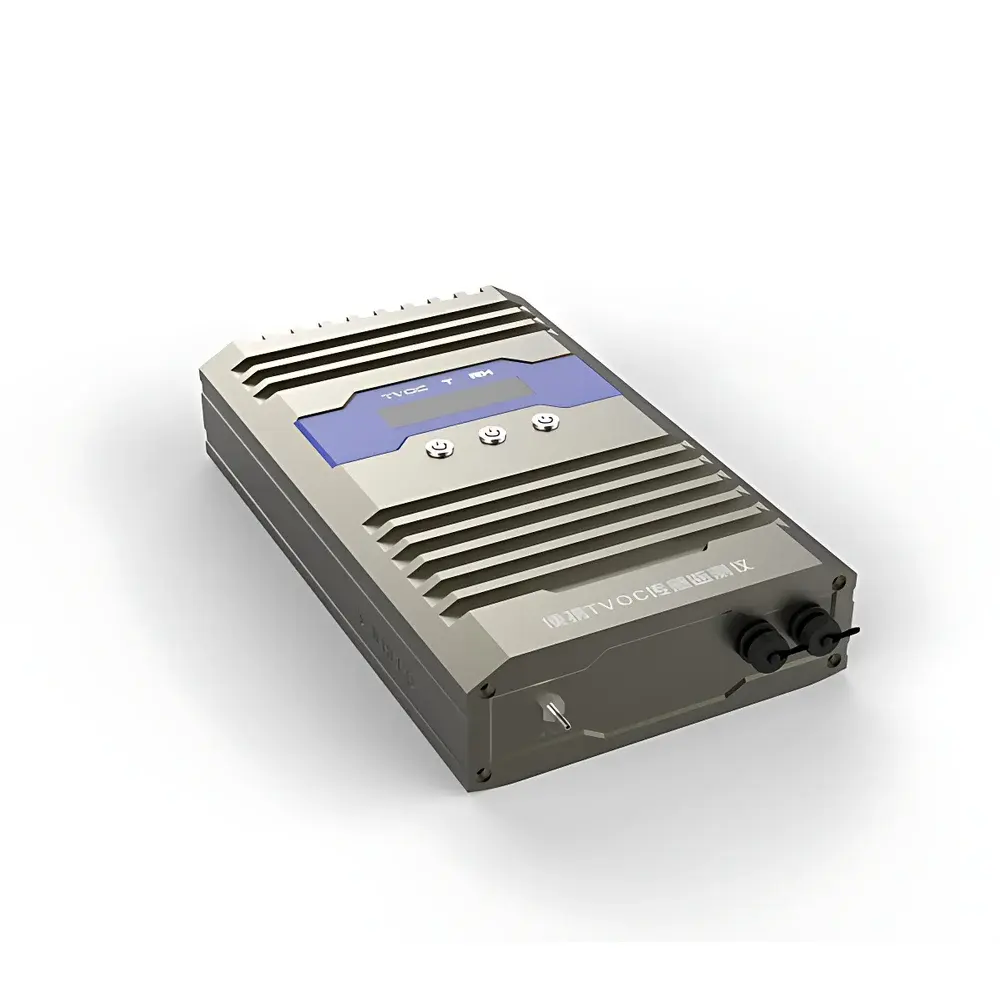
SAIL HERO XHAQSM-701 Portable TVOC Sensing Monitor
| Brand | SAIL HERO |
|---|---|
| Origin | Hebei, China |
| Manufacturer Type | Original Equipment Manufacturer (OEM/ODM) |
| Country of Origin | China |
| Model | XHAQSM-701 |
| Pricing | Available Upon Request |
| Detection Principle | Photoionization Detection (PID) |
| Detection Range | 0–10,000 ppb (TVOC as isobutylene equivalent) |
| LOD | 1 ppb (TVOC) |
| Response Time (T90) | <30 s |
| Temperature Range | −40 to +55 °C |
| Relative Humidity Range | 0–95 % RH (non-condensing) |
| Power Supply | 220 V AC ±10 % / 12 V DC (rechargeable Li-ion battery) |
| Battery Life | ≥48 h (internal battery, typical use) |
| Communication | 4G LTE (Cat 1), GPRS fallback, TLS 1.2 encrypted data transmission |
| Data Resolution | <60 s |
| Display | Integrated backlit LCD (128×64 pixels) |
| Enclosure Rating | IP54 |
| Weight | 2.0 kg |
| Dimensions (L×W×H) | 270 × 164 × 60 mm |
| Operating Altitude | ≤3000 m |
| Auto-zero Interval | Configurable (1–24 h) |
| Heater Control | Peltier-based low-temperature compensation (−40 °C start-up capability) |
| Compliance | CE, RoHS, FCC Part 15, GB/T 3836.1–2021 (Explosion-Proof Design for Industrial Environments) |
Overview
The SAIL HERO XHAQSM-701 Portable TVOC Sensing Monitor is an engineered field-deployable instrument designed for real-time, in-situ monitoring of total volatile organic compounds (TVOCs) alongside ambient temperature and relative humidity. Built upon a photoionization detection (PID) principle, the device utilizes a high-stability 10.6 eV UV lamp and a low-noise ion chamber to achieve selective, non-destructive quantification of aromatic hydrocarbons, aliphatic compounds, ketones, esters, and other VOCs with ionization potentials below 10.6 eV. Its ultra-low power architecture—optimized for continuous operation under variable environmental loads—enables autonomous deployment across diverse settings: indoor air quality (IAQ) assessments in offices and schools, fugitive emission screening at industrial perimeters, emergency response during chemical spills, and long-term urban background monitoring. The unit integrates environmental conditioning subsystems—including Peltier-assisted low-temperature startup heating and closed-loop thermal regulation—to maintain sensor stability across −40 °C to +55 °C operational ranges, ensuring metrological consistency in harsh climatic conditions.
Key Features
- High-sensitivity PID sensor with 1 ppb limit of detection (LOD) and sub-30-second T90 response time
- Dual-power architecture: supports both 220 V AC mains input and 12 V DC rechargeable Li-ion battery (≥48 h runtime on internal pack)
- Field-configurable auto-zero function with programmable intervals (1–24 hours), minimizing drift-induced calibration drift
- Integrated backlit monochrome LCD display (128×64 pixels) for local parameter visualization and status diagnostics
- 4G LTE (Cat 1) primary communication with GPRS fallback; all data transmitted via TLS 1.2–encrypted MQTT or HTTP(S) protocols
- IP54-rated enclosure with reinforced polycarbonate housing, suitable for outdoor mounting and mobile survey applications
- Onboard environmental compensation algorithms for temperature and humidity cross-sensitivity correction
Sample Compatibility & Compliance
The XHAQSM-701 is validated for direct sampling of ambient air without pre-concentration or catalytic conversion. It complies with ISO 16000-29:2015 for VOC measurement methodology and aligns with EPA Method TO-15 requirements for field-portable screening instruments. Its electrical design conforms to IEC 61000-4 electromagnetic compatibility standards and GB/T 3836.1–2021 for non-incendive equipment in potentially explosive atmospheres (Class II, Group IIA). Data integrity meets GLP audit-trail requirements through timestamped event logging (power cycles, zero events, alarm triggers) stored locally and synchronized to cloud platforms. Firmware supports configurable data retention policies and secure over-the-air (OTA) updates compliant with NIST SP 800-193 guidelines.
Software & Data Management
Instrument data streams are ingested into SAIL HERO’s proprietary cloud platform—accessible via web dashboard or RESTful API—supporting multi-tier user permissions, geotagged measurement mapping, and automated alerting (SMS/email) upon threshold exceedance. Raw sensor outputs undergo onboard digital filtering (moving average, median smoothing) prior to transmission. The platform provides export-ready CSV/JSON datasets compatible with third-party analytics tools (e.g., Python Pandas, MATLAB, Tableau). Audit logs record all configuration changes, firmware versions, and calibration history, satisfying FDA 21 CFR Part 11 requirements for electronic records when deployed in regulated environments such as pharmaceutical cleanrooms or food processing facilities.
Applications
- Indoor air quality surveillance in commercial buildings, hospitals, and educational institutions
- Fugitive emission detection and source attribution near petrochemical storage tanks, loading docks, and solvent-handling zones
- Post-remediation verification following mold abatement or fire-damaged structure restoration
- Mobile monitoring campaigns using vehicle-mounted or backpack-integrated configurations
- Long-term trend analysis in smart city infrastructure networks with edge-based anomaly detection
- Occupational exposure assessment in confined spaces where fixed monitoring points are impractical
FAQ
What VOC compounds does the XHAQSM-701 detect?
It responds to VOCs with ionization potentials ≤10.6 eV—including benzene, toluene, xylene, styrene, acetone, ethanol, and formaldehyde (with reduced sensitivity)—reported as isobutylene-equivalent concentration.
Can the device operate continuously for more than 48 hours?
Yes—by connecting an external 12 V high-capacity LiFePO₄ battery pack or standard AC power supply, the unit supports uninterrupted operation for weeks or months depending on telemetry frequency and environmental conditions.
Is remote firmware update supported?
Yes—secure OTA updates are delivered via signed packages authenticated using ECDSA-256 signatures and verified against embedded public keys prior to installation.
Does the instrument require periodic calibration gas exposure?
While auto-zero minimizes baseline drift, annual span calibration using certified 100 ppb isobutylene standard gas is recommended for regulatory-grade reporting per ISO/IEC 17025 laboratory practice guidelines.
How is data security ensured during wireless transmission?
All payloads are encrypted end-to-end using TLS 1.2 with certificate-pinned server authentication; device identity is established via embedded X.509 certificates provisioned at manufacturing.







