
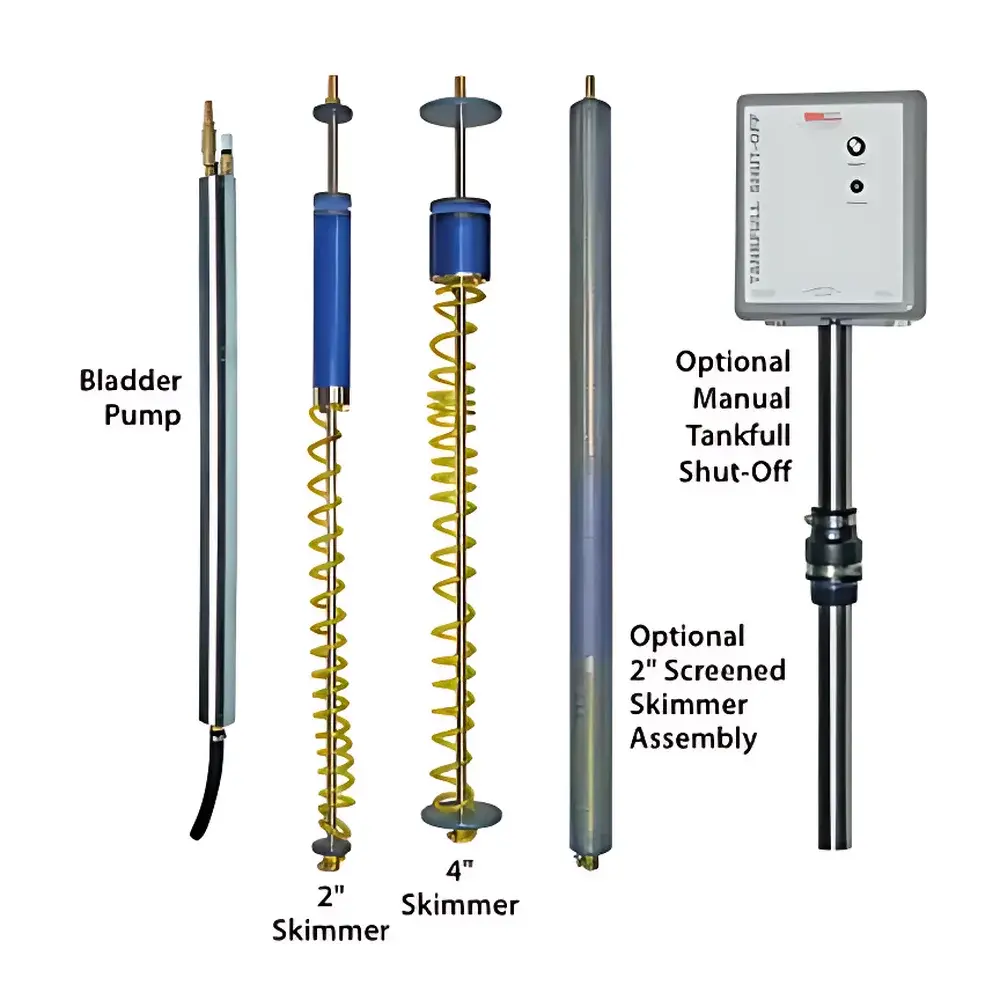
SpOILer Passive Hydrocarbon Recovery System by SAIL HERO
| Brand | SAIL HERO |
|---|---|
| Origin | Hebei, China |
| Manufacturer Type | Manufacturer |
| Origin Category | Domestic |
| Model | SpOILer |
| Pricing | Upon Request |
Overview
The SpOILer Passive Hydrocarbon Recovery System is a controller-free, pneumatically driven oil–water separation device engineered for passive, continuous recovery of Light Non-Aqueous Phase Liquids (LNAPLs) and, with optional configuration, Dense Non-Aqueous Phase Liquids (DNAPLs) from groundwater remediation wells, sumps, collection pits, and storage tanks. Unlike electrically powered or PLC-controlled skimmers, the SpOILer operates exclusively on compressed air—eliminating the need for electrical infrastructure, control cabinets, or programmable logic. Its core principle relies on buoyancy-driven positioning and pneumatic siphon cycling: an air-lift pump lifts oil-saturated water to the surface, where hydrophobic–oleophilic membrane screening separates free-phase hydrocarbons based on interfacial tension and wettability differentials. The system maintains dynamic alignment with the oil–water interface through vertical floatation, ensuring consistent LNAPL capture even under fluctuating groundwater levels.
Key Features
- Controller-free operation: No external PLC, HMI, or power supply required—ideal for intrinsically safe or remote deployment zones.
- Field-adjustable pneumatic cycle timer: Enables manual tuning of air injection intervals to match site-specific oil accumulation rates and minimize compressed air consumption.
- Rapid field deployment: Installation requires only two pneumatic lines—air supply and discharge—reducing setup time to under 30 minutes.
- Modular pump architecture: Standardized air-lift pump compatible with multiple skimmer configurations (e.g., belt, disk, weir), supporting adaptation to varying well diameters (≥5 cm) and fluid viscosities.
- Oleophilic membrane screening: Chemically stable, polymeric filter media with selective affinity for hydrocarbons and inherent water repellency—resists fouling in low-turbidity environments.
- Optional full-tank shutdown probe: Provides mechanical or capacitive level sensing to automatically halt air supply when the collection vessel reaches capacity—preventing overflow and enabling unattended operation.
- Optional oil-free air compressor package: Integrated Class 0 certified compressor eliminates lubricant carryover risk, satisfying ISO 8573-1:2010 Class 0 requirements for hydrocarbon-sensitive applications.
Sample Compatibility & Compliance
The SpOILer is validated for recovery of hydrocarbon mixtures ranging from volatile gasoline-range organics (GRO) to high-viscosity lubricating oils (LRO), including diesel, kerosene, used motor oil, and weathered petroleum products. It performs reliably in groundwater with total suspended solids (TSS) up to 100 mg/L; for higher particulate loads, an optional stainless-steel pre-filter screen (mesh size: 250 µm) can be installed upstream of the intake. While not certified to ATEX or IECEx standards out-of-the-box, the system’s air-only actuation and absence of ignition sources support compliance with Zone 2/Class I, Division 2 hazardous area requirements when paired with appropriately rated compressors and piping. Documentation supports adherence to ASTM D5095–22 (Standard Test Method for Determination of Total Recoverable Petroleum Hydrocarbons in Water) sample integrity protocols during active recovery.
Software & Data Management
As a passive mechanical system, the SpOILer does not incorporate embedded firmware, data logging, or network connectivity. All operational parameters—including cycle timing, air pressure (recommended range: 4–7 bar), and flow rate—are manually adjusted via inline regulators and needle valves. For regulatory reporting, users integrate the system into broader site monitoring frameworks using third-party SCADA-compatible pressure transducers or ultrasonic level sensors installed on the collection tank. Audit trails for maintenance, calibration, and operational logs are maintained per site-specific Quality Assurance Project Plans (QAPPs) aligned with EPA SW-846 and ISO/IEC 17025 documentation practices. Optional data acquisition modules (sold separately) provide analog 4–20 mA outputs for air pressure and tank level, supporting GLP-compliant record retention.
Applications
- Gas station UST (underground storage tank) leak remediation—continuous LNAPL removal from monitoring wells and interceptor sumps.
- Industrial brownfield redevelopment—hydrocarbon recovery from excavation dewatering systems and temporary containment cells.
- Waste oil recycling facilities—pre-concentration of recovered hydrocarbons prior to thermal or chemical treatment.
- Military and government fuel depot maintenance—low-infrastructure LNAPL management in austere or temporary field conditions.
- Regulatory compliance support—meeting state-mandated free-product thickness thresholds (e.g., ≤0.5 inch per NJDEP Technical Requirements) without introducing electrical hazards.
FAQ
Does the SpOILer require electricity or digital controls to operate?
No. It is entirely pneumatically actuated and contains no electronic components, controllers, or power connections.
Can it recover heavy oils such as bunker fuel or tar-like residues?
Standard configuration is optimized for LNAPLs. With the optional DNAPL adapter kit—including weighted float assembly and modified membrane pore structure—it achieves limited recovery of moderately dense hydrocarbons (density up to 1.05 g/cm³) under laminar flow conditions.
What compressed air specifications are recommended?
Minimum supply pressure: 4 bar (g); recommended operating range: 5–7 bar (g); dew point: ≤3°C; oil content: ≤0.01 mg/m³ (ISO 8573-1 Class 2 or better).
Is validation data available for regulatory submittals?
Yes—performance test reports, material safety data sheets (MSDS), and third-party verification of oleophilic membrane selectivity (ASTM F726–21) are provided upon request for inclusion in RCRA, CERCLA, or state-tiered closure packages.
Related Products







