
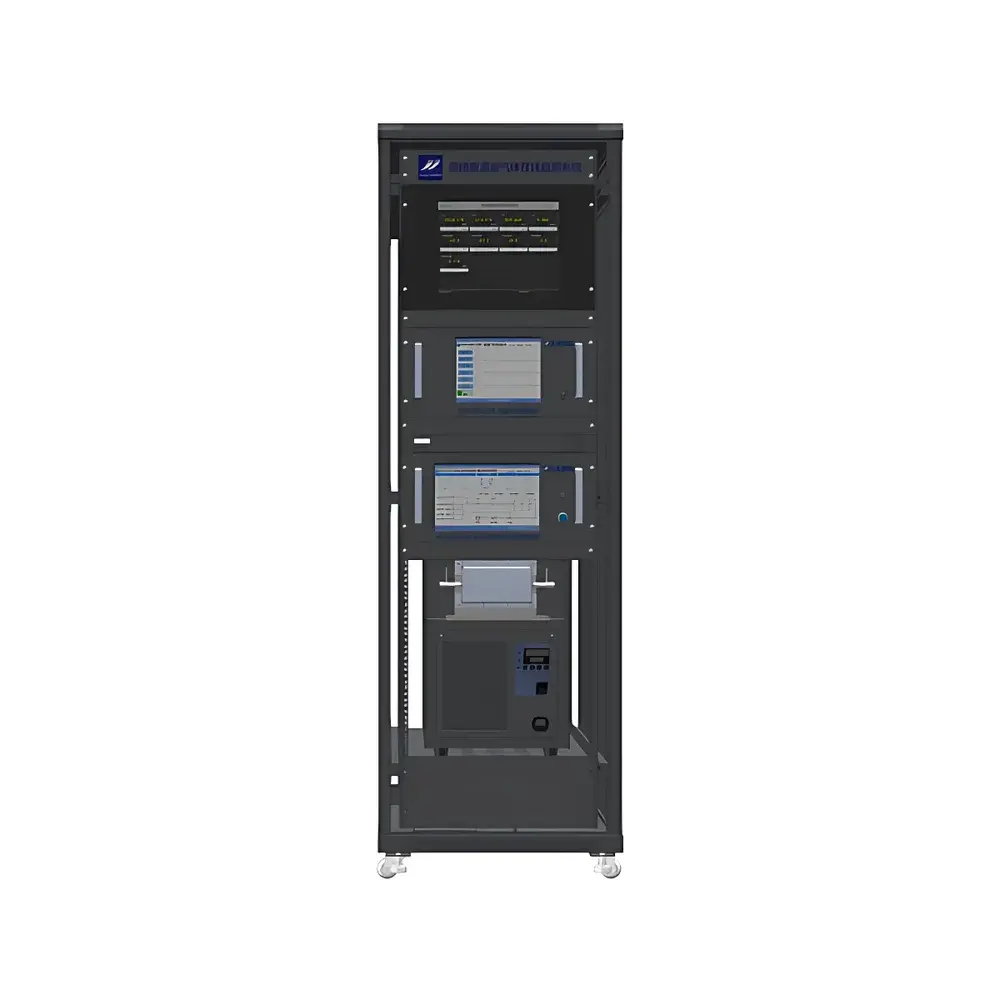
SAIL HERO XHCRDS100P High-Precision Greenhouse Gas Online Monitoring System
| Brand | SAIL HERO |
|---|---|
| Origin | Hebei, China |
| Manufacturer Type | Manufacturer |
| Country of Origin | China |
| Model | XHCRDS100P |
| Detection Principle | Cavity Ring-Down Spectroscopy (CRDS) |
| Target Gases & Ranges | CO₂, CO, CH₄, H₂O |
| Response Time | <20 s to 90% |
Overview
The SAIL HERO XHCRDS100P High-Precision Greenhouse Gas Online Monitoring System is an engineered solution for continuous, unattended atmospheric measurement of key greenhouse gases—carbon dioxide (CO₂), carbon monoxide (CO), methane (CH₄), and water vapor (H₂O)—using Cavity Ring-Down Spectroscopy (CRDS). CRDS provides exceptional sensitivity and long-term stability by measuring the decay rate of laser light trapped within a high-finesse optical cavity; minute changes in absorption directly correlate to trace gas concentrations with sub-part-per-trillion (ppt) detection limits. Designed for integration into national and regional atmospheric observation networks, the system complies with performance specifications defined by the World Meteorological Organization (WMO) Global Atmosphere Watch (GAW) program and the Integrated Carbon Observation System (ICOS), ensuring data traceability, comparability, and suitability for climate modeling, flux inversion, and policy-relevant reporting under frameworks such as the Paris Agreement.
Key Features
- Optimized CRDS architecture with thermally stabilized, ultra-low-drift laser sources and high-reflectivity mirrors (>99.999%) enabling baseline stability better than ±0.1 ppb over 30 days.
- Multi-gas simultaneous quantification without cross-interference compensation algorithms—each analyte resolved via wavelength-specific spectral fitting against validated line lists (e.g., HITRAN2020).
- Compact 19-inch rack-mount design (standard depth: 600 mm) with integrated environmental control: dual-stage temperature regulation (±0.05 °C) and pressure stabilization (±0.01 hPa) to minimize instrumental drift.
- Automated zero/span validation using certified reference gas cylinders and internal calibration manifold—supports scheduled or event-triggered calibration per WMO GAW QA/QC protocols.
- Robust industrial-grade enclosure rated IP54, qualified for operation across –20 °C to +45 °C ambient conditions with humidity tolerance up to 95% RH non-condensing.
Sample Compatibility & Compliance
The XHCRDS100P accepts ambient air samples via heated stainless-steel inlet lines (maintained at 40 °C to prevent condensation) and employs particle filtration (0.3 µm PTFE membrane) upstream of the optical cavity. It meets ISO 17025 requirements for analytical competence when operated under documented SOPs, and its data output structure conforms to WMO GAW metadata standards (including time synchronization via NTP, GPS-derived latitude/longitude, and instrument status flags). The system supports audit-ready logging aligned with GLP principles and is compatible with FDA 21 CFR Part 11–compliant data management platforms when deployed in regulatory monitoring contexts.
Software & Data Management
Embedded firmware runs on a real-time Linux OS with deterministic I/O scheduling. The web-based user interface (accessible via HTTPS) provides live spectral visualization, diagnostic dashboards (mirror reflectivity, cavity alignment status, laser power), and configurable alarm thresholds. Raw absorbance spectra and processed concentration time series are exported in CF-compliant NetCDF format, supporting ingestion into ICOS Carbon Portal, NOAA’s GML database, or national environmental information systems. Remote firmware updates, secure SSH access, and TLS 1.2 encryption ensure cybersecurity compliance in networked deployments.
Applications
- Long-term background monitoring at WMO GAW global and regional stations, including mountain-top, coastal, and remote continental sites.
- Urban emission inventory verification through dense sensor networks and mobile platform integration (e.g., vehicle-mounted or drone-deployable configurations).
- Soil-atmosphere flux studies using eddy covariance towers where high temporal resolution (<1 Hz) and low noise floor are critical.
- Validation of satellite-based greenhouse gas retrievals (e.g., OCO-2/3, TROPOMI, GOSAT) via ground-truthing campaigns.
- Compliance monitoring for industrial point sources under national emissions trading schemes (ETS), supporting MRV (Monitoring, Reporting, Verification) workflows.
FAQ
What calibration standards does the XHCRDS100P support?
It accepts NIST-traceable compressed gas standards for CO₂, CO, CH₄, and H₂O, with automated switching between up to four reference cylinders via solenoid valve manifold.
Can the system operate without internet connectivity?
Yes—local data storage (16 GB onboard flash) retains >12 months of high-resolution time-series; offline operation includes full spectral logging and internal diagnostics.
Is the instrument suitable for mobile deployment?
The system is vibration-tested to IEC 60068-2-6 (5–500 Hz, 0.15 mm displacement) and features shock-absorbing mounting rails, making it appropriate for trailer- or vessel-based installations.
How is water vapor interference handled during CO₂ and CH₄ measurement?
H₂O is measured concurrently and used in real-time spectral correction models based on empirical line broadening coefficients from HITRAN, eliminating need for external drying units.
Does the system meet international data interoperability requirements?
Yes—it generates metadata-compliant files adhering to ICOS Data Policy v3.0 and WMO GAW Station Metadata Template v2.1, enabling direct upload to international repositories.







