
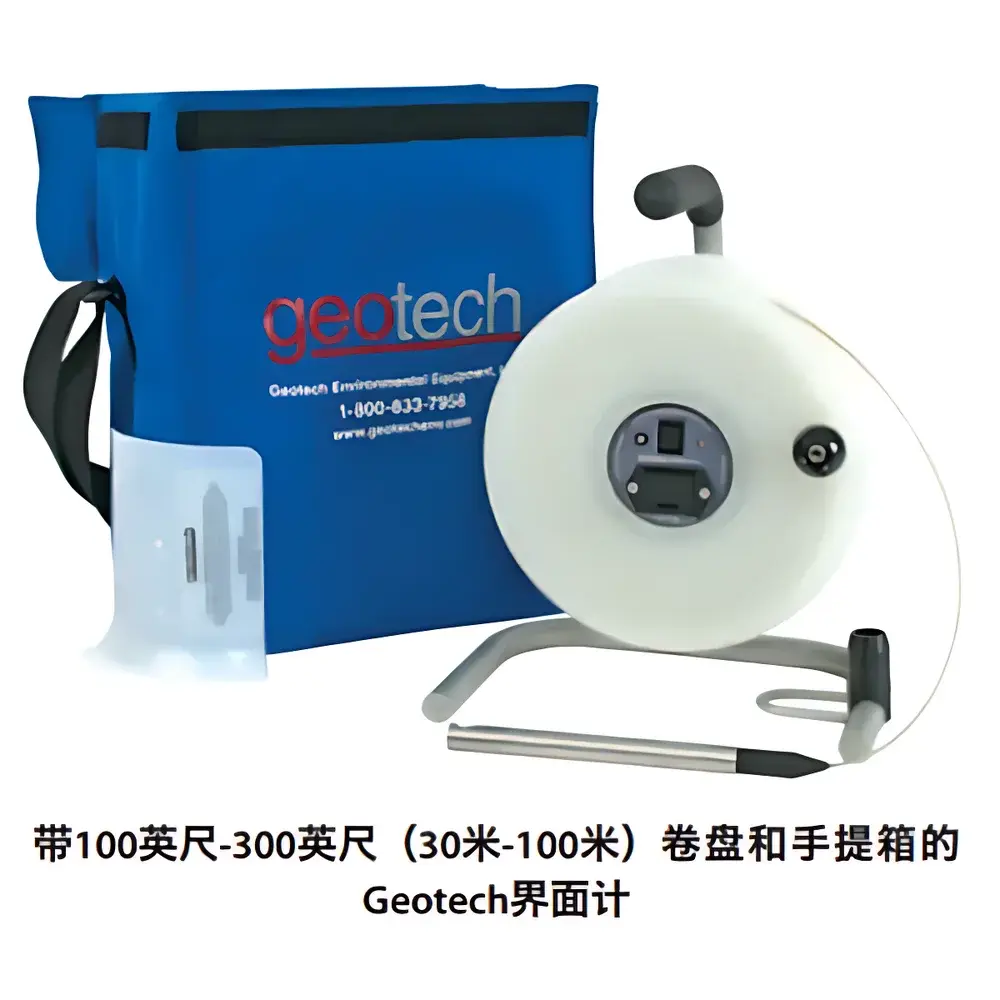
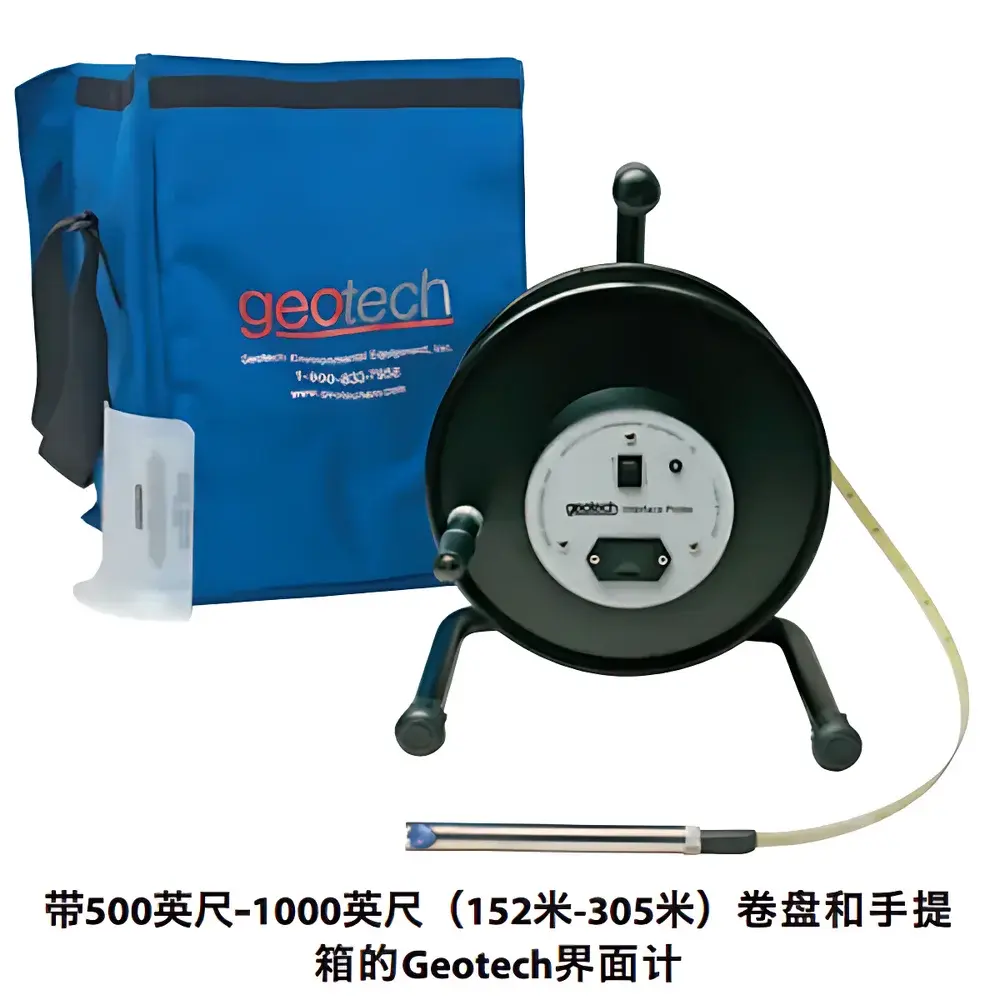
Geotech Interface Meter for Oil-Water Interface Detection in Groundwater Monitoring Wells
| Brand | SAIL HERO (Geotech Series) |
|---|---|
| Origin | Hebei, China |
| Manufacturer Type | Direct Manufacturer |
| Country of Origin | China |
| Model | Geotech Interface Meters |
| Instrument Type | Manual Bail-Down Interface Locator |
| Probe Diameter | 1.6 cm |
| Minimum Well ID | 19 mm (3/4″) |
| Power Supply | 9 V Alkaline Battery |
| Probe Material | Stainless Steel or PTFE-Coated |
| Cable | Stainless Steel Conductor with Viton® Stress-Relief Jacket |
| Measuring Tape | Steel Tape with Kynar® Coating |
| Frame | Anodized Aluminum |
| Reel Housing | Polypropylene |
| Carry Case | Waterproof-Lined Portable Bag with Rotating Spool Mount |
Overview
The Geotech Interface Meter is a field-deployable, manual bail-down instrument engineered for precise detection and depth measurement of the oil-water interface in groundwater monitoring wells. It operates on the principle of electrical conductivity contrast: non-aqueous phase liquids (NAPLs), such as light or dense petroleum hydrocarbons, exhibit significantly lower electrical conductivity than water. When the probe—comprising dual-sensing electrodes—is lowered through the well column, contact with conductive water triggers a distinct vibratory tone and red LED illumination; contact with non-conductive oil elicits an audible beep and green LED activation. The differential response enables unambiguous identification of transition zones, allowing users to determine both the top-of-oil (TOO) and water table (WT) depths directly from the calibrated steel tape scale. Designed for compliance with standard site investigation protocols—including ASTM D5088 (Standard Practice for Soil Gas Sampling in the Vadose Zone) and EPA Method 9071B (Oil and Grease Extraction)—this meter supports regulatory characterization of subsurface contamination plumes without requiring power-intensive or lab-based analysis.
Key Features
- Compact 1.6 cm diameter probe compatible with narrow-diameter monitoring wells down to 19 mm (3/4″ ID), enabling deployment in legacy or space-constrained boreholes.
- Dual-mode audio-visual feedback system: discrete beep + green LED for oil contact; vibratory tone + red LED for water contact—minimizing operator interpretation error.
- Corrosion-resistant stainless steel or PTFE-coated probe tip with Viton® stress-relief boot ensures long-term integrity in aggressive hydrocarbon environments.
- Kynar®-coated steel measuring tape provides high-resolution depth readings with abrasion resistance and UV stability for repeated field use.
- Anodized aluminum frame and polypropylene reel housing deliver mechanical robustness while maintaining portability and chemical inertness.
- Auto-shutoff circuitry conserves 9 V alkaline battery life between measurements; battery replacement requires no tools and is field-serviceable.
- Integrated rotating spool mount and waterproof-lined carry case protect tape alignment and equipment during transport and storage.
Sample Compatibility & Compliance
The Geotech Interface Meter is validated for use in saturated and unsaturated zone monitoring wells containing free-phase petroleum hydrocarbons (e.g., gasoline, diesel, fuel oil) and chlorinated solvents (e.g., PCE, TCE). It detects interfaces between water and low-conductivity NAPLs with high reproducibility under typical field conditions (temperature range: −10 °C to 50 °C; pH 4–10). While not a quantitative analytical device, its qualitative interface localization aligns with U.S. EPA guidance documents (OSWER Directive 9200.4-18P) and ASTM D6771 (Standard Test Method for Determination of Light Non-Aqueous Phase Liquids [LNAPL] Thickness in Monitoring Wells). The instrument meets general requirements for field instrumentation used in GLP-compliant environmental site assessments and supports documentation traceability when paired with standardized field logs.
Software & Data Management
This is a standalone, hardware-only interface locator with no embedded firmware, Bluetooth, or digital data logging capability. All measurements are recorded manually in field notebooks or electronic logbooks (e.g., ESRI Field Maps, ArcGIS Survey123). Users are advised to document probe descent rate, signal onset depth, tape tension consistency, and ambient conditions per sampling event to ensure data defensibility. For audit readiness, laboratories and consultants may integrate readings into LIMS platforms via structured CSV import, referencing ASTM D5092 (Standard Guide for Design and Installation of Ground-Water Monitoring Wells) for metadata completeness.
Applications
- Delineation of LNAPL or DNAPL thickness and vertical distribution in groundwater monitoring wells during Phase II Environmental Site Assessments (ESAs).
- Verification of underground storage tank (UST) integrity by detecting floating or pooled hydrocarbons beneath suspected leak zones.
- Long-term plume monitoring at brownfield sites, refineries, and military installations where periodic interface tracking informs remediation progress.
- Calibration support for automated pressure transducers or capacitance-based interface sensors deployed in permanent wells.
- Field validation of geophysical surveys (e.g., GPR, ERT) indicating anomalous subsurface zones requiring direct confirmation.
FAQ
Can this instrument distinguish between different types of NAPLs (e.g., gasoline vs. diesel)?
No. The Geotech Interface Meter responds only to bulk conductivity differences between water and non-aqueous liquids—it cannot chemically identify or differentiate NAPL species.
Is calibration required before each use?
No formal calibration is needed; however, a functional check using distilled water and mineral oil in a test column is recommended prior to critical deployments to verify audio-visual response fidelity.
What is the maximum recommended well depth for reliable operation?
The standard tape length is 100 m; mechanical accuracy remains consistent up to 75 m under controlled descent conditions. Beyond that, tape sag and probe orientation may affect interface resolution.
Does the probe require cleaning between wells?
Yes. Residual hydrocarbons must be removed using isopropyl alcohol and lint-free wipes to prevent cross-contamination and maintain electrode sensitivity.
Is the device suitable for saline or brackish groundwater?
Yes—the conductivity contrast remains sufficient even at EC levels up to 50,000 µS/cm; however, extremely high salinity (>100,000 µS/cm) may reduce signal differentiation marginally.
Related Products







