
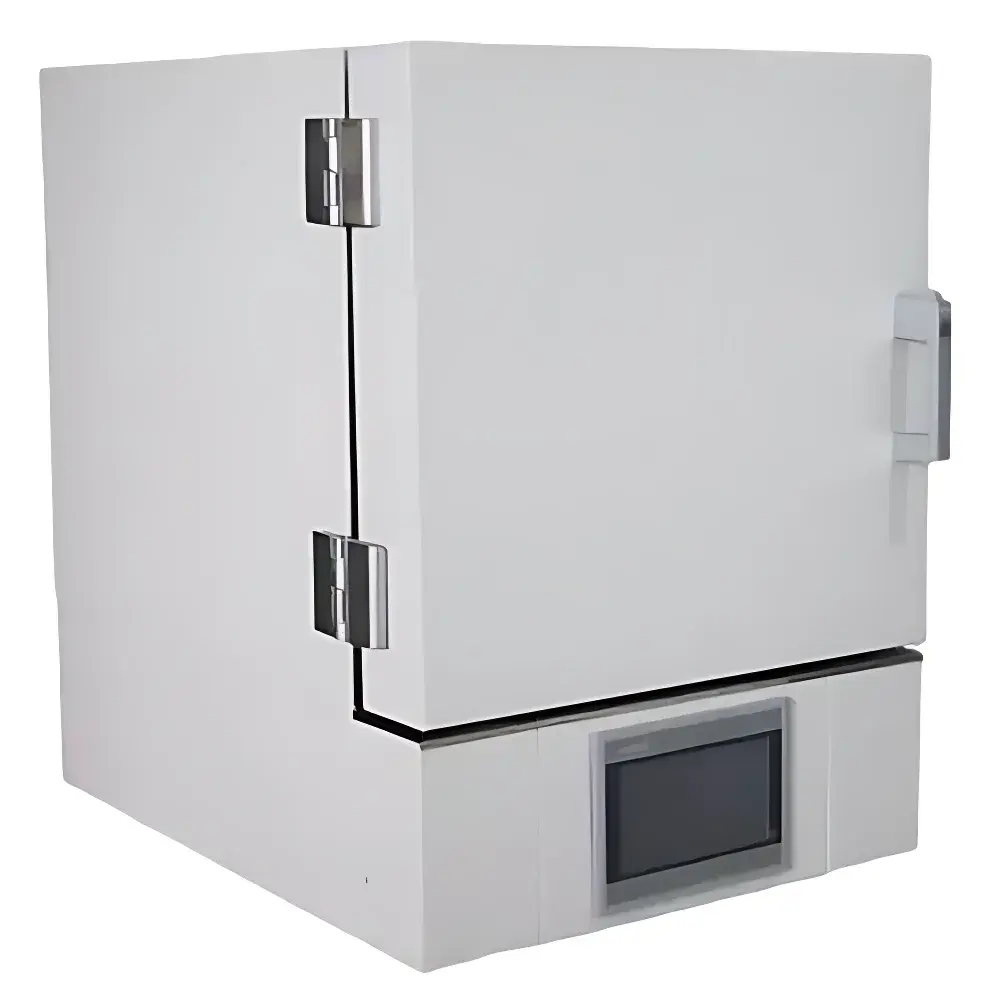
Peiou PQSX2-4-7 Box-Type Resistance Muffle Furnace
| Brand | Peiou |
|---|---|
| Origin | Shanghai, China |
| Model | PQSX2-4-7 |
| Instrument Type | Box-Type Muffle Furnace |
| Max Temperature | 1200 °C |
| Temperature Control Accuracy | ±1 °C |
| Max Power | 4 kW |
| Heating Time to Max Temp | 28 min |
| Heating Chamber Material | Imported Ceramic Fiber |
| Internal Dimensions | 300 × 200 × 120 mm |
| Control Interface | 7-inch Touchscreen Controller |
| Thermocouple Type | K |
| Voltage | AC 220 V / 50 Hz |
| Programmable Stages | 30 |
| Stored Programs | 16 |
Overview
The Peiou PQSX2-4-7 Box-Type Resistance Muffle Furnace is a precision-engineered laboratory heating system designed for controlled high-temperature thermal processing in academic, industrial, and R&D environments. Operating on resistive heating principles, it utilizes high-purity imported ceramic fiber as both the heating chamber lining and primary insulation medium—enabling rapid thermal response, excellent thermal uniformity, and minimal energy loss. With a maximum operating temperature of 1200 °C and a recommended continuous use limit of 1100 °C, this furnace supports critical applications including ashing, calcination, sintering, annealing, and heat treatment of ceramics, metals, polymers, and geological samples. Its compact internal chamber (300 × 200 × 120 mm; 7.2 L volume) ensures efficient heat distribution while maintaining spatial efficiency on standard lab benches.
Key Features
- High-performance ceramic fiber furnace chamber: Low thermal mass enables rapid heating (≤28 min to 1200 °C) and fast cooldown, improving throughput and reducing energy consumption.
- Dual-layer cold-rolled steel housing with acid pickling, phosphating, and electrostatic powder coating—ensuring structural integrity, corrosion resistance, and long-term dimensional stability.
- Integrated safety architecture: Includes automatic power cutoff upon door opening, anti-restart logic after power interruption, and reinforced heavy-duty hinges with custom ergonomic handles.
- 7-inch capacitive touchscreen controller with PID auto-tuning, real-time temperature curve display, and intuitive program navigation—supporting up to 30 ramp/soak segments across 16 stored profiles.
- Multi-zone thermal insulation: Composite ceramic fiber board and blanket layers minimize surface temperature rise (<45 °C at ambient), enhancing operator safety and lab environment compliance.
- Forced-air cooling system: Strategically positioned axial fans maintain optimal ambient temperature around electrical components and control electronics, extending service life and reliability under repeated thermal cycling.
Sample Compatibility & Compliance
The PQSX2-4-7 accommodates a broad range of sample forms—including crucibles (alumina, quartz, platinum), petri dishes, refractory boats, and custom fixtures—within its fully sealed, oxidation-resistant chamber. Its design conforms to general laboratory safety requirements per IEC 61010-1 (Safety Requirements for Electrical Equipment for Measurement, Control, and Laboratory Use). While not certified for hazardous location use (e.g., ATEX or UL Class I Div 2), it meets standard GLP documentation practices when paired with validated calibration records and logbook entries. Temperature uniformity across the working zone complies with ASTM E220–22 (Standard Test Method for Calibration of Thermocouples by Comparison Techniques) when used with traceable reference thermocouples.
Software & Data Management
The embedded firmware supports local data logging (time-stamped temperature, setpoint, and error codes) directly to internal memory. An optional USB interface enables export of session logs (CSV format) for offline analysis in Excel or LIMS-integrated platforms. The controller supports audit-trail-capable operation when configured with password-protected user levels (Operator, Technician, Administrator), aligning with basic FDA 21 CFR Part 11 expectations for electronic record integrity—though full Part 11 compliance requires external validation and networked timestamping infrastructure. Firmware updates are performed via USB stick without requiring vendor service intervention.
Applications
- Gravimetric analysis: Quantitative ash content determination in food, pharmaceutical, and environmental samples per AOAC 923.03 and ISO 2171.
- Materials synthesis: Solid-state reaction initiation, precursor decomposition, and oxide phase formation in battery cathode research (e.g., LiCoO₂, NMC).
- Metallurgical testing: Stress-relief annealing of small alloy specimens and intermetallic diffusion studies.
- Geochemical preparation: Fusion bead preparation for XRF analysis using lithium tetraborate fluxes.
- Quality control: Thermal stability assessment of polymer composites and ceramic coatings per ISO 306 and ASTM D648.
FAQ
What is the maximum recommended continuous operating temperature?
The furnace is rated for continuous operation up to 1100 °C; prolonged exposure above this threshold may accelerate degradation of the ceramic fiber insulation and thermocouple accuracy.
Can the furnace be integrated into an automated lab workflow?
Yes—via optional USB data export and RS485 Modbus RTU communication (available on PQSX2-5-12 variant); custom SCADA integration requires third-party driver development.
Is calibration certification included with shipment?
No factory calibration certificate is supplied by default; users must perform initial verification using NIST-traceable reference thermocouples and document results per internal SOPs.
How often should the ceramic fiber chamber be inspected?
Visual inspection is recommended before each use; replace if cracking, delamination, or visible fiber shedding exceeds 5% of surface area.
Does the unit comply with CE or UKCA marking requirements?
This model is intended for the domestic Chinese market and does not carry CE or UKCA markings; export variants require separate conformity assessment and technical file compilation.



