
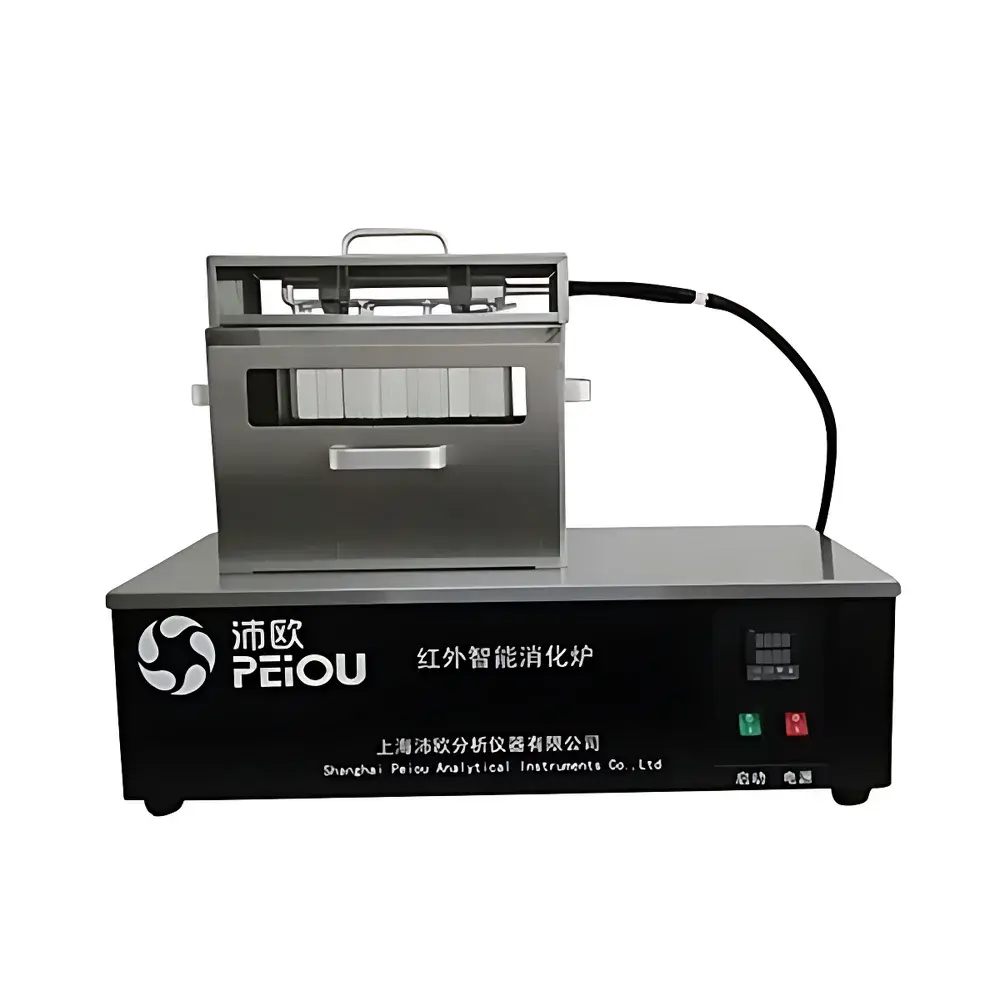
Peiou SKD-20S2 Infrared Programmable Quartz Digestion Furnace
| Brand | Peiou |
|---|---|
| Origin | Shanghai, China |
| Model | SKD-20S2 |
| Control System | Microcontroller-based (64-step programmable ramp + timer) |
| Heating Method | Far-infrared radiation from opal milky quartz tubes |
| Number of Digestion Ports | 20 |
| Temperature Range | Ambient to 550 °C |
| Ramp Time | 20 min (ambient to 400 °C) |
| Temperature Stability | ±1 °C |
| Voltage | AC 220 V |
| Power Consumption | 1950 W |
| Dimensions (L×W×H) | 655 × 340 × 210 mm |
| Digestion Tube Compatibility | Ø42 × 300 mm |
| Safety Features | Dual independent switches (power & heating), over-current protection, earth-leakage circuit breaker, stainless steel fume hood with SO₂ scrubbing duct |
| Optional Accessory | Sample explosion guard |
Overview
The Peiou SKD-20S2 Infrared Programmable Quartz Digestion Furnace is an engineered solution for high-reproducibility wet digestion in analytical laboratories requiring precise thermal control and minimal sample loss. Unlike conventional conductive heating systems—such as aluminum block or graphite block digesters—the SKD-20S2 employs far-infrared radiation generated by opal milky quartz heating elements. This method eliminates physical contact between heat source and digestion vessel, thereby eliminating thermal gradients caused by conduction inefficiencies and material-specific thermal inertia. The furnace operates on the principle of selective electromagnetic energy transfer: electrical resistance heating within the quartz tube generates visible and near-infrared radiation; >97% of this energy is absorbed by the opal milky quartz envelope, exciting Si–O bond vibrations that re-emit energy as far-infrared radiation (peak emission ~3–5 µm). This spectral match enhances absorption efficiency by silica-based and organic matrices, enabling rapid, uniform heating across all 20 digestion positions. Designed for applications demanding strict adherence to AOAC, ISO 11047, and EPA Method 3050B protocols, the SKD-20S2 supports standardized Kjeldahl nitrogen determination, heavy metal extraction (e.g., Cd, Pb, As), and total phosphorus analysis in complex biological and environmental matrices.
Key Features
- 64-step programmable temperature ramping with timer-based endpoint control, enabling method-specific thermal profiles for diverse sample types (e.g., dairy, feed, soil, plant tissue).
- Opal milky quartz infrared emitters: chemically inert under concentrated H₂SO₄, HNO₃, and HClO₄ exposure; no degradation or leaching observed after >5,000 h cumulative operation.
- Uniform irradiance distribution ensures inter-port temperature deviation <±0.8 °C at 400 °C, minimizing digestion inconsistency and wall deposition ("walling") in viscous or lipid-rich samples.
- Low thermal mass design achieves <20 min ramp from ambient to 400 °C and <15 min cooldown to 100 °C—reducing cycle time without compromising digestion completeness.
- Dual independent switching system isolates power supply from heating circuitry, allowing safe parameter configuration and energy conservation during standby.
- Integrated stainless steel fume containment hood with dedicated exhaust port, compatible with laboratory-grade acid gas scrubbers or water-trap vacuum systems compliant with OSHA 29 CFR 1910.1200 (HCS) requirements.
- PID-controlled digital temperature regulator with 0.1 °C setpoint resolution and <0.5 °C overshoot at full load—validated per ASTM E220 for thermal uniformity mapping.
Sample Compatibility & Compliance
The SKD-20S2 accommodates standard borosilicate or quartz digestion tubes (Ø42 × 300 mm), supporting open-vessel digestion per ISO 14851 and closed-vessel pre-digestion workflows. Its non-contact heating architecture eliminates cross-contamination risk associated with shared metal blocks and avoids thermal stress-induced tube fracture common in high-thermal-inertia systems. The furnace meets CE safety directives (2014/35/EU Low Voltage Directive and 2014/30/EU EMC Directive), with built-in Class II insulation, reinforced grounding, and residual current device (RCD) protection rated at ≤30 mA trip threshold. All electrical components comply with IEC 61010-1:2010 for laboratory equipment safety. While not intrinsically rated for hazardous area use, its fume management system aligns with local institutional EH&S policies governing sulfur dioxide and nitrogen oxide emissions during acid digestion.
Software & Data Management
The SKD-20S2 operates via embedded microcontroller firmware with no external PC dependency. All 64 ramp segments—including dwell time, target temperature, and rate (°C/min)—are stored in non-volatile memory and retain settings after power interruption. An optional RS-232 interface (available upon request) enables integration with LIMS or ELN platforms for audit-trail generation, satisfying GLP and FDA 21 CFR Part 11 requirements when paired with validated third-party software. Event logs record start/stop timestamps, peak temperature achieved per port (via calibrated thermocouple feedback), and fault codes (e.g., over-temperature, sensor open-circuit), exportable as CSV for QA review. No cloud connectivity or proprietary drivers are required.
Applications
This furnace is routinely deployed in accredited testing laboratories performing:
- Kjeldahl nitrogen analysis in milk powder, soy protein, and animal feed per AOAC 984.13 and ISO 5983-1;
- Heavy metal quantification (As, Cd, Cr, Pb, Hg) in soils and sediments per EPA 3050B and ISO 11047;
- Total phosphorus and potassium determination in plant tissue and fertilizer formulations per ISO 11047 and AOAC 975.03;
- Preparation of certified reference materials (CRMs) where inter-batch consistency is critical;
- Method development for novel matrices such as microplastics, biochar, and algal biomass requiring controlled oxidative decomposition.
FAQ
What distinguishes infrared quartz heating from aluminum or graphite block digestion?
Infrared quartz heating relies on electromagnetic radiation rather than conductive transfer, eliminating thermal lag and inter-sample variability caused by differential contact resistance or declining thermal conductivity at elevated temperatures—particularly above 300 °C in graphite systems.
Can the SKD-20S2 be used for closed-vessel microwave-assisted digestion prep?
Yes. It serves as a robust pre-digestion platform for samples requiring initial charring or low-temperature oxidation prior to microwave-assisted acid digestion, reducing pressure buildup risks.
Is the fume hood compatible with standard lab exhaust manifolds?
The 50 mm diameter exhaust port accepts standard PVC or PTFE-lined flexible ducting and integrates seamlessly with central vacuum systems operating at ≥150 m³/h flow rate.
Does the instrument support GLP-compliant data archiving?
When equipped with the RS-232 option and validated data acquisition software, full traceability—including user ID, method ID, timestamped temperature profiles, and fault logs—is achievable per 21 CFR Part 11 Annex 11 guidelines.
What maintenance is required for long-term reliability?
Annual verification of thermocouple calibration against NIST-traceable reference and visual inspection of quartz emitter integrity are recommended; no routine lubrication or heater replacement is needed under normal usage conditions.



