
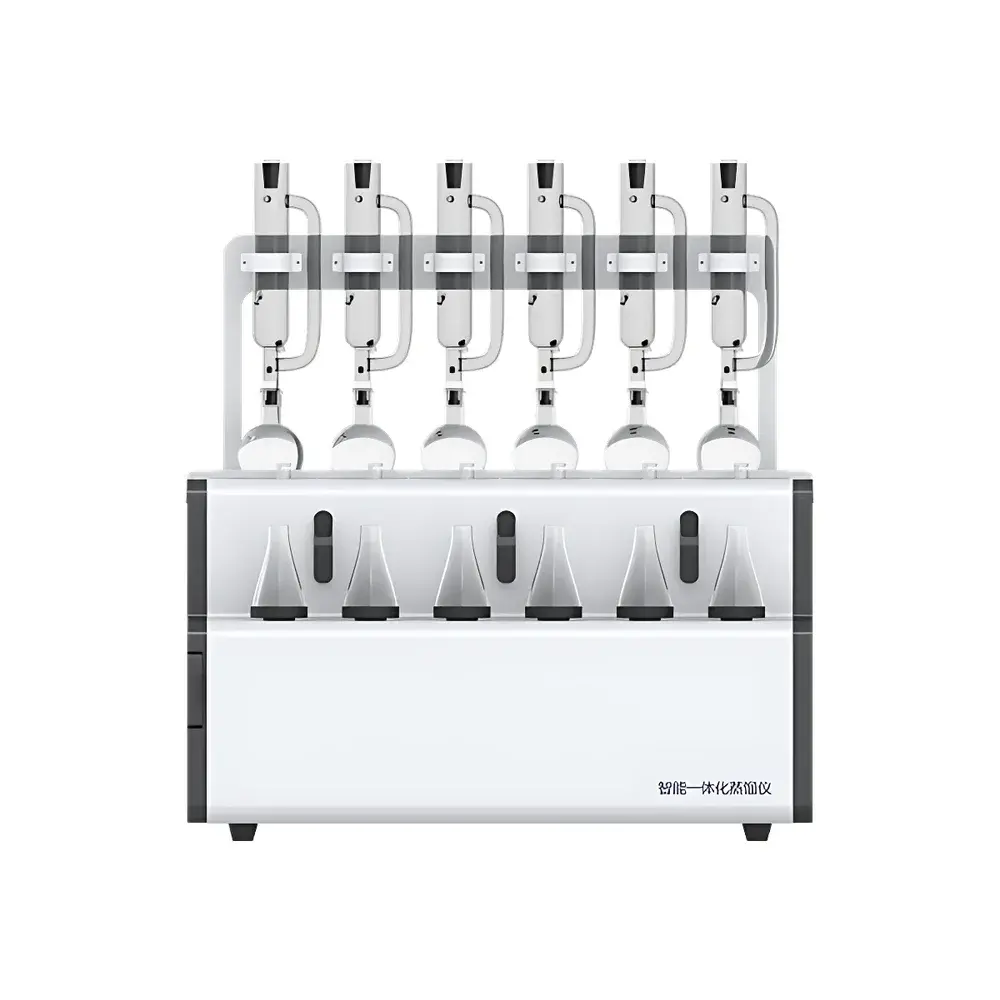
Peiou PQZL-1000 Intelligent Integrated Distillation System with Built-in Closed-Circuit Chiller
| Brand | Peiou |
|---|---|
| Origin | Shanghai, China |
| Model | PQZL-1000 |
| Heating Method | Far-Infrared Ceramic Radiant Heating |
| Cooling System | Integrated Compressor-Based Closed-Loop Chiller |
| Distillation Channels | 6 Independent Units |
| Control Interface | 7-inch HD Touchscreen LCD |
| Temperature Range | Ambient to 300 °C |
| Heating Ramp Time | <8 min |
| Distillation Modes | Gravimetric (1–600 g, ±2 g accuracy) and Timed (1–600 min) |
| Endpoint Detection | Dual-mode (load cell + timer) with anti-suckback valve activation |
| Cleaning | Integrated auto-cleaning pump |
| Preloaded Methods | 7 factory-default protocols + user-customizable method storage |
| Single-Channel Control | Yes |
| Compliance | Designed for GLP-compliant laboratory workflows requiring audit-ready operation logs |
Overview
The Peiou PQZL-1000 Intelligent Integrated Distillation System is an automated, benchtop distillation platform engineered for precision, reproducibility, and unattended operation in environmental, food, pharmaceutical, and regulatory quality control laboratories. It implements a dual-mode endpoint detection architecture—combining high-resolution gravimetric measurement (±2 g repeatability) with programmable time-based termination—to ensure consistent distillate recovery across heterogeneous sample matrices. Unlike conventional steam distillation apparatuses reliant on manual supervision or open-loop cooling, the PQZL-1000 integrates a hermetically sealed, compressor-driven chiller unit directly into its chassis, eliminating external water supply dependencies and reducing footprint by >40%. Its far-infrared ceramic heating elements operate without open flame, delivering uniform thermal distribution across six independent reaction zones while minimizing localized superheating and bumping—a critical advantage for volatile analyte preservation in EPA Method 524.2, AOAC 984.27, and ISO 5667-16 applications.
Key Features
- Six-channel modular design with fully independent temperature, timing, and endpoint control per channel—enabling parallel processing of diverse sample types under distinct protocols.
- Far-infrared ceramic radiant heating modules: energy-efficient (typical power draw <1.2 kW total), corrosion-resistant surface, rapid thermal response (<8 min to 300 °C), and precise zone-specific thermal management.
- Built-in closed-circuit chiller: integrated hermetic compressor, refrigerant R134a, and stainless-steel heat exchanger; maintains coolant temperature stability within ±0.5 °C over extended runs without external tap water or drainage.
- Gravimetric endpoint detection: calibrated load cell array synchronized with real-time mass feedback; automatically terminates distillation upon reaching user-defined mass threshold (1–600 g), then engages mechanical outlet lock and internal anti-suckback valve to prevent post-termination backflow.
- One-touch cleaning cycle: integrated peristaltic wash pump circulates deionized water or mild detergent through all vapor pathways and condensate lines—no disassembly required.
- 7-inch capacitive touchscreen interface with intuitive icon-driven navigation, real-time graphical display of mass accumulation curves, and on-screen method editing with password-protected parameter locking.
Sample Compatibility & Compliance
The PQZL-1000 accommodates standard 500 mL round-bottom flasks and 250 mL receiving vessels (compatible with ASTM D323, ISO 3405, and USP <467> residual solvent test configurations). Its sealed cooling loop and non-sparking heating architecture meet IEC 61010-1 safety requirements for laboratory electrical equipment. All operational parameters—including setpoints, actual temperatures, mass readings, start/stop timestamps, and method identifiers—are logged internally with UTC synchronization and exportable via USB to CSV or PDF. Audit trail functionality supports GLP and GMP environments compliant with FDA 21 CFR Part 11 when paired with validated electronic signature workflows.
Software & Data Management
The embedded microcontroller firmware provides deterministic real-time control with no external PC dependency. Method files (including heating ramp profiles, cooling setpoints, endpoint logic, and cleaning sequence duration) are stored in non-volatile flash memory with version timestamping. Up to 99 user-defined methods may be saved alongside the seven preloaded templates (e.g., “Kjeldahl Nitrogen,” “VOC Volatiles,” “Ethanol Recovery”). All system events—including sensor faults, door interlock status, chiller pressure anomalies, and endpoint confirmation—are recorded with millisecond resolution. Data export supports traceability requirements: each distillation run generates a unique alphanumeric ID linked to operator ID, method name, and raw sensor time-series data.
Applications
- Determination of volatile organic compounds (VOCs) in wastewater per EPA Method 502.2 and 524.2.
- Kjeldahl nitrogen analysis in dairy, feed, and fertilizer samples (AOAC 984.13, ISO 5983-1).
- Essential oil yield quantification in botanical extracts (ISO 9235).
- Residual solvent testing in pharmaceutical intermediates (USP <467>, ICH Q3C).
- Distillation-based separation of low-boiling azeotropes in fine chemical synthesis QC.
- Automated preparation of calibration standards requiring precise volume/mass recovery.
FAQ
Does the PQZL-1000 require external cooling water?
No—the system incorporates a self-contained, compressor-based chiller with a closed-loop glycol-water mixture; no tap water connection or drain line is needed.
Can different distillation methods be run simultaneously across the six channels?
Yes—each channel operates independently with dedicated heating, cooling, and endpoint logic; method selection, mass/time thresholds, and ramp rates may differ per position.
Is the gravimetric sensor calibrated traceable to NIST standards?
The load cell subsystem is factory-calibrated using certified reference masses; users may perform field verification with Class M2 weights per ISO/IEC 17025 guidelines.
What maintenance intervals are recommended for the chiller module?
Compressor oil and refrigerant charge require inspection every 24 months under continuous operation; condenser coil cleaning is advised quarterly in dust-prone environments.
How is data integrity ensured during power interruption?
Non-volatile memory retains all active method parameters and last 100 run logs; upon restart, the system resumes from last stable state without data loss.



