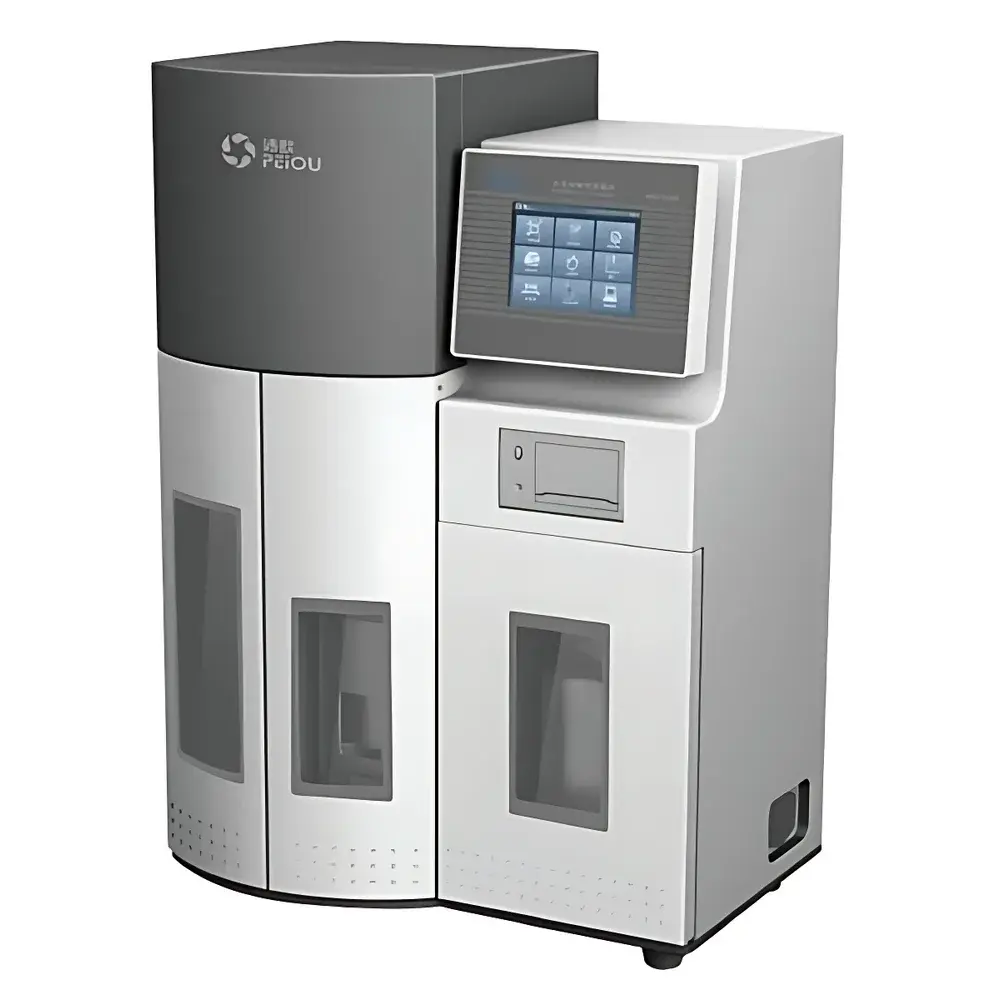
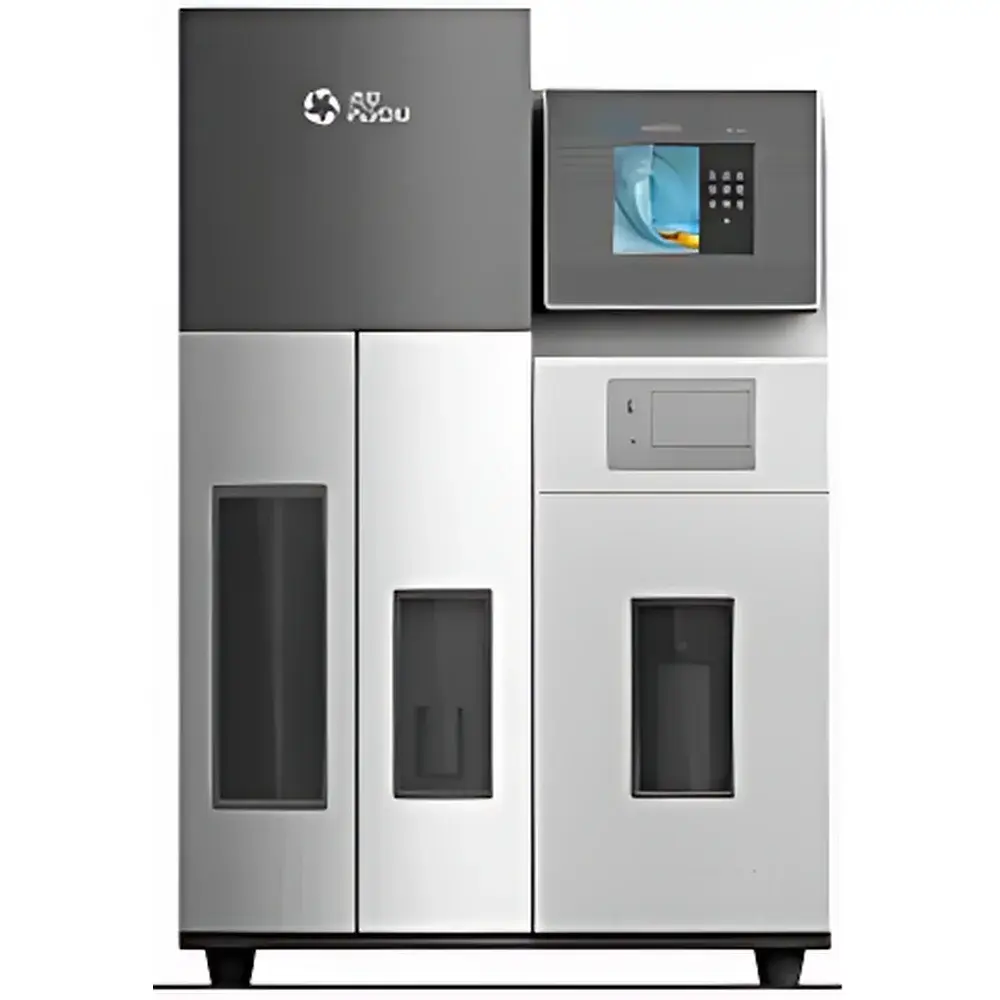
Peiou SKD-2000 Fully Automated Kjeldahl Nitrogen Analyzer
| Brand | Peiou |
|---|---|
| Origin | Shanghai, China |
| Model | SKD-2000 |
| Principle | Kjeldahl digestion and distillation followed by colorimetric titration |
| Nitrogen Range | 0.1–240 mg N |
| Repeatability | RSD ≤ 0.5% |
| Detection Limit | 0.1–240 mg N |
| Recovery Rate | >99.5% |
| Distillation Time | 3–8 min/sample |
| Distillation Rate | 15–30 mL/min (adjustable) |
| Titration Resolution | 0.002 µL/step |
| Minimum Titration Volume | 0.8 µL/step |
| Sample Capacity | ≤6 g solid or ≤16 mL liquid |
| Alkali Addition | 1–10 segments, 0–15 s interval |
| Delay Time | 0–1800 s |
| Dimensions | 500 × 350 × 720 mm |
Overview
The Peiou SKD-2000 Fully Automated Kjeldahl Nitrogen Analyzer is an engineered solution for precise, traceable, and high-throughput total nitrogen and crude protein quantification in compliance with internationally recognized wet-chemistry standards—including AOAC 984.13, ISO 8968-1, ISO 1871, USP , and ASTM D1122. Based on the classical Kjeldahl method, the instrument integrates controlled acid digestion (performed off-instrument), automated alkaline distillation under inert steam atmosphere, and photometric endpoint detection via RGB color-sensor-based titration. It delivers quantitative ammonia liberation from organic nitrogen compounds—followed by immediate neutralization with standardized boric acid and titration with sulfuric or hydrochloric acid—to yield nitrogen content with metrological traceability to primary reference materials. Designed for routine QC/QA laboratories in food, feed, agricultural, pharmaceutical, and environmental sectors, the SKD-2000 eliminates operator-dependent variability while maintaining full adherence to GLP and GMP documentation requirements.
Key Features
- Intelligent dual-level steam generator with continuous vapor output and auto-refill—ensuring uninterrupted distillation without dry-burn risk.
- RGB tri-color photometric titration system with real-time spectral curve monitoring (red, green, blue channels), enabling dynamic endpoint recognition and visual process validation.
- High-resolution syringe pump titration (0.002 µL/step resolution; minimum dispense volume: 0.8 µL), calibrated against certified volumetric standards and compliant with ISO/IEC 17025 volumetric accuracy criteria.
- Multi-stage alkali addition (1–10 pulses, programmable inter-pulse delay 0–15 s) to suppress exothermic runaway during neutralization—critical for nitrate-rich or thermally labile samples.
- Comprehensive hardware safety architecture: real-time door position sensing, coolant flow/pressure monitoring, reagent level detection, distillation cup temperature feedback control, and condensate flow interruption protection.
- Corrosion-resistant fluidic path constructed from proprietary chemically inert polymer tubing (guaranteed 3-year service life), coupled with ABS engineering-grade chassis for electrical insulation and long-term mechanical stability.
- Simultaneous distillation and titration—ammonia is captured and titrated in real time, minimizing volatilization loss and reducing cycle time by up to 40% versus sequential systems.
- Full audit trail support: timestamped parameter logs, raw sensor outputs, reagent consumption records, and user action history—all exportable in CSV/Excel format for 21 CFR Part 11-compliant review.
Sample Compatibility & Compliance
The SKD-2000 accommodates a broad matrix range: cereal grains, dairy powders, meat products, plant-based proteins, animal feed, soil extracts, fertilizers, pharmaceutical excipients, and wastewater sludge. Solid samples up to 6 g and liquids up to 16 mL are processed within standardized 100–500 mL digestion tubes (not included). All operational parameters—including digestion-derived sample transfer, distillation ramp profiles, alkali stoichiometry, and titrant concentration—are configurable to meet matrix-specific validation protocols per ISO 5725 (accuracy, precision, trueness) and AOAC Performance Tested Methods (PTM) guidelines. The system supports method customization for ammonium nitrate interference correction (via programmable delay up to 1800 s) and meets EU Regulation (EC) No 152/2009 Annex III requirements for feed analysis.
Software & Data Management
The embedded Linux-based controller features a 7-inch capacitive color touchscreen with intuitive Chinese/English bilingual GUI (configurable at startup). Method templates are stored locally with version-controlled naming (e.g., “Milk_Protein_v2.1”). All analytical data—including raw absorbance curves, titration volume vs. time plots, calculated %N, %crude protein (×6.38 or user-defined factor), and QC flag status—are automatically timestamped and saved to internal flash memory (≥10,000 result capacity). Optional RS232/USB/WiFi modules enable direct integration with LIMS, ERP, or ELN platforms. Optional balance interface (Sartorius, Mettler Toledo) enables automatic sample weight import with digital signature logging. Data exports include PDF reports (with lab header, analyst ID, instrument ID, calibration certificate links) and raw CSV files compatible with JMP, Minitab, or Python pandas workflows.
Applications
- Regulatory protein labeling verification in dairy, soy, and cereal products per FDA 21 CFR 101.9 and EU Regulation (EU) No 1169/2011.
- Crude protein certification in compound feed formulations under FAMI-QS and GMP+ standards.
- Nitrogen balance studies in agronomic soil testing (ISO 11261) and fertilizer efficacy trials (ISO 20003).
- Excipient nitrogen screening in pharmaceutical development per ICH Q5C and USP .
- Wastewater treatment plant effluent monitoring per ISO 14253-1 and EPA Method 351.2.
- Method transfer and verification support for ISO/IEC 17025-accredited laboratories seeking scope expansion in nitrogenous analyte testing.
FAQ
Does the SKD-2000 require external digestion equipment?
Yes—the SKD-2000 performs only distillation and titration. Sample digestion must be completed separately using a certified block digester or microwave system meeting ISO 20079 requirements.
Can the instrument be validated for 21 CFR Part 11 compliance?
Yes—when equipped with optional user authentication module (PIN + biometric fingerprint reader) and electronic signature-enabled software package, it supports audit trail generation, role-based access control, and immutable record retention per Part 11 Subpart B.
What maintenance intervals are recommended for routine operation?
Daily: rinse all fluid paths with deionized water; weekly: inspect and clean condenser coil and titration cell; quarterly: recalibrate color sensor using NIST-traceable cyanuric acid standard; annually: full pump calibration and reagent line replacement.
Is method development supported for non-standard matrices like algae or insect meal?
Yes—the open-method architecture allows custom distillation power ramps, alkali pulse timing, and endpoint sensitivity thresholds. Validation templates for novel matrices are available upon request from Peiou Application Support.
How is data integrity ensured during power interruption?
The system employs non-volatile FRAM memory for active method state and result buffers; all ongoing analyses resume from last confirmed step after power restoration, with no data loss or manual intervention required.