
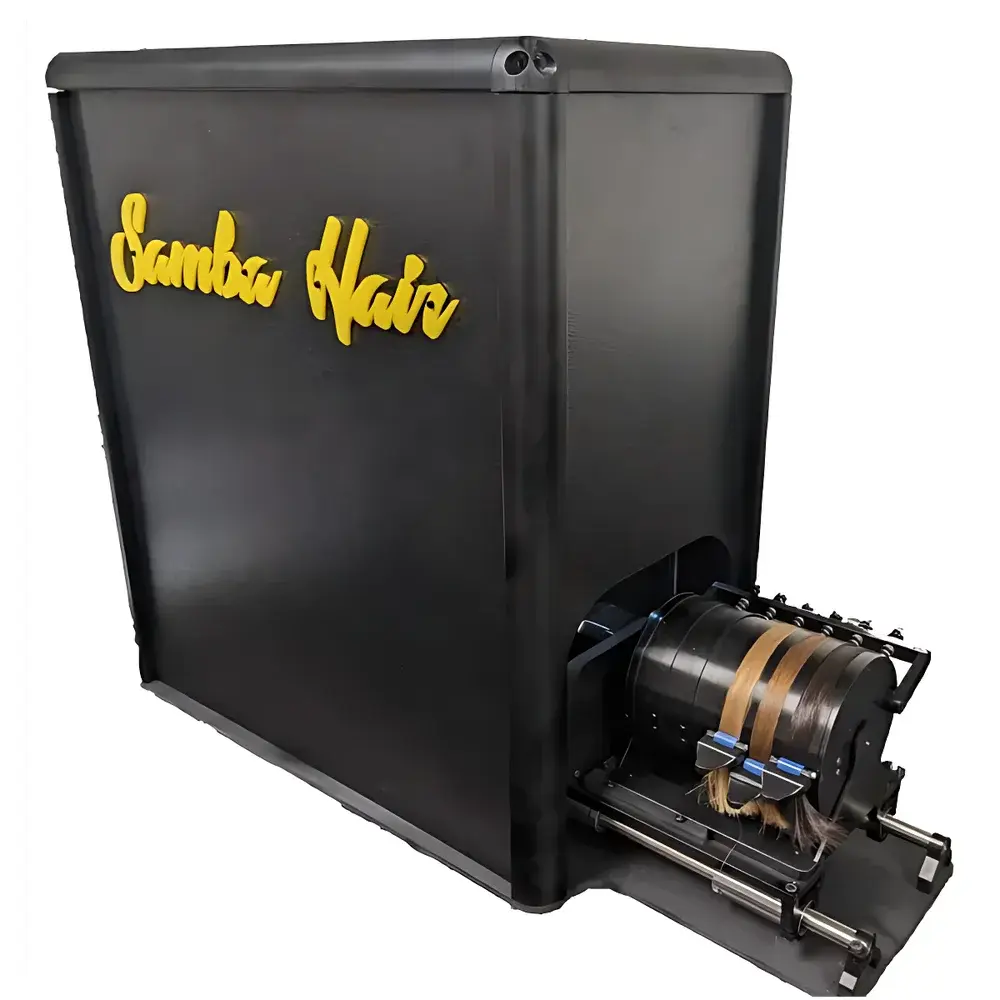
SAMBA HAIR Hair Gloss Meter by Dia-stron
| Brand | Dia-stron |
|---|---|
| Origin | United Kingdom |
| Manufacturer Type | Authorized Distributor |
| Product Origin | Imported |
| Model | SAMBA HAIR |
| Pricing | Available Upon Request |
Overview
The SAMBA HAIR Hair Gloss Meter, engineered by Dia-stron (UK), is a dedicated optical instrumentation system designed for objective, quantitative assessment of hair surface reflectance and gloss performance. Unlike conventional glossmeters intended for flat, non-porous surfaces (e.g., painted panels or plastics), the SAMBA HAIR employs polarized light imaging to resolve specular vs. diffuse reflectance components from three-dimensional, heterogeneous hair tresses under controlled illumination and viewing geometry. Its measurement principle is grounded in bidirectional reflectance distribution function (BRDF) analysis adapted for fibrous biological substrates—enabling discrimination between surface-oriented gloss (associated with cuticle integrity and lipid layer continuity) and subsurface scattering (linked to cortical porosity and damage). The system operates in vitro on mounted hair bundles under standardized environmental conditions (23 °C ± 1 °C, 50% RH ± 5%), ensuring repeatability compliant with internal method validation protocols used in cosmetic R&D laboratories.
Key Features
- Polarized light imaging module with dual-channel detection: separates s-polarized (specular-dominant) and p-polarized (mixed reflectance) signals to isolate surface gloss contribution.
- Integrated sample chamber with hermetic sealing: maintains stable humidity and minimizes ambient light interference during acquisition.
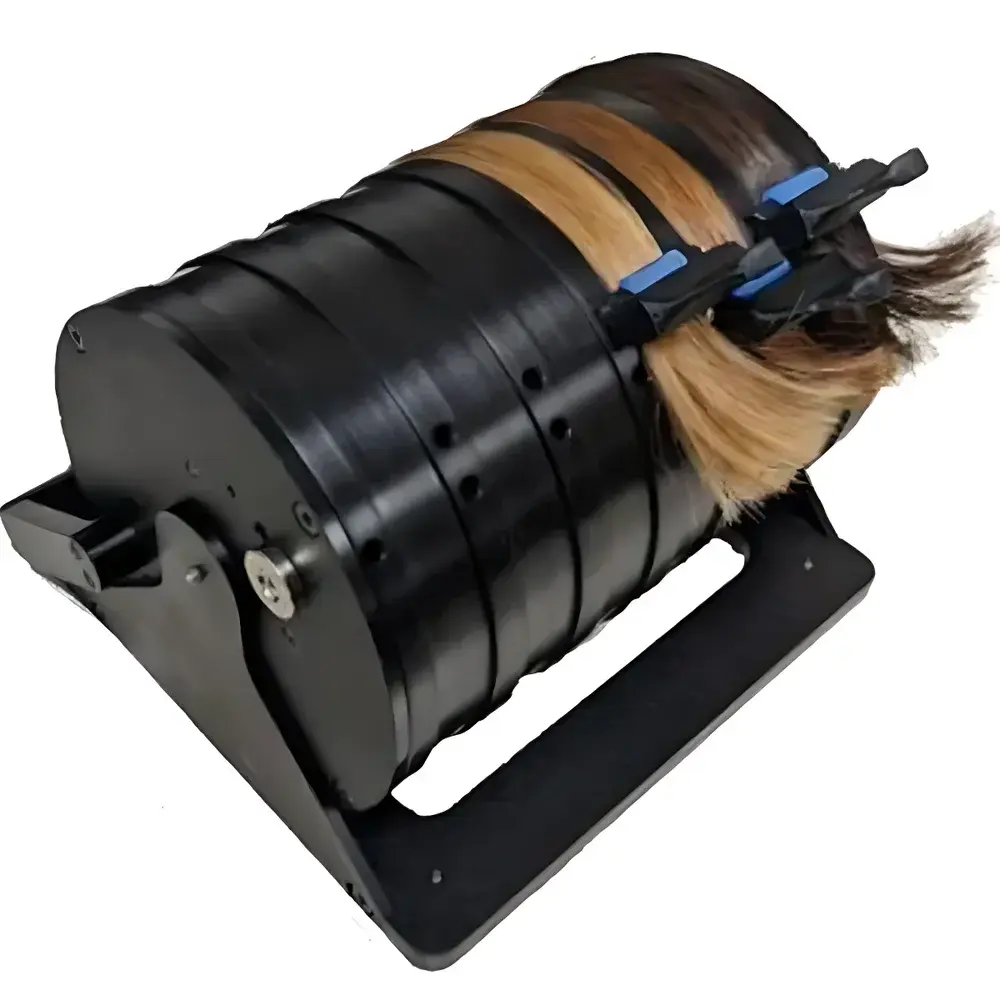
- Cylindrical combing jig with precision linear translation: positions hair tresses reproducibly at fixed incident angle (20°) and collection angle (20°), conforming to modified ASTM E430-03 guidelines for structured biological surfaces.
- Calibration traceable to NPL (National Physical Laboratory, UK)-certified reference standards for reflectance and polarization purity.
- Robust aluminum chassis with vibration-damped optical bench: ensures mechanical stability during long-duration sequential measurements across multiple samples.
- USB 3.0 interface with real-time data streaming and hardware-triggered acquisition for synchronization with auxiliary instruments (e.g., tensile testers or environmental chambers).
Sample Compatibility & Compliance
The SAMBA HAIR accommodates human and synthetic hair tresses ranging from 0.5 g to 2.0 g mass, with lengths between 10 cm and 25 cm. Samples are mounted on the proprietary cylindrical梳理 jig using standardized tension (0.5 N ± 0.05 N) and combing cycles (3 passes with Dia-stron M-100 comb). The system supports comparative testing across ethnic hair types (Caucasian, Asian, Afro-textured), chemically treated (bleached, permed, relaxed), and heat-damaged cohorts. Data outputs comply with internal QA documentation requirements for GLP-aligned cosmetic efficacy studies. While not certified to ISO/IEC 17025, the instrument’s measurement uncertainty budget (±3.2% k=2 for gloss units relative to reference tress) has been validated per ISO/IEC Guide 98-3 (GUM) and referenced in peer-reviewed publications on hair surface metrology.
Software & Data Management
Control and analysis are performed via Dia-stron’s SAMBA Suite v4.2 software (Windows 10/11, 64-bit), which provides automated acquisition sequencing, real-time image preview, and batch processing for up to 96 samples per session. Raw polarized intensity maps are exported in TIFF format with embedded EXIF metadata (exposure time, gain, polarization state, sample ID). Quantitative outputs include Gloss Index (GI), Specular Ratio (SR = s-pol / total intensity), and Diffuse Scatter Coefficient (DSC), all stored in CSV and SQL-compatible database formats. Audit trails record operator login, calibration timestamp, environmental sensor logs (temperature/humidity), and parameter modifications—supporting FDA 21 CFR Part 11 compliance when deployed with validated electronic signature modules and networked server storage.
Applications
- Formulation development: evaluation of silicone deposition efficiency, cationic polymer film uniformity, and oil-phase distribution on hair surfaces.
- Damage quantification: correlation of gloss loss with FTIR amide I band shifts, SEM cuticle scoring, and wet/dry combing force profiles.
- Claim substantiation: generation of objective, instrument-based evidence for “instant shine,” “long-lasting gloss,” or “anti-frizz” claims per ISO 19728:2020 and CTFA/PCPC guidance.
- Stability testing: monitoring gloss retention after accelerated aging (40 °C/75% RH, 4 weeks) or UV exposure (ISO 24443).
- Competitive benchmarking: cross-product comparison against market leaders using harmonized test protocols defined in Cosmetics Europe Technical Document No. 12.
FAQ
Is the SAMBA HAIR suitable for single-hair fiber analysis?
No. It is optimized for bundled tress geometry (minimum 50–100 fibers) to ensure statistically representative surface area sampling and signal-to-noise ratio.
Does it require annual factory recalibration?
Dia-stron recommends biannual verification using supplied NIST-traceable reference tresses; full recalibration is required only after physical impact, optical alignment disturbance, or firmware upgrade.
Can raw image data be exported for third-party spectral analysis?
Yes—full-resolution 16-bit polarized intensity frames are exportable without compression or proprietary codec dependency.
Is the system compatible with LIMS integration?
Via ODBC-compliant database output and configurable REST API endpoints for sample metadata ingestion and result push.
What environmental controls are built into the chamber?
Integrated PT100 sensors monitor temperature and relative humidity continuously; chamber purge ports support external dry-air or nitrogen purging for low-RH testing.






