
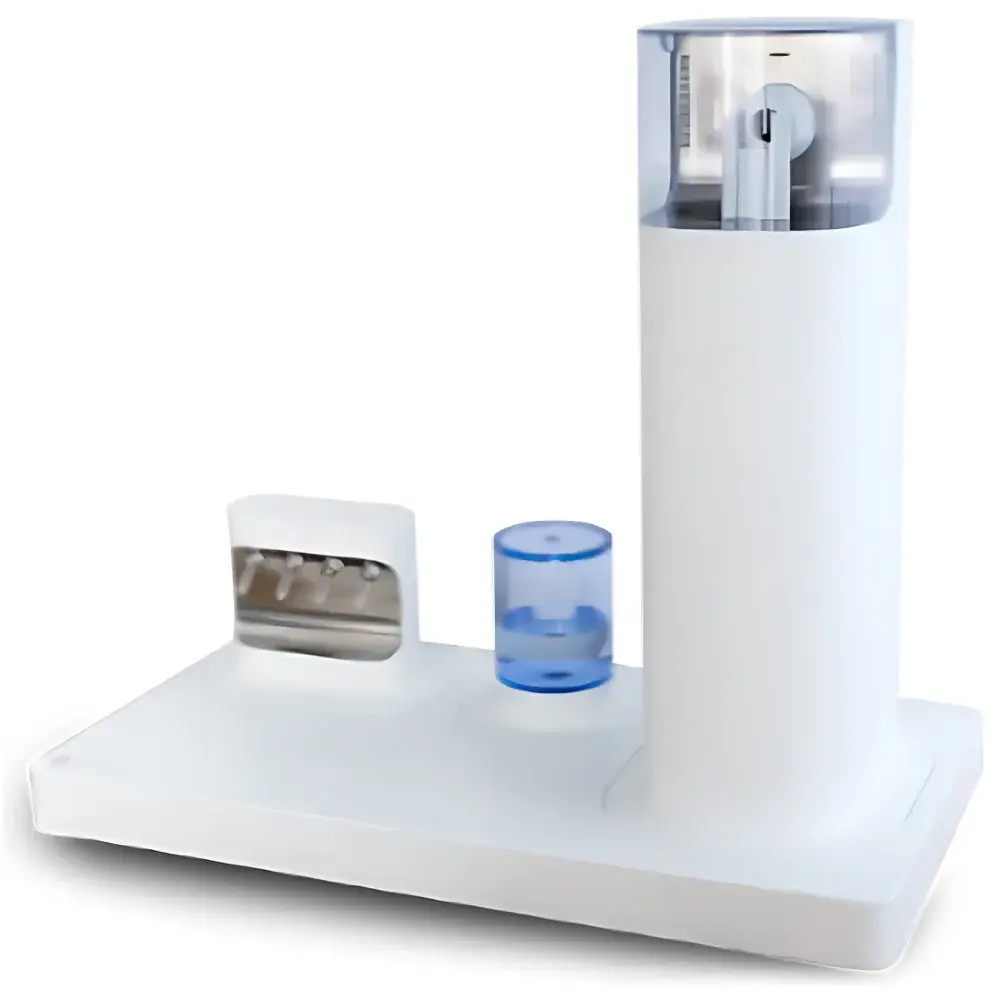
μfactory SMART-PORE In Vitro Smart Pore Simulator for Antiperspirant Efficacy Testing
| Brand | μfactory |
|---|---|
| Origin | France |
| Manufacturer Type | Authorized Distributor |
| Origin Category | Imported |
| Model | SMART-PORE |
| Pricing | Available Upon Request |
Overview
The μfactory SMART-PORE In Vitro Smart Pore Simulator is a purpose-built microfluidic platform engineered to quantitatively assess the occlusive efficacy of antiperspirant actives under physiologically relevant conditions. Unlike conventional gravimetric or visual pore-blockage assays, the SMART-PORE system replicates key biophysical elements of human eccrine sweat duct physiology—including dynamic fluid transport, epidermal barrier mimicry, and real-time obstruction kinetics—using a synthetic polymer-based artificial skin membrane integrated with high-resolution optical monitoring and capacitive flow sensing. The system operates on the principle of controlled transmembrane sweat analog perfusion, where changes in volumetric flux across micropatterned pore channels are measured before and after topical application of test formulations. This enables direct, label-free quantification of pore occlusion rate, duration, and reversibility—parameters critical for substantiating “24-hour protection” claims in compliance with ISO 16128, OECD TG 439 (for non-animal testing), and EU Cosmetics Regulation (EC) No 1223/2009 Annex I requirements.
Key Features
- Microfluidic pore architecture with tunable channel diameter (50–120 µm) and depth (150–300 µm), mimicking anatomical variability across facial, axillary, and palmar regions
- Optically transparent synthetic epidermis composed of crosslinked polyacrylamide hydrogel, engineered for permeability coefficient (Kp) matching human stratum corneum (1.2–2.8 × 10⁻⁶ cm/s)
- Real-time capacitive flow sensor array with sub-nanoliter resolution (±0.8 nL/min), enabling continuous monitoring of sweat analog displacement over time
- Integrated LED-based optical imaging module (470 nm excitation, 525 nm emission) for simultaneous visualization of pore occlusion morphology and crystalline plug formation
- Automated dosing station compatible with aerosol, roll-on, cream, and gel formulations; supports standardized application volume (1.5 ± 0.1 µL per pore) and contact time protocols
- Temperature- and humidity-controlled test chamber (32 ± 0.3 °C, 60 ± 3% RH) aligned with ISO 29621:2020 guidelines for cosmetic product microbiological risk assessment environments
Sample Compatibility & Compliance
The SMART-PORE platform accepts aqueous, alcoholic, and emulsion-based antiperspirant formulations without pre-dilution or solvent extraction. It accommodates active ingredients including aluminum zirconium tetrachlorohydrex gly, aluminum chloride, and emerging non-metallic alternatives (e.g., quaternary ammonium polymers, bio-derived chelators). All test protocols are designed to support adherence to OECD Test Guideline 439 (Reconstructed Human Epidermis assay) for irritation screening, and data outputs meet audit requirements for GLP-compliant dossier submissions to EFSA, Health Canada, and ASEAN Cosmetic Directive Annexes. The system generates timestamped, user-authenticated raw data files (.csv, .tiff, .json) compliant with FDA 21 CFR Part 11 electronic record and signature standards.
Software & Data Management
SMART-PORE Control Suite v3.2 provides full instrument orchestration, including automated calibration routines, adaptive threshold detection for occlusion onset, and kinetic curve fitting using first-order exponential decay models (R² > 0.998). Data export supports batch processing for statistical comparison across formulation variants (ANOVA, Tukey HSD, p < 0.05). Audit trails log all operator actions, parameter modifications, and calibration events with SHA-256 hashing. Raw sensor streams and image sequences are archived in vendor-neutral formats compatible with LIMS integration (via ASTM E1467-compliant API).
Applications
- Accelerated screening of novel antiperspirant actives and delivery systems (e.g., lipid nanoparticles, iontophoretic carriers)
- Comparative dose–response analysis for aluminum salt optimization and reduction strategies
- Stability assessment of occlusion integrity under mechanical stress (simulated arm flexion via programmable membrane strain cycles)
- Regulatory dossier generation for marketing claim substantiation (“reduces sweat by ≥75% for 24 h”) per ISO 16128 Annex C
- Compatibility testing with co-applied skincare ingredients (e.g., niacinamide, probiotics) to evaluate interference with pore sealing kinetics
FAQ
How does SMART-PORE differentiate between temporary surface film formation and true pore occlusion?
It measures volumetric flux reduction through defined microchannels—not surface reflectance—ensuring only intraluminal blockage contributes to the efficacy signal.
Can SMART-PORE data replace in vivo clinical trials for regulatory submission?
No. It serves as a Tier 1 screening tool and mechanistic support; final claim substantiation requires controlled human studies per ISO 18562-2 and CTFA protocols.
Is the synthetic skin membrane reusable?
Each membrane is single-use to prevent cross-contamination and ensure consistent hydraulic resistance; lot-specific calibration certificates are supplied with every kit.
What validation documentation is provided with the system?
Includes IQ/OQ/PQ protocols, traceable NIST-calibrated flow sensor certificates, and inter-laboratory reproducibility reports (CV ≤ 4.2% across 5 sites).
Related Products






