
Thermo Fisher Scientific 5800 VOCs Continuous Emission Monitoring System (CEMS)
| Brand | Thermo Fisher Scientific |
|---|---|
| Origin | USA |
| Manufacturer Type | Original Equipment Manufacturer (OEM) |
| Origin Category | Imported |
| Model | 5800 VOCs CEMS |
| Detection Principle | Gas Chromatography–Flame Ionization Detection (GC-FID) |
| Instrument Type | Online Continuous Analyzer |
| Typical Configuration | Multi-component VOC Analyzer |
| Target Compounds | Up to 90 Volatile Organic Compounds |
| Resolution | 0.05 ppm |
| Accuracy | ±1% of full scale or ±0.1 ppm (whichever is greater) |
| Response Time | 1 minute (for methane/non-methane hydrocarbons) |
Overview
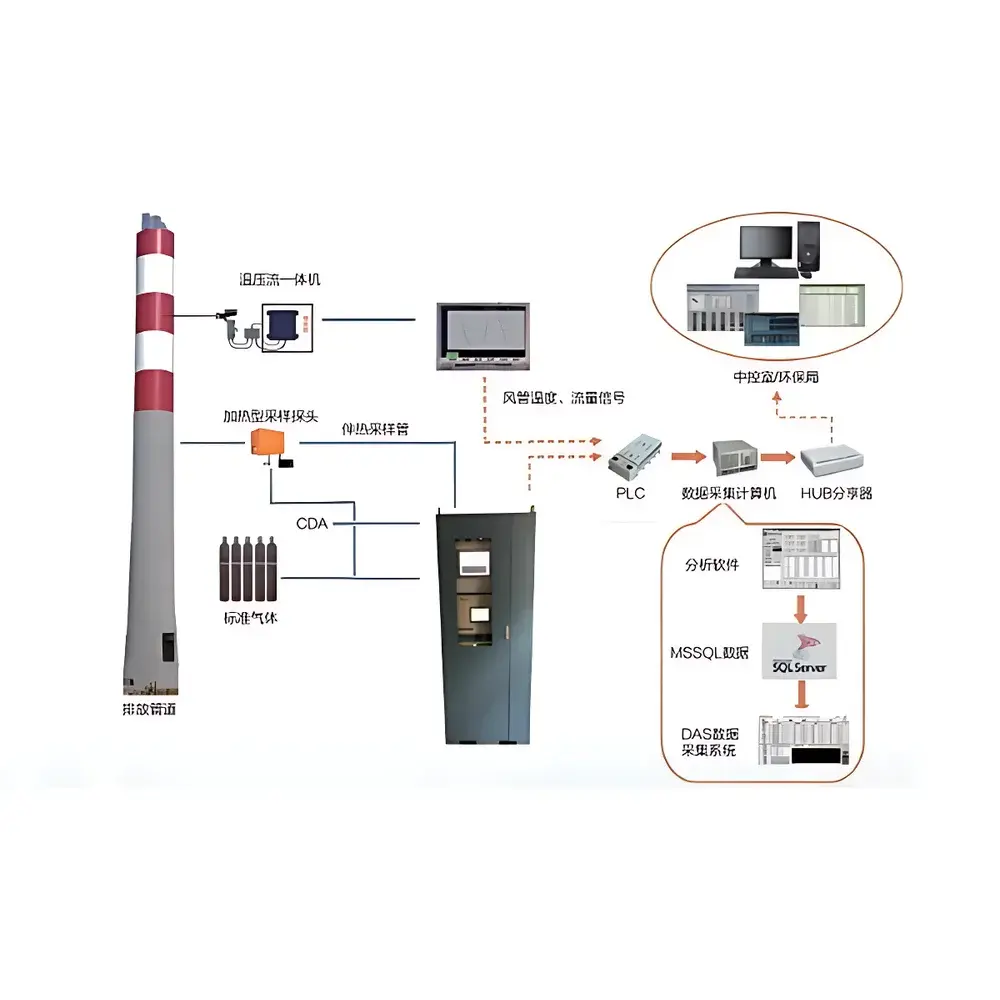
The Thermo Fisher Scientific 5800 VOCs Continuous Emission Monitoring System (CEMS) is an industrial-grade, high-reliability online analyzer engineered for regulatory-compliant, real-time quantification of volatile organic compounds (VOCs) from fixed emission sources. Built upon proven gas chromatography–flame ionization detection (GC-FID) methodology, the system delivers trace-level sensitivity, compound-specific resolution, and long-term measurement stability under demanding stack conditions. Unlike extractive NDIR or PID-based solutions, the 5800 employs dual-column GC separation coupled with a robust FID detector to differentiate and quantify individual hydrocarbons—including methane (CH₄), non-methane hydrocarbons (NMHC), benzene, toluene, xylenes (o-, m-, p-), ethylbenzene, styrene, cumene, and up to 90 target compounds aligned with U.S. EPA TO-14/TO-15, EU EN 13649-2, and China HJ 1012–2018 reference methods. Its design conforms to ISO 14064-3 and ASTM D6348 for greenhouse gas and VOC emissions reporting, supporting compliance with national and regional CEMS performance specifications (e.g., U.S. EPA Performance Specification 8, China HJ 75–2017 and HJ 76–2017).
Key Features
- High-temperature hot-wet sampling architecture: Integrated heated probe (up to 200 °C), stainless-steel heated sample line (80–150 °C), and 220 °C inlet tolerance ensure vapor-phase integrity for VOCs with boiling points between 50–260 °C—minimizing adsorption, condensation, and thermal degradation.
- Multi-range, field-configurable quantification: Selectable full-scale ranges from 0.05–50 ppm to 0–50% CH₄ equivalent, enabling precise measurement across high-concentration inlet streams (e.g., RTO/RCO feed) and low-concentration outlet effluents (e.g., post-combustion).
- Automated, end-to-end calibration: Full-system calibration (probe to detector) using certified standard gases; supports zero/span checks per U.S. EPA Method 205 and China HJ 75–2017 Section 7.3. Calibration frequency programmable from monthly to annual intervals.
- Dual-path GC-FID analysis: Simultaneous THC/NMHC determination via molecular sieve column and speciated VOC profiling via custom capillary column sets—enabling tailored method development for site-specific compound lists (e.g., EPA Photochemical Assessment Monitoring Stations [PAMS] 56-species list).
- Intelligent particulate management: Heated 5 µm sintered metal filter with automated back-purge (user-defined interval); probe rated for dust loading ≤10 g/m³; corrosion-resistant wet-gas handling for post-scrubber or wet electrostatic precipitator applications.
Sample Compatibility & Compliance
The 5800 CEMS accommodates complex flue gas matrices typical of chemical manufacturing, coating operations, pharmaceutical production, and municipal waste treatment. It maintains analytical integrity in presence of variable moisture (up to saturated), moderate SO₂/NOₓ, and particulate-laden streams—provided sample conditioning avoids chilling below dew point. The system meets key regulatory requirements for CEMS validation and data integrity: U.S. EPA PS-8 and Appendix B QA/QC protocols; China HJ 75–2017 (technical specification) and HJ 76–2017 (performance testing); EU Directive 2010/75/EU (IED) Annex VIII monitoring criteria; and ISO 14064-3 verification guidance. All firmware and data logging modules support audit-trail functionality compliant with FDA 21 CFR Part 11 and GLP/GMP record-keeping standards.
Software & Data Management
Embedded Thermo Fisher CEMS Manager software provides local HMI control, method configuration, alarm logging, and diagnostic trending. Raw chromatograms, peak integration tables, and calibration history are stored internally (≥12 months at 1-min resolution) and exportable via Modbus TCP. Optional integration with third-party SCADA or EMS platforms supported through RS-232/RS-485 serial interfaces or configurable 4–20 mA analog outputs (up to 12 channels). Data output includes CH₄, NMHC, total VOCs, individual species concentrations (e.g., benzene, toluene), and auxiliary parameters (stack flow, O₂, temperature, pressure) when interfaced with optional flue gas parameter modules. All measurements timestamped with NTP-synchronized UTC time; data files conform to ASTM E2500-17 metadata schema.
Applications
- Regulatory continuous emission monitoring at stationary sources subject to VOC mass emission limits (e.g., U.S. EPA NESHAP Subpart HHHHH, China GB 31571–2015, EU IED BAT conclusions for surface coating).
- Performance verification of abatement technologies—thermal oxidizers (RTO/TO), catalytic oxidizers (CO), carbon adsorption systems, and biofilters—by quantifying inlet/outlet concentration differentials and destruction/removal efficiency (DRE).
- Process optimization and fault detection: Real-time VOC speciation enables identification of process upsets (e.g., solvent carryover, catalyst deactivation, seal leakage) and supports closed-loop control of burner air/fuel ratios or adsorbent regeneration cycles.
- Environmental impact assessment and fugitive emission quantification when deployed with dynamic dilution sampling or flux chamber coupling (per ASTM D6829).
- Research-grade source characterization for atmospheric chemistry modeling, particularly for high-reactivity VOCs (HRVOCs) contributing to ozone formation potential (OFP) and secondary organic aerosol (SOA) yield estimation.
FAQ
What detection principle does the 5800 employ, and why is GC-FID preferred for regulatory VOC monitoring?
The 5800 utilizes gas chromatography coupled with flame ionization detection (GC-FID), which offers superior selectivity, linear dynamic range (>10⁶), and compound-specific quantification—critical for meeting U.S. EPA PS-8 and ISO 13864 accuracy requirements. Unlike broad-spectrum sensors, GC-FID resolves co-eluting isomers (e.g., xylene isomers) and distinguishes methane from NMHC without interference.
Can the system operate reliably in high-moisture or high-dust exhaust streams?
Yes—the hot-wet design eliminates condensation-related errors, and the heated probe/filter/back-purge architecture ensures stable operation in streams with up to 10 g/m³ particulate loading and saturated humidity. No refrigerated dryer or permeation dryer is used, preserving water-soluble VOCs (e.g., acetaldehyde, methanol) that would be lost in cold-trap systems.
How is calibration traceability maintained across the entire sampling train?
Calibration gas is introduced at the probe tip via a dedicated calibration port, validating the entire path—including heated line, pre-filter, GC columns, and FID. This “full-system” approach satisfies U.S. EPA Method 205 and China HJ 75–2017 Section 7.3.1 for CEMS accuracy verification.
What auxiliary measurements can be integrated with the 5800 platform?
Optional flue gas parameter modules provide simultaneous measurement of stack flow rate (differential pressure or thermal dispersion), temperature (Pt100), static/dynamic pressure, and O₂ concentration (zirconia or paramagnetic)—all synchronized and reported alongside VOC data for mass emission rate calculations per EPA Method 19 or ISO 11185.
Is remote diagnostics and firmware update capability supported?
Yes—via embedded Ethernet interface and secure HTTPS web portal. Remote access enables real-time chromatogram review, method reconfiguration, alarm acknowledgment, and over-the-air firmware updates validated per IEC 62443-4-2 cybersecurity guidelines for industrial control systems.
Related Products







