
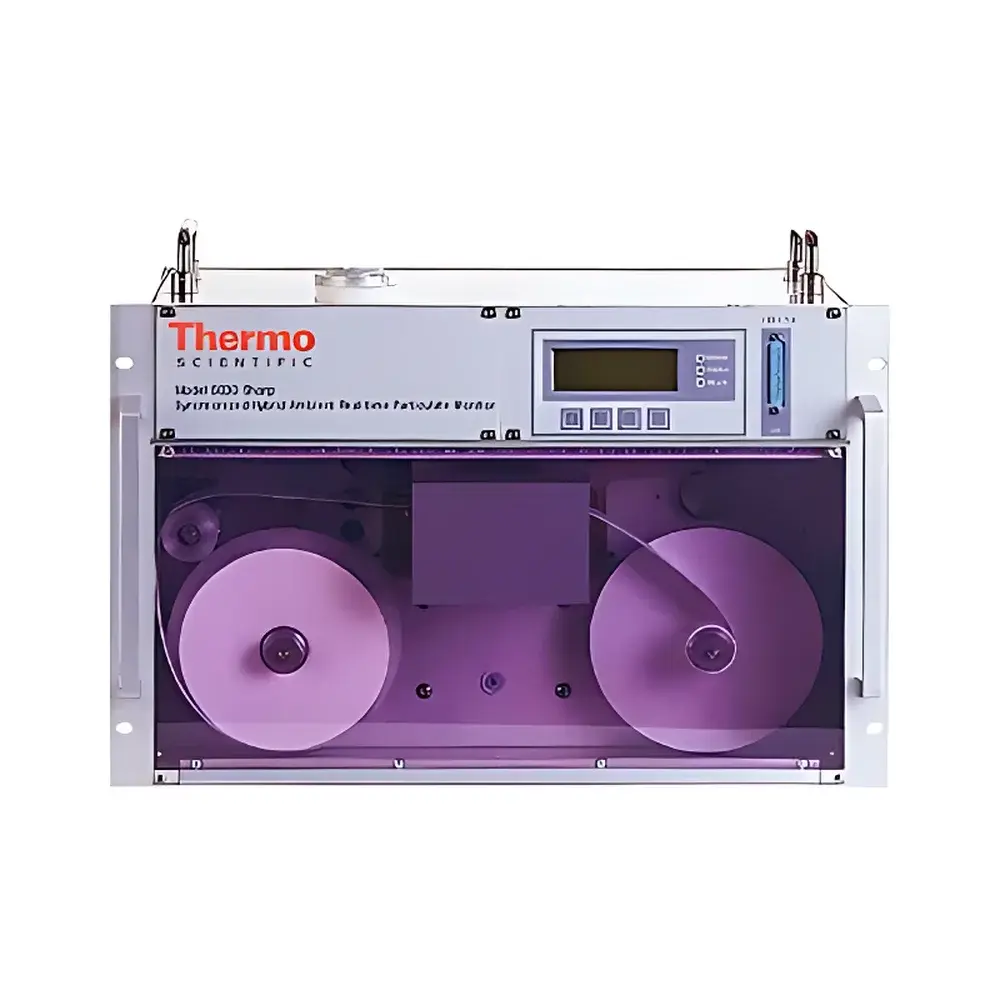
Thermo Scientific 5030 SHARP Particulate Matter Monitor
| Brand | Thermo Fisher |
|---|---|
| Origin | USA |
| Manufacturer | Thermo Fisher Scientific |
| Type | Imported Instrument |
| Model | Thermo Scientific 5030 |
| Measurement Principle | Simultaneous Optical Scattering (880 nm IR LED) and Beta Attenuation (¹⁴C source, <100 µCi) |
| Measured Parameters | PM₁₀ and PM₂.₅ |
| Detection Limit | 0.5 µg/m³ (1-hour resolution) |
| Range | 0–1,000 µg/m³ and 0–10,000 µg/m³ (auto-ranging) |
| Flow Rate | 1 m³/h (16.7 L/min) |
| 24-hr Drift | ±0.002% full scale |
| Accuracy | ±2 µg/m³ for concentrations <80 µg/m³ |
| Light Source | Infrared LED (6 mW, 880 nm) |
| Beta Source | Carbon-14 (<100 µCi) |
Overview
The Thermo Scientific 5030 SHARP (Synchronized Hybrid Ambient Real-time Particulate) Monitor is a regulatory-grade, dual-method atmospheric particulate matter analyzer engineered for continuous, high-fidelity measurement of PM₂.₅ and PM₁₀ mass concentrations in ambient air. It uniquely integrates real-time optical scattering with beta-ray attenuation in a single, co-located sampling path—enabling simultaneous, cross-validated quantification without temporal offset or spatial mismatch. This hybrid architecture satisfies U.S. EPA Federal Reference Method (FRM) equivalency requirements for PM₂.₅ (40 CFR Part 53) and supports compliance with ISO 12103-1, EN 12341, and EU Directive 2008/50/EC. The instrument operates on the principle that light scattering intensity (at 880 nm) correlates with particle surface area and number concentration, while beta-ray attenuation provides direct, gravimetrically traceable mass determination via absorption of low-energy electrons through a deposited filter tape. By fusing these orthogonal physical measurements—each subject to distinct systematic biases—the 5030 achieves superior accuracy, long-term stability, and robustness against environmental interferences such as humidity and volatile aerosol loss.
Key Features
- True synchronous dual-method operation: Integrated optical scattering (IR LED, 880 nm) and beta attenuation (¹⁴C source, <100 µCi) within one sample stream and filter substrate.
- Continuous on-board mass calibration: Automatic, real-time correction using dynamic digital filtering algorithms that adjust for tape transport variability, source decay, and photodetector drift.
- Intelligent humidity management system: Thermoelectrically controlled Nafion® dryer preserves semi-volatile organic compounds (SVOCs) and ammonium nitrate while removing water vapor interference—critical for accurate PM₂.₅ mass assignment in humid climates.
- High time resolution: Capable of 1-minute raw data acquisition and 1-hour integrated reporting with detection limit of 0.5 µg/m³ (1-hr average).
- Auto-ranging capability: Seamlessly switches between 0–1,000 µg/m³ and 0–10,000 µg/m³ ranges to maintain precision across background, urban, and near-source environments.
- Regulatory validation: EPA-designated Equivalent Method for PM₂.₅ (EQPM-0510-192); meets performance specifications for FRM and FEM networks including AQS, CASTNET, and IMPROVE.
Sample Compatibility & Compliance
The 5030 is optimized for ambient air monitoring at fixed-site regulatory stations, mobile platforms, and research-grade field deployments. It accepts standard 47-mm quartz or Teflon-coated glass fiber filter tapes compliant with EPA Method IO-3.1 and ISO/IEC 17025-accredited calibration protocols. All internal diagnostics—including flow verification, beta source activity logging, optical alignment checks, and tape tension monitoring—are recorded with timestamped metadata to support GLP and GMP audit trails. Data output conforms to EPA Air Quality System (AQS) format and includes full traceability to NIST-traceable mass standards. The unit complies with electromagnetic compatibility (EMC) per IEC 61326-1 and safety standards IEC 61010-1, and carries CE marking for use in EEA member states.
Software & Data Management
Instrument control, data acquisition, and quality assurance are managed via Thermo Scientific™ EPAS™ (Environmental Parameter Acquisition Software), a Windows-based application supporting remote configuration, real-time visualization, and automated QA/QC flagging. Raw scatter and attenuation signals, along with environmental parameters (temperature, pressure, RH), are logged at 1-Hz resolution and archived in HDF5-compliant files. EPAS enables user-defined calibration curves, automatic zero/span validation scheduling, and generation of EPA-mandated daily summary reports (e.g., Form 32). Data export supports CSV, XML, and direct ingestion into EPA’s CEDEN and AirNow systems. Audit logs record all operator actions, parameter changes, and maintenance events with electronic signatures compliant with FDA 21 CFR Part 11 requirements.
Applications
- Ambient air quality monitoring networks (e.g., U.S. EPA AQS, European EEA AirBase)
- Source apportionment studies requiring high-temporal-resolution PM speciation input
- Health effects epidemiology campaigns requiring exposure assessment at neighborhood scale
- Industrial fence-line monitoring where rapid response to fugitive emissions is critical
- Calibration transfer and reference monitoring for lower-cost sensor networks
- Long-term trend analysis under evolving regulatory frameworks (e.g., WHO 2021 updated PM guidelines)
FAQ
Is the Thermo 5030 SHARP approved by the U.S. EPA for regulatory PM₂.₅ monitoring?
Yes—it is designated an EPA Equivalent Method (EQPM-0510-192) for PM₂.₅ and meets all performance criteria outlined in 40 CFR Part 53 for Federal Equivalent Methods.
How does the intelligent dehumidification system differ from conventional dryers?
Unlike chilled-mirror or permeation dryers, the 5030’s thermoelectric Nafion® system maintains sample temperature above dew point while selectively removing water vapor—minimizing volatilization losses of ammonium nitrate and organic aerosols.
What is the recommended maintenance interval for the beta source and optical components?
The ¹⁴C source has a half-life of 5,730 years; routine replacement is not required. Optical alignment and detector gain calibration are performed automatically during each tape advance cycle; manual verification is recommended annually per ISO/IEC 17025 QA procedures.
Can the 5030 operate unattended for extended periods?
Yes—designed for continuous 24/7 operation with 30-day tape capacity, onboard power failure recovery, and remote diagnostics via Ethernet or cellular modem.
Does the instrument support external meteorological sensor integration?
Yes—RS-232 and analog inputs accept signals from co-located temperature, pressure, relative humidity, wind speed/direction, and solar radiation sensors for comprehensive environmental context.
Related Products







