
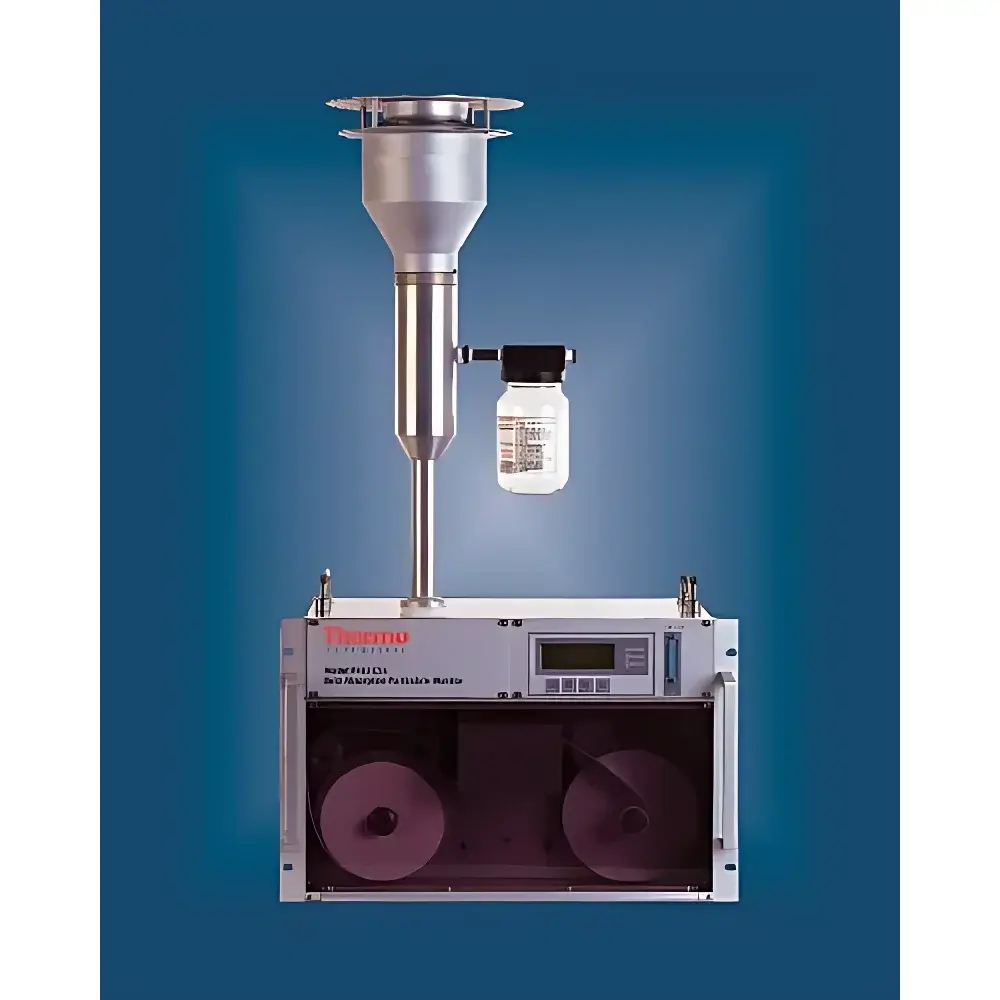
Thermo Scientific FH62C14 Series Beta-Ray Continuous Particulate Matter Monitor
| Brand | Thermo Fisher |
|---|---|
| Origin | USA |
| Manufacturer | Thermo Fisher Scientific |
| Product Type | Imported Instrument |
| Model | FH62C14 |
| Measurement Method | Beta-Ray Absorption |
| Measured Parameter | PM2.5 |
| Radioisotope Source | Carbon-14 (¹⁴C) |
| Activity | <3.7 MBq (<100 μCi) |
| Measurement Range | 0–5000 μg/m³ or 0–10000 μg/m³ |
| LOD (24-h avg) | <1 μg/m³ |
| LOD (1-h avg) | <4 μg/m³ |
| Accuracy | ±2 μg/m³ (24-h) |
| Resolution | ±1 μg/m³ (instantaneous) |
| Correlation Coefficient | R > 0.98 |
| Sampling Flow Rate | 1 m³/h (16.67 L/min), adjustable 0–20 L/min via built-in critical orifice |
| Operating Temperature | −30 °C to +60 °C |
| Data Averaging Intervals | 0.5, 1, 3, and 24 hours |
| Storage Capacity | >1 year of half-hourly averages |
| Communication Interfaces | Dual RS-232 serial ports |
| Analog Outputs | 4–20 mA or 0–10 V |
| Power Supply (Analyzer) | 100–240 VAC, 50/60 Hz, 15 W |
| Power Supply (Pump) | 220–240 VAC, 50/60 Hz, 100 W |
| Dimensions (Analyzer) | 483 mm (W) × 311 mm (H) × 330 mm (D) |
| Weight (Analyzer) | 22.5 kg |
| Dimensions (Pump) | 210 mm (W) × 222 mm (H) × 108 mm (D) |
| Weight (Pump) | 8.16 kg |
| Regulatory Certifications | U.S. EPA and California Air Resources Board (CARB) equivalency for PM₂.₅ and PM₁₀ |
Overview
The Thermo Scientific FH62C14 Series Beta-Ray Continuous Particulate Matter Monitor is a reference-grade ambient air monitoring instrument engineered for regulatory-compliant, long-term measurement of fine particulate mass concentration—specifically PM2.5. It operates on the well-established principle of beta-ray absorption (BAM), wherein the attenuation of beta particles emitted from a calibrated 14C radioisotope source is quantitatively correlated with the mass loading of airborne particles collected on a moving filter tape. Unlike traditional BAM instruments requiring physical transport of the filter between sampling and measurement positions, the FH62C14 performs continuous, simultaneous collection and measurement at a single location—eliminating mechanical transfer errors, reducing maintenance intervals, and improving temporal resolution and data continuity. The system incorporates real-time correction for naturally occurring radon progeny interference through integrated alpha/beta discrimination and background subtraction algorithms, significantly enhancing detection sensitivity and baseline stability in uncontrolled ambient environments.
Key Features
- Continuous, non-destructive beta-ray absorption measurement using a low-activity 14C source (<3.7 MBq), compliant with international radiation safety guidelines and exempt from most licensing requirements;
- Integrated radon interference compensation—dynamically measures and subtracts contributions from ambient 222Rn decay products, ensuring high fidelity at low concentrations (LOD <1 μg/m³ over 24 h);
- Dual RS-232 serial interfaces support remote configuration, firmware updates, and bidirectional data exchange with central data acquisition systems or SCADA networks;
- Onboard data logging retains over one year of half-hourly averaged PM2.5 values with full time-stamping and audit-ready metadata;
- Temperature- and vibration-insensitive optical-electronic architecture enables stable operation across extreme field conditions (−30 °C to +60 °C);
- User-selectable reporting modes: mass concentration referenced to either standard temperature and pressure (STP) or actual ambient conditions;
- Fully automated calibration sequence managed by embedded microprocessor—including zero checks, span verification, and flow validation using internal reference standards.
Sample Compatibility & Compliance
The FH62C14 is designed exclusively for ambient air sampling and meets the performance criteria defined in U.S. Environmental Protection Agency (EPA) Reference Method EQPM-0899-051 for PM2.5, as well as California Air Resources Board (CARB) certification requirements for both PM2.5 and PM10. It complies with ISO 12103-1 for aerosol generation traceability and adheres to ASTM D6216 for instrumental determination of atmospheric particulate matter. All firmware and data handling routines are structured to support GLP/GMP-aligned workflows, including secure user access control, electronic signature capability, and audit-trail logging per FDA 21 CFR Part 11 when deployed in regulated environmental compliance programs.
Software & Data Management
Data output conforms to standard environmental telemetry protocols including EPA’s CDX (Compliance Data Exchange) schema and MODBUS RTU over RS-232. The instrument supports configurable analog outputs (4–20 mA or 0–10 V) for integration into legacy PLC-based monitoring stations. Raw beta-count data, corrected mass values, flow rate logs, temperature/humidity readings (when paired with optional sensors), and diagnostic flags are timestamped with millisecond precision and stored in non-volatile memory. Export formats include CSV and XML; no proprietary software is required for data retrieval—standard terminal emulators or custom Python/Node.js scripts may be used for automation. Firmware updates are performed via serial interface with SHA-256 verified binary packages.
Applications
- Regulatory ambient air quality monitoring networks (e.g., NAAQS compliance, EU Air Quality Directive reporting);
- Urban and roadside monitoring stations requiring high temporal resolution and low-level detection capability;
- Long-term trend analysis and source apportionment studies where multi-year data consistency is critical;
- Industrial fence-line monitoring for fugitive dust emissions under Title V permitting;
- Research-grade field campaigns investigating secondary aerosol formation, wildfire plume dynamics, or regional transport patterns;
- Calibration and co-location studies with optical particle counters, TEOM, or gravimetric samplers.
FAQ
What regulatory certifications does the FH62C14 hold?
The FH62C14 is certified by the U.S. EPA and the California Air Resources Board (CARB) for PM2.5 and PM10 measurements under federal and state reference method equivalency protocols.
Does the instrument require manual filter changes?
No—the FH62C14 uses a continuously advancing filter tape with automatic positioning; typical tape life exceeds 30 days at standard flow and average ambient loading.
Can it measure PM10 or TSP in addition to PM2.5?
Yes—when configured with an appropriate size-selective inlet (e.g., WINS impactor or VSCC cyclone), the same beta-ray detection core supports PM10 and total suspended particulates (TSP) measurement.
How is radon interference mitigated without compromising response time?
The system employs pulse-shape discrimination and dual-channel counting logic to separate alpha events (from radon progeny) from beta events in real time—enabling sub-minute background correction without interrupting continuous sampling.
Is remote diagnostics supported?
Yes—via RS-232, users can retrieve real-time sensor status, error logs, calibration history, and raw count statistics; optional cellular or Ethernet gateways enable cloud-based health monitoring.
Related Products







