
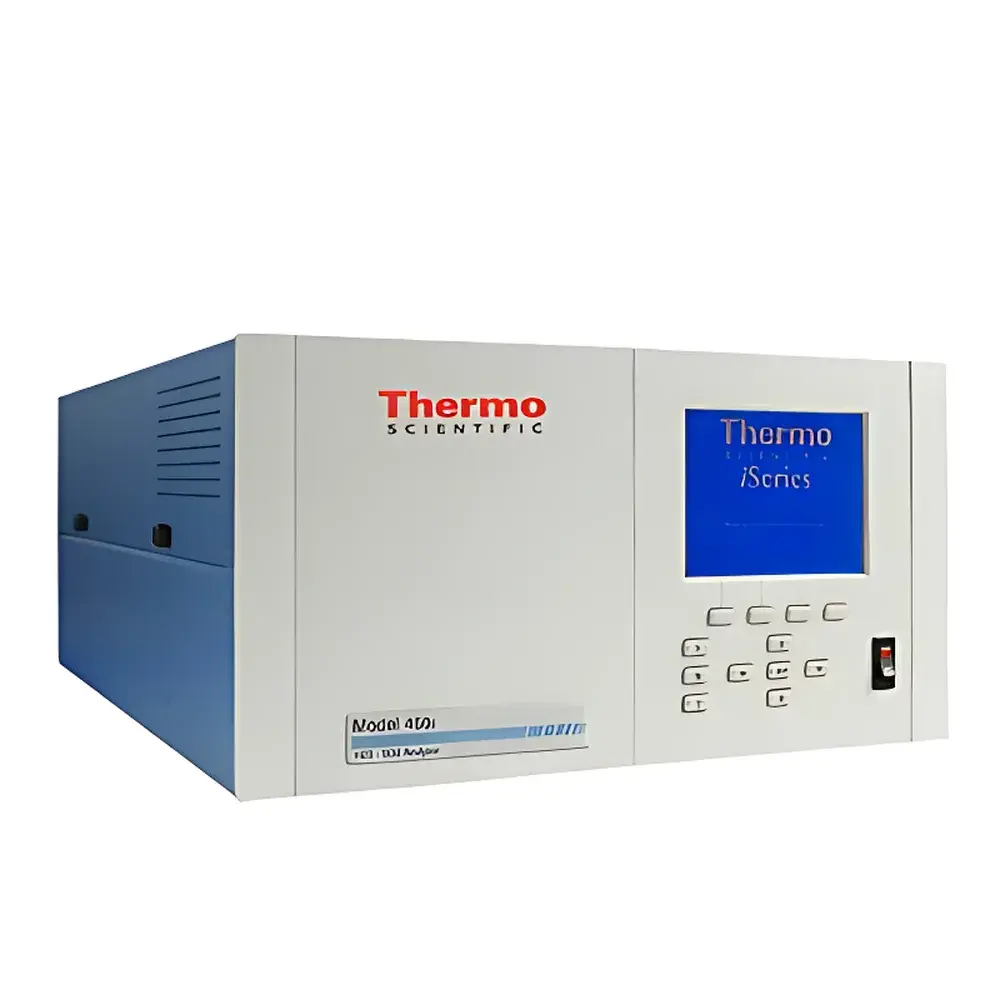
Thermo Fisher Scientific Model 450i H₂S Analyzer
| Brand | Thermo Fisher Scientific |
|---|---|
| Origin | USA |
| Manufacturer Type | Original Equipment Manufacturer (OEM) |
| Product Origin | Imported |
| Model | 450i |
| Instrument Type | Online Gas Analyzer |
| Target Analyte | Hydrogen Sulfide (H₂S) |
| Response Time (T₉₀) | 80 s |
| Measurement Accuracy | ±1% of reading or ±1 ppb (whichever is greater) |
| Measurement Ranges | 0–0.05, 0.1, 0.2, 0.5, 1, 2, 5, 10 ppm |
| Extended Ranges | 0–0.5, 1, 2, 5, 10, 20, 50, 100 ppm |
| Mass Concentration Ranges | 0–0.2, 0.5, 1, 2, 5, 10, 25 mg/m³ and 0–2, 5, 10, 20, 50, 100, 200, 250 mg/m³ |
| Zero Noise | 1.0 ppb RMS (60-s averaging) |
| Limit of Detection (LOD) | 2.0 ppb (60-s averaging) |
| Zero Drift (24 h) | <1 ppb |
| Span Drift (24 h) | ±1% of full scale |
Overview
The Thermo Fisher Scientific Model 450i H₂S Analyzer is a high-performance, continuous online gas analyzer engineered for precise, stable, and regulatory-compliant measurement of hydrogen sulfide (H₂S) in ambient air, stack emissions, and industrial process streams. It employs pulsed ultraviolet (UV) photometry—a selective, interference-resistant optical detection principle—based on the characteristic absorption of H₂S at 210 nm. Unlike electrochemical or metal-oxide semiconductor sensors, this method eliminates cross-sensitivity to common interferents such as SO₂, NO₂, hydrocarbons, and humidity fluctuations, ensuring long-term baseline stability and metrological traceability. Designed for unattended operation in demanding environmental monitoring networks—including EPA-designated reference and equivalent methods sites—the 450i delivers sub-ppb detection capability with low drift and high reproducibility across its multi-range configuration.
Key Features
- Pulsed UV photometric detection optimized for H₂S specificity and minimal spectral interference
- Eight selectable primary concentration ranges (0–0.05 ppm to 0–10 ppm) and eight extended ranges (up to 100 ppm), configurable via software without hardware modification
- Low zero noise (1.0 ppb RMS, 60-s average) and sub-ppb limit of detection (2.0 ppb), enabling compliance with stringent ambient air quality standards (e.g., WHO guideline value of 150 µg/m³ ≈ 110 ppb)
- Integrated flash memory for secure, non-volatile data storage; supports automated remote data retrieval via Ethernet or optional modem interface
- Large backlit LCD display with user-definable soft keys for intuitive local operation, real-time diagnostics, and manual calibration initiation
- Modular internal architecture with standardized circuit boards and tool-free access to critical components—including optical cell, lamp assembly, and flow control system—reducing mean time to repair (MTTR)
- Comprehensive onboard diagnostics including lamp intensity monitoring, optical path integrity checks, and pressure/temperature-compensated flow verification
Sample Compatibility & Compliance
The Model 450i is validated for continuous sampling of ambient air, flue gas (with appropriate conditioning), and clean industrial process air. Sample conditioning—via optional Nafion™ dryer, particulate filter, and heated sample line—is recommended for high-humidity or particulate-laden environments to maintain optical path clarity and prevent condensation-induced signal attenuation. The analyzer complies with U.S. EPA Performance Specification 15 (PS-15) for H₂S analyzers used in ambient air monitoring, and its design supports adherence to ISO 10156 (gas cylinder labeling), ISO 8573-1 (compressed air purity), and EN 14181 (QAL2/QAL3 requirements for automated measuring systems). Its firmware architecture incorporates audit-trail functionality aligned with principles of 21 CFR Part 11 for electronic records and signatures where applicable in regulated QA/QC workflows.
Software & Data Management
Instrument operation, configuration, and data handling are managed through Thermo Fisher’s proprietary INNOVA® software suite (v4.0+), compatible with Windows-based host systems. The software provides real-time graphical trending, automated zero/span validation scheduling, event-triggered data logging, and export in CSV, XML, or EPA-compatible .DAT formats. Remote access is supported via TCP/IP over standard Ethernet, enabling integration into SCADA, EMS, or centralized environmental data management platforms (e.g., EQuIS, AQS, or custom SQL-based dashboards). All calibration events, diagnostic alerts, and configuration changes are timestamped and stored with user ID attribution, satisfying GLP/GMP documentation requirements for environmental laboratories and industrial compliance reporting.
Applications
- Ambient air quality monitoring networks (AQN) for urban, industrial boundary, and background site compliance with national ambient air quality standards (NAAQS)
- Fugitive emission monitoring at oil refineries, natural gas processing facilities, wastewater treatment plants, and landfills
- Continuous emissions monitoring systems (CEMS) for H₂S in biogas upgrading and sour gas handling processes
- Occupational health and safety programs requiring real-time exposure assessment in confined spaces or near sulfur recovery units
- Research applications involving atmospheric chemistry studies, odor impact assessments, and sensor intercomparison campaigns
FAQ
What is the principle of detection used in the Model 450i?
It uses pulsed ultraviolet photometry at 210 nm, exploiting the unique absorption signature of H₂S in the deep UV spectrum.
Can the instrument measure H₂S in high-humidity samples?
Yes—when paired with an optional heated sample line and Nafion™ dryer to prevent condensation and maintain optical path integrity.
Does the 450i support remote calibration and diagnostics?
Yes—zero and span calibrations can be initiated remotely via INNOVA® software; full diagnostic status is accessible over Ethernet in real time.
Is the analyzer compliant with U.S. EPA requirements for ambient monitoring?
Yes—it meets PS-15 specifications and is widely deployed in EPA-certified ambient air monitoring stations.
How is data integrity ensured during power interruption or network outage?
Onboard flash memory retains all operational data and calibration logs; synchronization resumes automatically upon network restoration.
Related Products







