
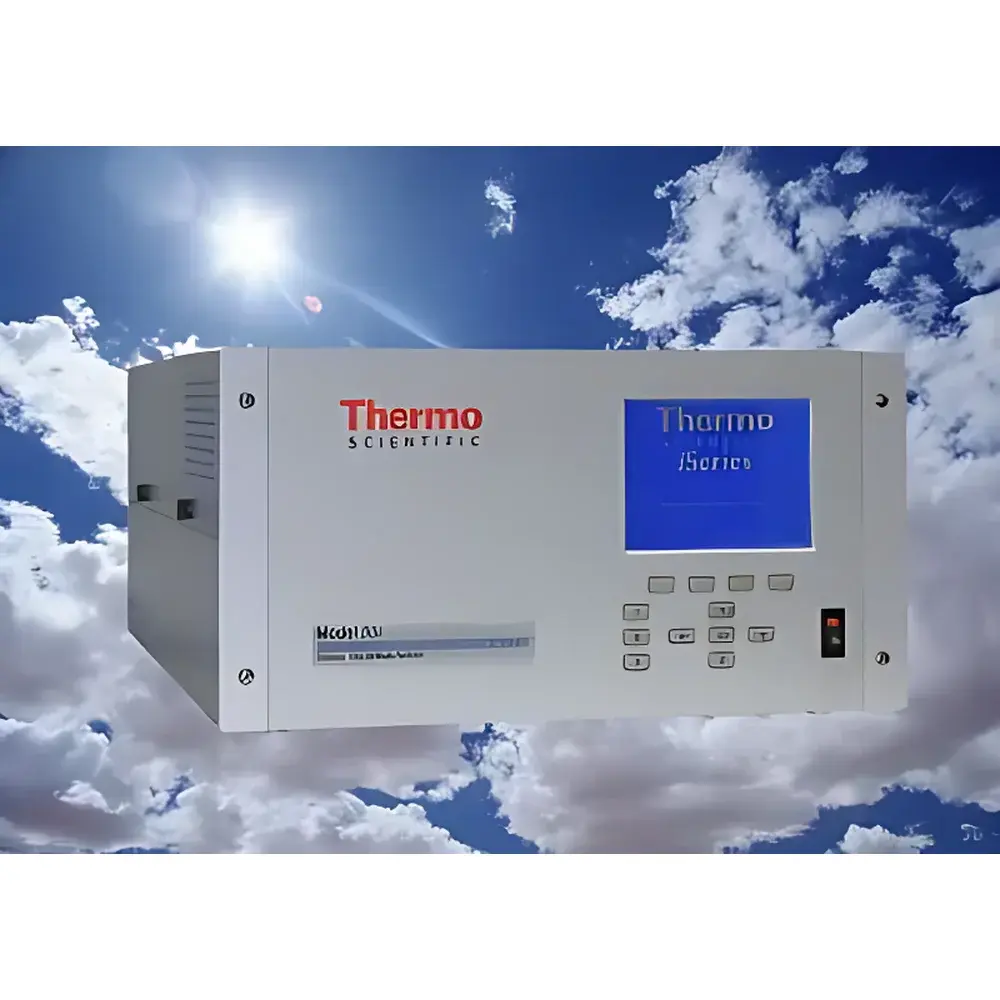
Thermo Fisher Scientific 55i Methane and Total Non-Methane Hydrocarbons Analyzer
| Brand | Thermo Fisher |
|---|---|
| Origin | USA |
| Manufacturer Type | Original Equipment Manufacturer (OEM) |
| Product Origin | Imported |
| Model | 55i |
| Price | Upon Request |
| Measurement Principle | Back-Flush Gas Chromatography with Flame Ionization Detection (GC-FID) |
| Detection Target | CH₄ and Total Non-Methane Hydrocarbons (TNMHC) |
| Analysis Cycle | 70 seconds |
| Detection Limit | 0.050 ppm (as propane, 300-s average) |
| Zero Noise | 0.025 ppm RMS |
| Precision | ±2.0% of reading or ±50 ppb (whichever is greater) |
| Linearity | ±2% of span (10–100% full scale) |
| Operating Temperature | 15–35 °C |
| Power Requirement | 100–240 V AC, 50/60 Hz, 420 W |
| Dimensions | 42.5 × 21.9 × 58.4 cm (W×H×D) |
| Weight | 27.2 kg |
| Sample Flow Rate | ≥0.5 L/min |
| Carrier Gas | N₂ (25–50 mL/min) |
| Zero Air | 275–350 mL/min (hydrocarbon-free) |
| Fuel Gas | H₂ (25–50 mL/min) or H₂/He mix (100–150 mL/min) |
| Output Options | 0–20/4–20 mA (isolated), RS232/RS485, TCP/IP, 10 relay status outputs, power failure alarm |
| Input Options | 16-bit digital input (standard), 8–10 V analog input (optional) |
Overview
The Thermo Fisher Scientific 55i Methane and Total Non-Methane Hydrocarbons Analyzer is a dedicated, fully automated gas chromatographic system engineered for regulatory-grade ambient air monitoring of methane (CH₄) and total non-methane hydrocarbons (TNMHC). Unlike conventional dual-detector or catalytic oxidation-based analyzers, the 55i implements a true back-flush GC-FID architecture—enabling direct, interference-free quantification of TNMHC without reliance on subtraction algorithms or assumptions about background methane concentration. This method ensures high specificity, long-term stability, and trace-level sensitivity even in environments where methane constitutes >90% of total hydrocarbons (e.g., landfill perimeter monitoring, natural gas infrastructure sites, or biogas facility fence-line applications). The system operates on a fixed-volume sampling loop (typically 1–2 mL), with precise pneumatic actuation of an 8-port valve to inject sample onto a high-resolution packed or capillary column maintained at elevated temperature (150–200 °C). Separation exploits differential volatility and polarity: methane elutes first due to its low molecular weight and minimal interaction with the stationary phase; all C₂+ hydrocarbons—including ethane, propane, butanes, and low-volatility aromatics—are retained and subsequently back-flushed into the flame ionization detector (FID) in a single, integrated peak. The FID provides linear, wide-dynamic-range response (up to 5000 ppm as propane) with sub-ppb baseline stability and inherent immunity to oxygen quenching—a critical advantage for unconditioned ambient air analysis.
Key Features
- True back-flush gas chromatography eliminates reliance on indirect calculation methods, delivering certified accuracy for TNMHC under variable CH₄ backgrounds.
- Integrated FID with auto-ignition sequence and continuous flame status monitoring ensures uninterrupted operation and compliance with EPA Method 25A and EN 12619 requirements.
- Automated zero/span calibration with programmable frequency (daily, weekly, or event-triggered), supporting audit-ready traceability per ISO/IEC 17025 and US EPA 40 CFR Part 60, Appendix A.
- 70-second analysis cycle time enables high-temporal-resolution trend monitoring—critical for fugitive emission detection and dispersion modeling validation.
- Onboard particulate filter (0.5 µm absolute rating) protects the GC column and valve from airborne dust and aerosols, extending maintenance intervals in outdoor deployments.
- i-Series platform enhancements include embedded 2 GB flash memory (retaining ≥12 months of 1-minute averaged data), Ethernet TCP/IP interface (HTTP/Modbus TCP), remote firmware updates, and configurable soft-keys for field operator efficiency.
- Large-format graphical display (640 × 480 pixels) supports real-time chromatogram viewing, diagnostic status, and intuitive menu navigation without external PC dependency.
Sample Compatibility & Compliance
The 55i accepts untreated ambient air, stack effluent (with optional heated sampling line), or laboratory-generated standard gases without preconditioning. Its oxygen-tolerant column chemistry ensures quantitative recovery of C₂–C₁₀ hydrocarbons—including benzene, toluene, and xylenes—even in samples containing up to 21% O₂. The analyzer meets performance specifications outlined in U.S. EPA Reference Method 25A (for TNMHC), ASTM D6420 (for gaseous organic compounds), and EU Directive 2008/50/EC for ambient VOC monitoring. All calibration and operational logs are timestamped and stored with immutable metadata, satisfying FDA 21 CFR Part 11 requirements for electronic records when paired with Thermo’s optional Audit Trail software module. The system is CE-marked (EMC & LVD directives) and designed for Class I, Division 2 hazardous locations when installed with appropriate barrier kits.
Software & Data Management
Data acquisition and instrument control are managed via Thermo’s iPort™ embedded operating system, supporting local configuration through the front-panel interface or remotely via secure web browser (HTTPS) or Modbus TCP. Raw chromatograms, integration parameters, calibration history, and diagnostic flags (e.g., flame-out events, pressure deviations, valve timing errors) are archived in standardized CSV and XML formats. Optional Thermo TraceFinder™ Environmental Edition enables advanced peak deconvolution, multi-component quantitation, and automated report generation compliant with EPA QA/G-5 and ISO 11843-7. All data exports include embedded instrument ID, operator ID, and GPS-derived location metadata (when connected to external GNSS receiver)—facilitating chain-of-custody documentation for regulatory submissions.
Applications
- Ambient air quality monitoring networks (AQMS) requiring speciated NMHC data for ozone precursor assessment per U.S. EPA Photochemical Assessment Monitoring Stations (PAMS) protocols.
- Fence-line monitoring at oil & gas production facilities, compressor stations, and LNG terminals under EPA LDAR (Leak Detection and Repair) and NSPS OOOOa compliance mandates.
- Landfill gas migration studies and biogas upgrading process control, where distinguishing CH₄ from reactive NMHCs informs combustion efficiency and odor management strategies.
- Indoor air quality investigations in industrial hygiene settings, particularly where solvent use or chemical synthesis may generate volatile aliphatic/aromatic compounds.
- Research laboratories conducting atmospheric chemistry simulations, photochemical smog chamber experiments, or catalyst evaluation studies requiring high-fidelity hydrocarbon speciation.
FAQ
How does the 55i differentiate methane from non-methane hydrocarbons without catalytic oxidation?
It uses physical separation via gas chromatography: methane elutes first and is measured independently; all other hydrocarbons are retained and back-flushed as a collective group into the same FID—eliminating oxidation bias and cross-sensitivity to CO or H₂.
Is the 55i suitable for unattended operation in remote outdoor enclosures?
Yes—its solid-state electronics, wide operating temperature range (15–35 °C), internal thermal management, and support for 24 V DC auxiliary power make it compatible with solar-powered telemetry shelters meeting IP55 environmental ratings.
Can the 55i be integrated into existing SCADA or EMS platforms?
Absolutely—the built-in RS485 serial port and native Modbus TCP implementation allow seamless integration with Siemens Desigo, Honeywell Experion, or Schneider EcoStruxure systems without protocol gateways.
What maintenance intervals are recommended for routine field operation?
Column and FID jet cleaning every 6 months; carrier gas filter replacement every 3 months; annual verification of valve timing accuracy and FID response factor using certified NMHC standards traceable to NIST SRM 1862.
Does the 55i support dynamic range extension beyond its base 0–5000 ppm scale?
Yes—through optional hardware attenuation modules (e.g., 10:1 or 100:1 dilution injectors) and software-configurable span scaling, enabling measurement across six decades while preserving sub-ppb detection capability at low concentrations.
Related Products







