
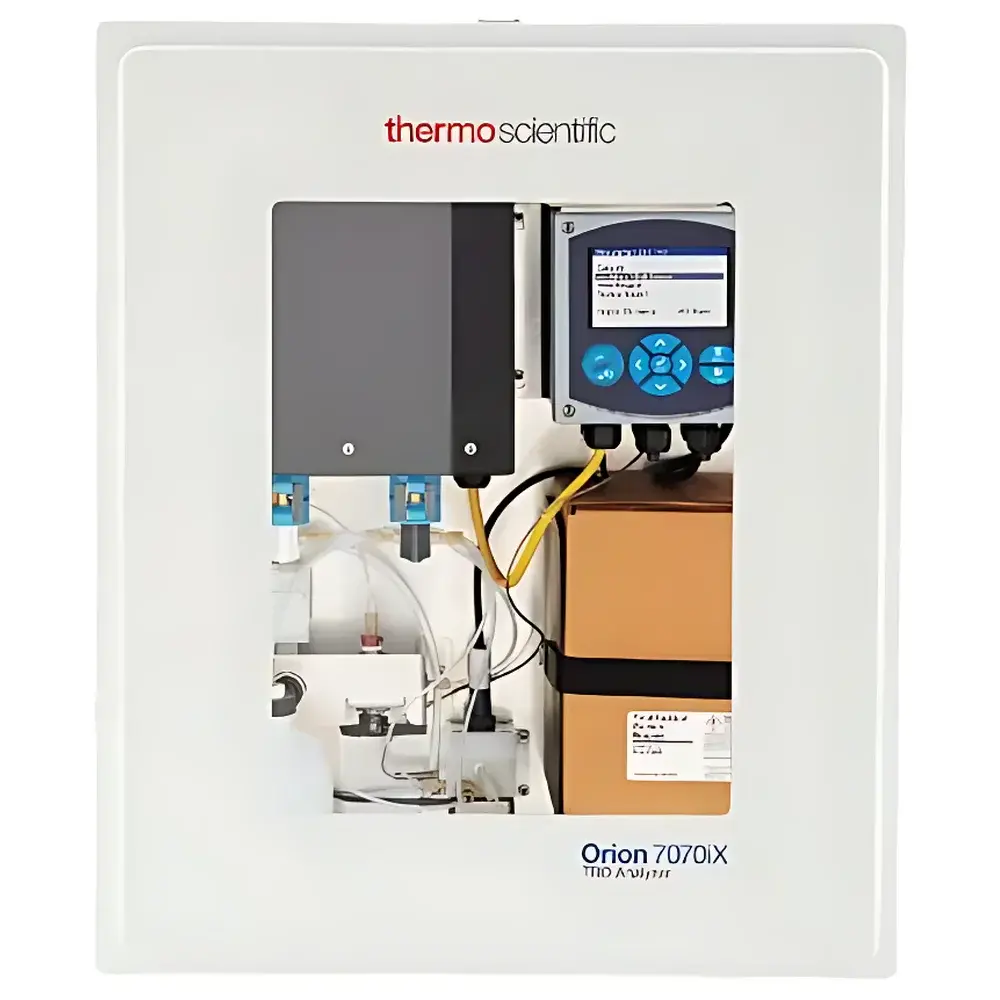
Thermo Scientific Orion 7070iX Total Residual Oxidants Analyzer
| Brand | Thermo Fisher |
|---|---|
| Origin | USA |
| Manufacturer | Thermo Fisher Scientific |
| Origin Category | Imported |
| Model | Orion 7070iX TRO |
| Price | Upon Request |
Overview
The Thermo Scientific Orion 7070iX Total Residual Oxidants (TRO) Analyzer is an industrial-grade, online electrochemical analyzer engineered for continuous or batch-mode monitoring of total residual oxidants—including free chlorine, combined chlorine (chloramines), and total chlorine—in wastewater effluent streams. It employs a potentiometric ion-selective electrode (ISE) measurement principle based on the EPA-approved Method 9770, delivering trace-level detection without optical interference from color, turbidity, or suspended solids—unlike colorimetric DPD-based systems. Designed specifically for regulatory compliance with stringent discharge limits (e.g., US EPA NPDES permits requiring sub-ppm TRO control), the instrument operates reliably across municipal and industrial wastewater treatment plants where accurate, low-maintenance, and audit-ready oxidation monitoring is critical to dechlorination process validation.
Key Features
- Electrode-based ISE technology compliant with EPA Method 9770—immune to spectral interferences from sample color, turbidity (up to 500 NTU), or organic dyes
- Ultra-low detection limit of 0.001 ppm TRO, with measurement range spanning 0.001–15 ppm across all residual oxidant species (TRO, TRC, TC)
- Patented bead-cleaning mechanism ensures long-term sensor stability and minimizes drift in low-concentration applications
- Flexible operation modes: configurable for continuous flow (40 mL/min) or discrete batch analysis, supporting both real-time process control and periodic verification protocols
- Compact IP54-rated enclosure (709 × 478 × 315 mm) suitable for panel-mount or wall-mount installation in control rooms or wet utility areas
- Low operational burden: reagent replacement interval up to 60 days under typical continuous operation; power consumption ≤40 W
- Robust environmental tolerance: operational at 5–45°C ambient temperature and up to 85% relative humidity at 40°C
Sample Compatibility & Compliance
The Orion 7070iX accepts raw or filtered wastewater samples with total suspended solids (TSS) ≤1000 ppm, particle size ≤130 µm, and residual chlorine ≤20 ppm. It accommodates inlet pressure between 5–50 psig and requires no external sample filtration beyond standard 130 µm pre-filtration—reducing clogging risk and maintenance frequency. The system meets international safety and electromagnetic compatibility standards including CE (EN/IEC 61010-1 for electrical safety; EN 61326-1 for EMC), cTUVus, FCC Class A, ISED CAN ICES-1/NMB-1, KC, and RCM. While not inherently 21 CFR Part 11-compliant out-of-the-box, its data logging architecture supports integration with validated LIMS or SCADA platforms that enforce electronic signature, audit trail, and data integrity requirements per GLP/GMP and ISO/IEC 17025 frameworks.
Software & Data Management
The analyzer features an embedded microprocessor with intuitive menu-driven interface accessible via front-panel keypad and LCD display. All configuration parameters—including calibration schedules, alarm thresholds, and output scaling—are stored in non-volatile memory. Two isolated 4–20 mA analog outputs support connection to DCS or PLC systems for real-time TRO trending and automated chemical feed control. Three programmable C-contact relays enable discrete actions such as pump activation, valve switching, or alarm escalation. A two-wire isolated digital input allows remote start/stop triggering. Data retention includes timestamped calibration logs, error codes, and sensor diagnostics—facilitating routine QA/QC review and regulatory reporting. Optional Modbus RTU or Ethernet/IP communication modules are available for enterprise-level integration.
Applications
- Final effluent monitoring prior to discharge to surface water bodies, ensuring compliance with NPDES permit limits for total residual oxidants
- Dechlorination process optimization in municipal wastewater treatment plants using sodium bisulfite, sulfur dioxide, or activated carbon contactors
- Industrial pretreatment verification for facilities discharging to POTWs under local sewer use ordinances
- Monitoring of chlorine residuals in reuse water distribution systems governed by state water recycling regulations
- Validation of disinfection contact time (CT) calculations in tertiary treatment trains
- Supporting ISO 24510 and ASTM D1253-compliant water quality management programs
FAQ
What measurement principle does the Orion 7070iX use, and how does it differ from DPD-based analyzers?
It uses a potentiometric ion-selective electrode (ISE) method per EPA 9770, eliminating optical interferences caused by sample color, turbidity, or manganese/bromide ions that commonly affect DPD colorimetry.
Can the instrument measure free chlorine and combined chlorine separately?
No—it reports total residual oxidants (TRO) as a composite value. For speciation, offline lab analysis using DPD titration or amperometric titration is required.
Is the system suitable for seawater or high-salinity influent applications?
Not recommended without dilution or specialized sensor conditioning; high chloride concentrations (>5000 ppm) may accelerate reference electrode drift and require more frequent calibration.
What is the minimum sample flow rate required for stable continuous operation?
40 mL/min is specified for optimal response kinetics and electrode hydration; lower flow rates may increase lag time and measurement variability.
Does the analyzer support automatic temperature compensation?
Yes—integrated NTC thermistor provides real-time temperature correction across the full 5–45°C sample range, referenced to 25°C per standard electrochemical practice.
Related Products







