
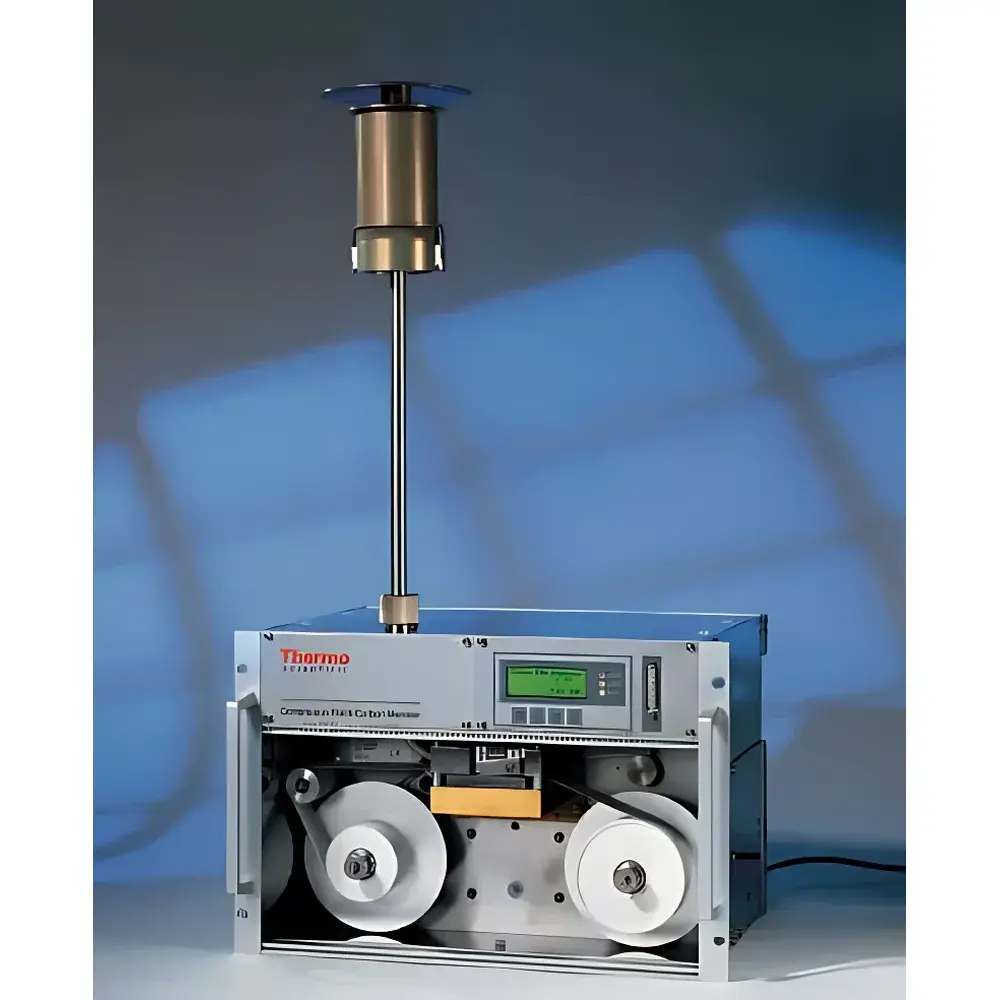
Thermo Scientific Model 5012 Multi-Angle Absorption Photometer (MAAP) for Black Carbon Monitoring
| Brand | Thermo Scientific |
|---|---|
| Origin | USA |
| Manufacturer | Thermo Fisher Scientific |
| Model | 5012, MAAP |
| Measurement Principle | Multi-angle absorption photometry |
| Measured Parameters | BC (Black Carbon), PM₁₀, PM₂.₅ |
| Detection Limit (2-min avg) | <100 ng/m³ BC, <0.66 M/m Babs |
| Detection Limit (10-min avg) | <50 ng/m³ BC, <0.33 M/m Babs |
| Detection Limit (30-min avg) | <20 ng/m³ BC, <0.13 M/m Babs |
| Flow Rate | 0.5–1.4 m³/h (16.7 L/min nominal) |
| Linearity Error | <1% @ 16.7 L/min |
| Filter Medium | Glass fiber tape (~40 m length) |
| Data Storage | 18,560 concentration values |
| Operating Temperature | −20 to +50 °C |
| Power | Instrument: 100–240 V, 50/60 Hz, 30 W |
| Pump | 220–240 V, 50/60 Hz, 100 W |
| Dimensions (Instrument) | 483 × 311 × 330 mm (W×H×D) |
| Weight (Instrument) | 22.5 kg |
| Pump Dimensions | 210 × 222 × 108 mm |
| Pump Weight | 6.1 kg |
| Analog Output | 0/4–20 mA or 0–10 V |
| Digital Interface | Dual RS-232 serial ports |
| Sampling Efficiency | >98% duty cycle |
Overview
The Thermo Scientific Model 5012 Multi-Angle Absorption Photometer (MAAP) is a research-grade, continuous black carbon (BC) monitoring instrument engineered for high-precision atmospheric aerosol characterization in ambient air, stack emissions, and indoor environments. It operates on the principle of multi-angle absorption photometry—measuring both transmitted and scattered light simultaneously across multiple angular configurations as aerosol particles are collected onto a rotating glass fiber filter tape. Unlike conventional single-beam transmissometers, the MAAP compensates for scattering artifacts by integrating real-time measurements of angularly resolved absorption and backscatter coefficients, enabling robust quantification of BC mass concentration (µg/m³) and aerosol absorption coefficient (Babs, M/m) with minimal reliance on empirical correction factors.
Key Features
- Continuous, unattended operation with automated tape advancement and zero-point calibration routines
- Dual-detector optical system measuring transmission and scattering at multiple angles (including forward and backward directions) to decouple absorption from scattering effects
- Real-time temperature and barometric pressure compensation for accurate volumetric normalization under variable environmental conditions
- Configurable averaging intervals (user-selectable from 1 minute to 1 hour) to support compliance reporting (e.g., hourly PM₂.₅ averages) or high-temporal-resolution source apportionment studies
- Integrated quality assurance logic including flow verification, tape position monitoring, and optical path diagnostics logged with timestamps
- Robust mechanical architecture designed for long-term field deployment in remote stations, urban observatories, and mobile platforms
Sample Compatibility & Compliance
The Model 5012 is optimized for sampling ambient particulate matter (PM) with aerodynamic diameters ≤10 µm (PM₁₀) and ≤2.5 µm (PM₂.₅), using a standardized inlet with optional size-selective cyclones compliant with ISO 10473 and EPA Method IO-3. The glass fiber filter tape meets ASTM D6216 requirements for low blank variability and consistent collection efficiency. Instrument outputs conform to data integrity standards required for regulatory submissions—including traceable audit logs, time-synchronized metadata, and non-volatile storage of raw detector signals. While not certified as a reference method per EU Directive 2008/50/EC Annex VI or US EPA EQOA-0003, the MAAP is widely accepted as an equivalent method for BC quantification in scientific networks such as ACTRIS, EMEP, and NASA AERONET due to its documented intercomparability and metrological traceability to NIST-traceable optical standards.
Software & Data Management
Data acquisition and instrument control are managed via two independent RS-232 serial interfaces, supporting integration into SCADA systems, centralized telemetry networks, or local PC-based logging software (e.g., Thermo Scientific’s optional MAAP Control Suite). Analog outputs (4–20 mA or 0–10 V) provide direct compatibility with PLCs and legacy data loggers. All measurements—including raw photodiode voltages, calculated BC mass concentrations, Babs, flow rate, temperature, pressure, and tape status—are timestamped and stored internally in non-volatile memory. The device retains up to 18,560 concentration records, plus 1,632 full diagnostic entries and 385 days of averaged results. Export formats include ASCII CSV and binary files compatible with MATLAB, Python (pandas), and R for post-processing, trend analysis, and model input generation. Audit trails comply with GLP/GMP principles, including operator-initiated events, firmware versioning, and sensor calibration history.
Applications
- Long-term climate-relevant BC monitoring in background, urban, and Arctic sites to constrain radiative forcing estimates
- Source attribution studies linking BC signatures to traffic emissions, biomass burning, or industrial combustion using temporal correlation and diurnal pattern analysis
- Validation of satellite-derived aerosol absorption products (e.g., from PACE, TROPOMI, or MODIS)
- Indoor air quality assessments in occupational settings where diesel particulate exposure is regulated (e.g., mining, tunnel construction)
- Calibration transfer and intercomparison campaigns among national reference laboratories and regional monitoring networks
- Field validation of numerical models simulating BC transport, aging, and cloud interaction processes
FAQ
How does the MAAP distinguish black carbon from other light-absorbing aerosols such as brown carbon or mineral dust?
The MAAP applies a wavelength-independent absorption model calibrated against elemental carbon standards. While it does not chemically speciate BC, its multi-angle design minimizes overestimation from scattering-dominated particles and provides higher specificity than single-wavelength transmissometers—particularly when combined with co-located measurements (e.g., OC/EC analyzers or UV-Vis spectrometers).
Is the Model 5012 suitable for use in low-temperature environments such as polar research stations?
Yes—the instrument is rated for operation between −20 °C and +50 °C. Its internal thermal management ensures stable photodetector response and tape drive functionality across this range. Optional external thermal enclosures and heated inlets are available for sustained sub-zero deployments.
What maintenance is required to ensure measurement continuity over extended periods?
Routine maintenance includes quarterly replacement of the glass fiber tape roll, biannual cleaning of optical windows and detector housings, and annual verification of flow calibration against a primary standard (e.g., bubble meter or critical orifice). No consumables beyond the tape are required during normal operation.
Can the MAAP output be directly integrated into EPA AirNow or EEA Air Quality e-Reporting platforms?
Yes—via middleware solutions that map MAAP’s ASCII output format to AQXML or INSPIRE-compliant schemas. Thermo Scientific provides technical documentation and mapping templates for interoperability with national data portals adhering to AQDM (Air Quality Data Model) specifications.
Related Products







