
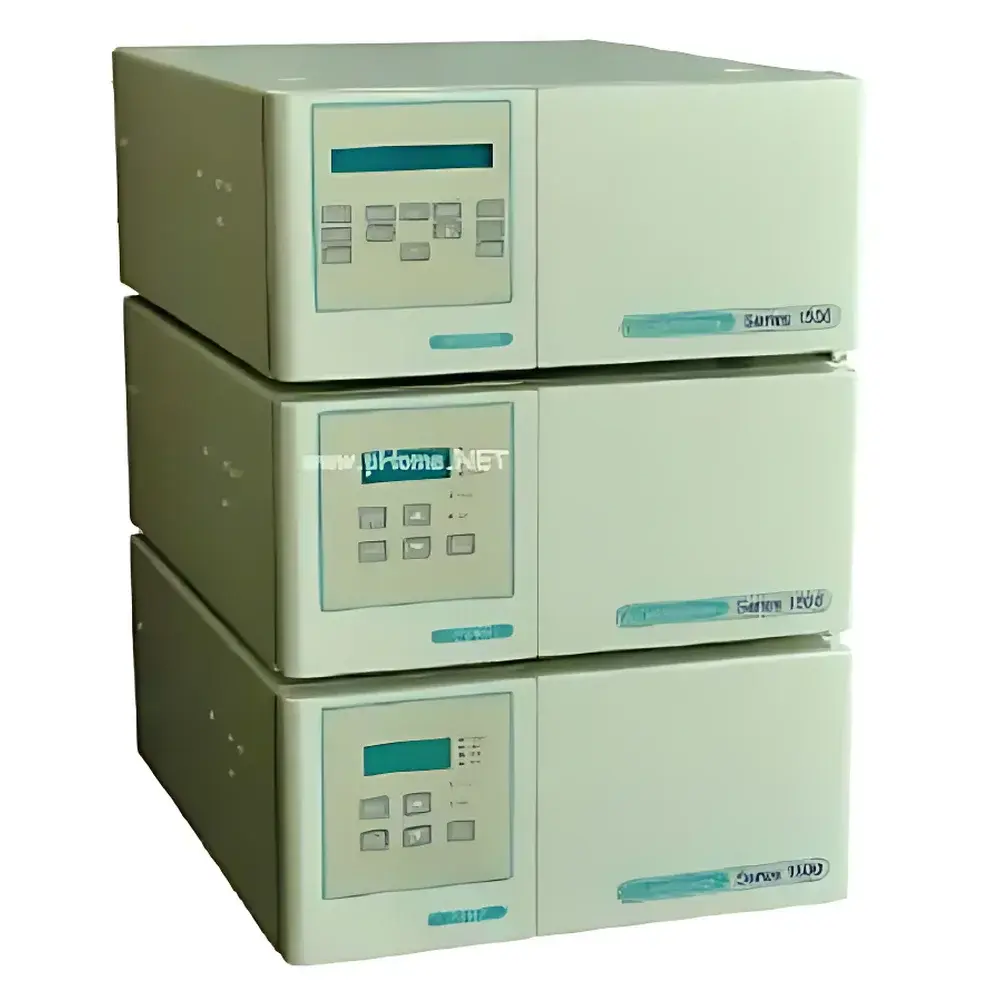
Laballiance HPLC 1500 Series Binary Manual Gradient System
| Brand | Laballiance |
|---|---|
| Origin | USA |
| Manufacturer Type | Authorized Distributor |
| Product Origin | Imported |
| Model | HPLC 1500 Series |
| Price | Upon Request |
| Flow Rate Range | 0.001–10 mL/min |
| Maximum Pressure | 6,000 psi |
| Flow Accuracy | ±1% |
| Flow Precision | ≤0.075% RSD |
| Gradient Precision | ±1% |
| Spectral Bandwidth | 6 nm |
| Wavelength Accuracy | ±1.0 nm |
| Wavelength Repeatability | ±0.1 nm |
| Wavelength Range | D₂ Lamp (190–380 nm), W Lamp (366–800 nm) |
Overview
The Laballiance HPLC 1500 Series Binary Manual Gradient System is a robust, modular high-performance liquid chromatography platform engineered for method development, quality control, and fingerprint profiling in research and regulated laboratory environments. Built upon dual III-series isocratic pumps and a 201 UV-Vis detector, the system implements high-pressure binary gradient mixing—eliminating the need for external degassing units while ensuring precise solvent composition control across the entire flow range (0.001–10 mL/min) and pressure capability up to 6,000 psi. Its core architecture follows the principles of low-dispersion, pulse-dampened solvent delivery and real-time wavelength-stabilized photometric detection, enabling reproducible retention time alignment and quantitative accuracy essential for GLP-compliant assay validation and USP/ICH method transfer.
Key Features
- Dual III-series single-piston reciprocating pumps with integrated pulse dampening and solvent compressibility compensation—delivering ≤0.075% RSD flow precision and ±1% gradient accuracy across full operational range.
- 201 UV-Vis detector featuring dual-lamp source (deuterium and tungsten), automatic lamp switching, 6 nm spectral bandwidth, and wavelength repeatability of ±0.1 nm—ensuring compliance with ASTM E275 and ISO 17025 spectral verification requirements.
- On-board high-pressure gradient mixing chamber with dynamic solvent blending—enabling precise gradient formation without post-mix degassing or low-pressure proportioning artifacts.
- Modular “building-block” design: easily reconfigured from binary gradient mode to two independent isocratic channels; supports column-switching, post-column derivatization, and auxiliary detector integration (e.g., fluorescence, conductivity).
- Full system control via dedicated chromatography workstation software—including real-time pump parameter monitoring, gradient programming, data acquisition, peak integration, and audit-trail-enabled method storage.
- Standard fluidic path options: electropolished 316 stainless steel or biocompatible PEEK—no cost differential, no tooling change required.
Sample Compatibility & Compliance
The HPLC 1500 Series accommodates reversed-phase, normal-phase, ion-exchange, and size-exclusion chromatographic modes using standard 4.6 mm × 150 mm columns (or custom lengths/diameters). It meets key regulatory expectations for analytical instrumentation in pharmaceutical QC labs: full traceability of instrument parameters, electronic signatures compatible with FDA 21 CFR Part 11 (when paired with validated software), and hardware-level compliance with IEC 61010-1 safety standards. The system’s flow and wavelength performance specifications align with USP and EP 2.2.46 chromatographic system suitability criteria, supporting routine qualification under IQ/OQ/PQ protocols.
Software & Data Management
Control and data handling are performed through Laballiance’s certified ChromaSoft™ workstation—a Windows-based application supporting method development, sequence execution, real-time chromatogram display, and report generation. The software includes built-in system suitability testing (SST) templates, peak purity analysis, and customizable reporting per ISO/IEC 17025 clause 7.8. Audit trails record all user actions—including method edits, calibration events, and data exports—with timestamped, non-erasable entries. Raw data files (.chd) are stored in vendor-neutral formats compatible with third-party processing tools (e.g., OpenLab CDS, Chromeleon, Empower).
Applications
- Method development and optimization for small-molecule APIs, impurities, and degradation products per ICH Q2(R2).
- Stability-indicating assays and forced degradation studies requiring high-resolution gradient elution.
- Phytochemical fingerprinting of botanical extracts using multi-wavelength UV detection and similarity index calculation.
- Quality control of excipients and raw materials where isocratic or shallow-gradient separations suffice—leveraging the system’s seamless switch to dual-isocratic operation.
- Column characterization and backpressure profiling under variable mobile phase viscosity conditions.
- Integration with fraction collectors or mass spectrometry interfaces for offline compound isolation or hyphenated analysis.
FAQ
Can the HPLC 1500 Series be upgraded to an autosampler-compatible configuration?
Yes—the system features standardized electrical and fluidic interfaces compliant with ANSI/SCTE-190-2022, allowing direct integration with third-party autosamplers (e.g., CTI, Leap PAL) without hardware modification.
Is the 201 detector compliant with pharmacopeial wavelength verification requirements?
Yes—its dual-lamp design, factory-calibrated holmium oxide filter verification, and ±0.1 nm wavelength repeatability meet USP , EP 2.2.25, and JP 6.05 specifications.
What maintenance intervals are recommended for the III-series pumps?
Pump seals require replacement every 6,000 operating hours or annually under typical QC usage; piston wash and check valve inspection are advised quarterly per Laballiance Maintenance Protocol MP-HPLC-1500-Rev.4.
Does the system support GLP audit readiness out-of-the-box?
Hardware supports GLP workflows; full audit readiness requires validated ChromaSoft™ installation, documented IQ/OQ, and enabled electronic signature modules per internal SOP-LAB-2023-08.
Are PEEK flow paths suitable for aggressive solvents like THF or chloroform?
PEEK tubing and fittings are rated for continuous use with THF, acetonitrile, methanol, and aqueous buffers; chloroform and DCM require stainless-steel wetted parts due to PEEK swelling potential—configuration guidance available upon request.





