
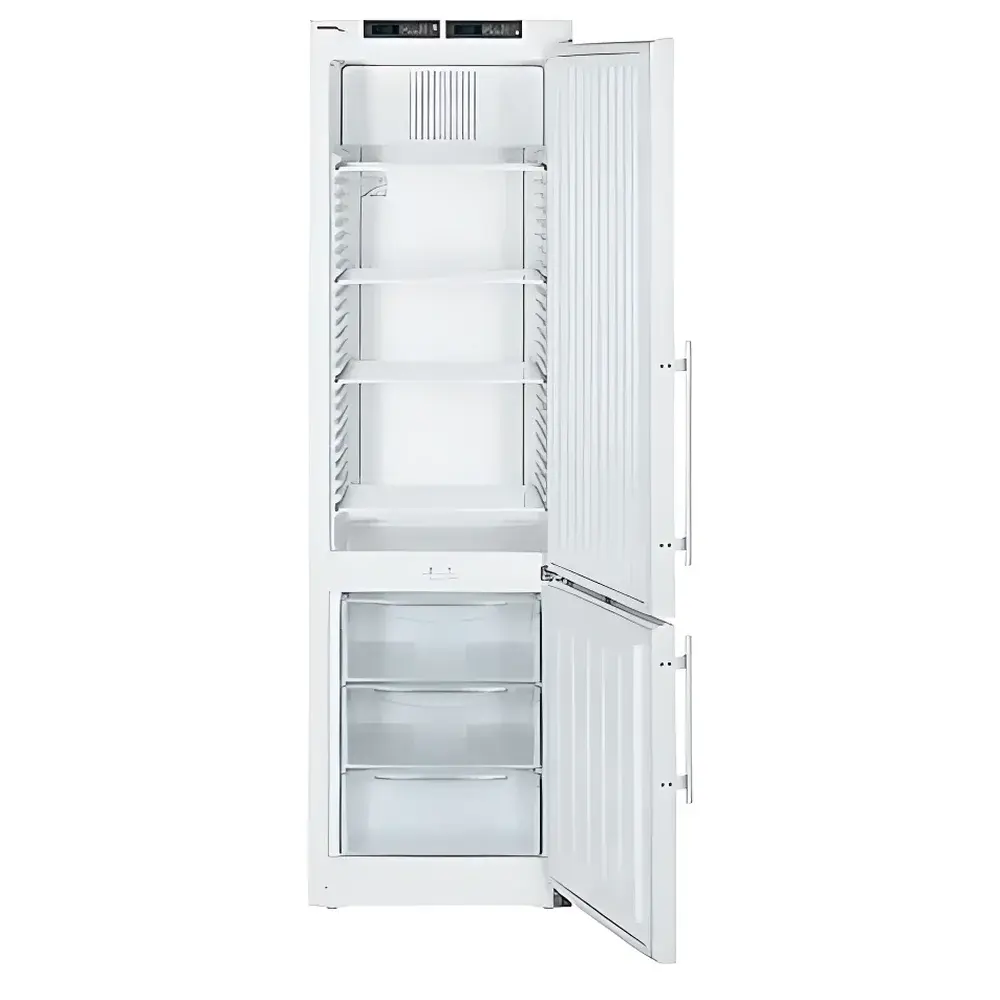
Liebherr LCv 4010 Laboratory Refrigerator-Freezer Combination Unit
| Brand | Liebherr |
|---|---|
| Origin | Austria |
| Model | LCv 4010 |
| Refrigeration Temperature Range | +3°C to +16°C |
| Freezing Temperature Range | −11°C to −30°C |
| Total Capacity | 254 L (Refrigerator) / 107 L (Freezer) |
| Effective Refrigerator Volume | 240 L |
| External Dimensions (W×D×H) | 597 × 615 × 2003 mm |
| Cooling Method | Forced-air (refrigerator section) |
| Energy Consumption | 1.800 kWh/24h |
| ATEX Certification | II 3G Ex nA IIC T6 X (per Directive 94/9/EC) |
| Door | Reversible hinge |
| Control | Mechanical thermostat (±1°C setting resolution) |
| Security | Integrated key lock |
| Condensate Management | Sealed internal drip pan compliant with ATEX maintenance requirements |
Overview
The Liebherr LCv 4010 is a CE-marked, ATEX-certified laboratory refrigerator-freezer combination unit engineered for precise, stable, and safe low-temperature storage of temperature-sensitive biological and chemical materials in regulated research and quality control environments. Designed and manufactured in Austria under strict ISO 9001-compliant production protocols, the LCv 4010 integrates dual-zone thermal management—forced-air refrigeration (+3°C to +16°C) and direct-cooled freezing (−11°C to −30°C)—within a single footprint. Its architecture adheres to the fundamental thermodynamic principles of vapor-compression refrigeration, employing high-efficiency compressors, optimized heat exchangers, and insulated cabinet construction (polyurethane foam, ≥60 mm thickness) to ensure minimal thermal fluctuation (<±0.8°C in refrigerator compartment under standard load conditions per EN 60068-2-1/2). The unit meets IEC 61010-1 safety requirements for laboratory equipment and is validated for continuous operation under GLP- and GMP-aligned workflows where traceable, reproducible cold chain integrity is essential.
Key Features
- ATEX-certified interior (II 3G Ex nA IIC T6 X) for safe storage of flammable solvents, reagents, and volatile organic compounds—no internal ignition sources, fully grounded metal components, non-sparking surfaces, and sealed condensate retention pan.
- Dual independent temperature zones: refrigerated compartment (254 L gross / 240 L usable) and deep-freeze compartment (107 L gross), each with mechanical thermostatic control offering ±1°C setpoint resolution across full operating ranges.
- Robust internal construction featuring molded polymer ribbed supports enabling 32-mm adjustable-height tempered glass shelves—resistant to chemical splashes and autoclave-compatible for decontamination.
- Reversible door hinge system allows left- or right-handed installation without tools, supporting ergonomic integration into modular lab furniture layouts.
- Integrated security lock with two-key system prevents unauthorized access—critical for controlled substances, clinical specimens, and proprietary biologics.
- Energy-optimized design achieving 1.800 kWh/24h consumption (tested per EN 62552-3), compliant with EU Ecodesign Regulation (EU) 2019/2024 for refrigerating appliances.
Sample Compatibility & Compliance
The LCv 4010 is validated for long-term storage of a broad spectrum of life science and diagnostic materials, including but not limited to: monoclonal antibodies, serum, cell culture media, primary and cryopreserved cells, enzymatic reagents (e.g., restriction enzymes, polymerases), viral/bacterial stocks, tissue sections, ELISA and PCR assay kits, and reference standards for QC testing. Its thermal stability profile satisfies storage requirements outlined in USP , ISO 5725-2 (precision), and CLSI GP35-A4 for refrigerated specimen handling. The ATEX certification enables use in laboratories handling Class I, Group C/D gases per NEC 500, and aligns with OSHA 1910.106 and EU Directive 1999/92/EC for hazardous area classification. All electrical components are rated IP20 and conform to RoHS 2011/65/EU and REACH Annex XVII restrictions.
Software & Data Management
As a mechanically controlled unit, the LCv 4010 does not incorporate digital controllers or networked data logging. However, its design facilitates seamless integration with external monitoring systems via standardized 4–20 mA or 0–10 V analog output interfaces (optional accessory port). When paired with validated third-party temperature mapping and alarm platforms—such as DicksonOne, SensiLog, or Eurotherm 3500—the unit supports 21 CFR Part 11-compliant audit trails, electronic signature capability, and automated deviation reporting. Calibration certificates (traceable to NIST or PTB standards) are provided with each unit, and routine verification follows ASTM E2875-22 for stability assessment and ISO/IEC 17025-accredited procedures.
Applications
The LCv 4010 serves critical roles across academic, industrial, and clinical laboratories: maintaining cold chain integrity for biospecimen biobanking (ISO 20387:2018); storing temperature-labile diagnostics under CLIA and CAP accreditation requirements; preserving stability-indicating reference materials in pharmaceutical QC labs (ICH Q5C); supporting microbiology workflows requiring consistent refrigerated incubation media and frozen stock cultures; and enabling secure, compliant storage of controlled substances in university core facilities and public health laboratories (e.g., CDC, NIH, ECDC partner sites). Its compact vertical form factor (2003 mm height) optimizes floor space in high-density lab environments while meeting accessibility standards per ADA and EN 16005.
FAQ
Does the LCv 4010 support remote temperature monitoring or Ethernet connectivity?
No—the unit features mechanical thermostats only. Remote monitoring requires integration with an external data logger or building management system via analog signal outputs.
Is the freezer compartment suitable for long-term cryopreservation of cell lines?
It maintains −11°C to −30°C, appropriate for short-to-medium term storage (≤6 months) of non-cryogenic samples; for liquid nitrogen-level preservation (−135°C or lower), a dedicated ultra-low temperature freezer is required.
What documentation is supplied for regulatory audits?
Each unit ships with EU Declaration of Conformity, ATEX certificate (issued by Electrosuisse), factory calibration report, and full technical dossier compliant with Annex III of Directive 2014/34/EU.
Can the internal shelves be removed for cleaning or sterilization?
Yes—tempered glass shelves and polymer supports are fully removable and compatible with 70% ethanol wipe-downs, hydrogen peroxide vapor (HPV) decontamination, and steam autoclaving at 121°C (non-continuous exposure).
How often must the condensate drip pan be emptied?
Under typical ambient conditions (23°C, 50% RH), manual emptying is recommended every 7–10 days; frequency increases proportionally with humidity and door-open events.





