
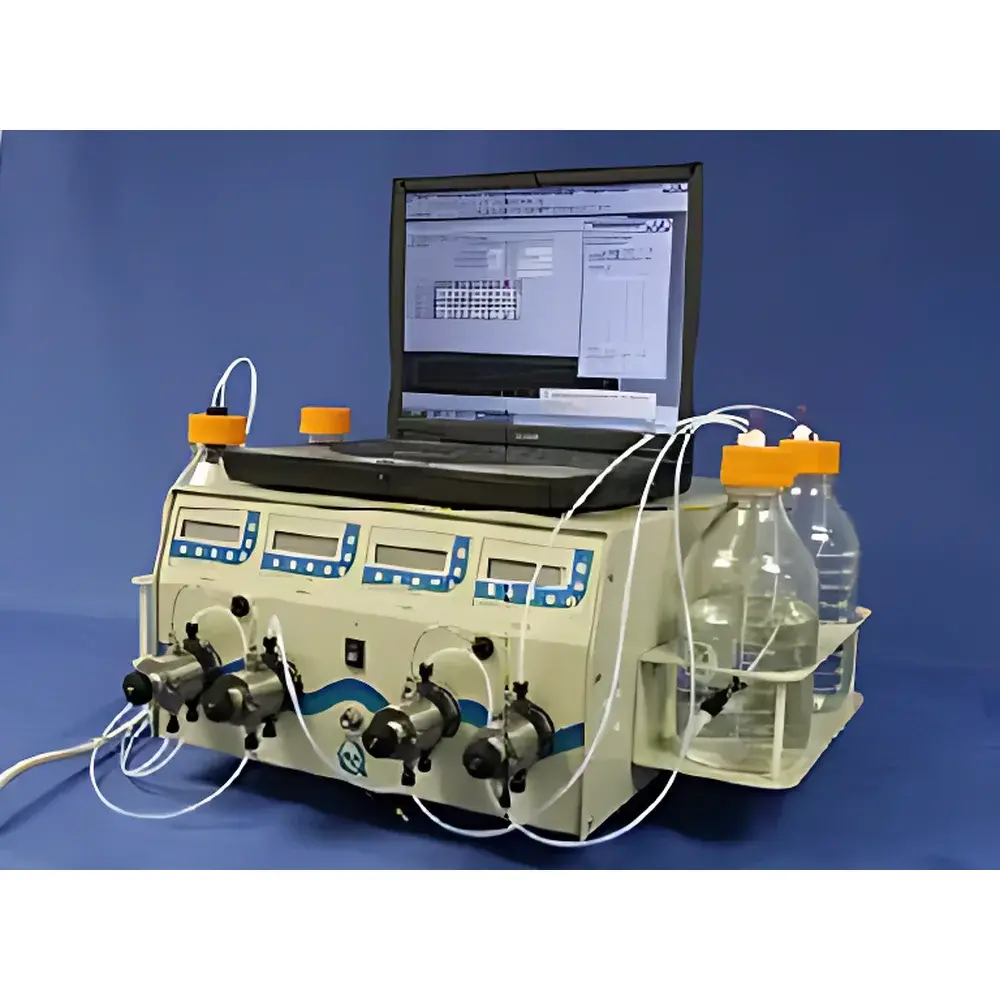
LabAlliance Q-Grad Quaternary High-Pressure Gradient Pump
| Brand | LabAlliance |
|---|---|
| Origin | USA |
| Model | Q-Grad |
| Flow Rate | 0.001–5.0 mL/min per pump head |
| Maximum Pressure | 6,000 psi (stainless steel), 5,000 psi (PEEK) |
| Pressure Ripple | ≤1% at 1,000 psi and 1 mL/min |
| Gradient Accuracy | ±0.1% of set value at 1 mL/min and 1,000 psi |
| Flow Accuracy | ±1% |
| Flow Precision | ≤0.075% RSD |
| Pressure Accuracy | ±1% of full scale |
| Communication | RS-232 (per pump), TTL |
| Dimensions | 9" H × 15" W × 21.5" D (without solvent rack) |
| Power | 110–240 VAC |
Overview
The LabAlliance Q-Grad Quaternary High-Pressure Gradient Pump is an engineered solution for high-performance liquid chromatography (HPLC) systems requiring precise, reproducible gradient elution under elevated backpressures. Unlike low-pressure (pump-before-mixing) gradient systems, the Q-Grad implements true high-pressure mixing—four independent piston pumps deliver solvents at full system pressure before combining them downstream of the pump heads. This architecture eliminates air entrapment during solvent blending, prevents bubble formation in immiscible mobile phase combinations (e.g., water/acetonitrile or water/THF), and significantly expands method development flexibility. Each pump head operates with a dedicated self-cleaning mechanism to mitigate inorganic salt crystallization at the plunger seal interface—a common failure mode in long-term HPLC operation with buffered mobile phases. The integrated pulse-dampening mixer and real-time pressure monitoring ensure stable flow delivery across the full operating range (0.001–5.0 mL/min per channel), supporting both analytical-scale separations and preparative applications.
Key Features
- Four independently controlled high-pressure piston pumps with integrated online self-cleaning circuits to extend seal life and maintain baseline stability during extended runs with phosphate or ammonium acetate buffers.
- True high-pressure quaternary mixing architecture—solvents are blended post-pumping, enabling superior gradient fidelity, reduced dwell volume (< 150 µL typical), and compatibility with ultra-high-pressure LC (UHPLC)-compatible columns (up to 6,000 psi with stainless steel configuration).
- Dual-material pump head options: PEEK-wetted path for enhanced chemical resistance with aggressive solvents (e.g., chlorinated organics, strong acids/bases); stainless steel for maximum pressure rating and thermal stability in demanding routine QC environments.
- Onboard pressure transducer with programmable overpressure cutoff and leak detection logic—automatically halts operation if pressure deviates beyond user-defined thresholds, protecting columns and system integrity.
- Modular control architecture supporting three operational modes: standalone keypad operation (SCU460 controller), PC-based control via LabAlliance Q-Grad software (Windows-compatible), or seamless integration into third-party HPLC platforms via TTL or RS-232 interfaces.
- Real-time flow and pressure telemetry output, run/stop TTL trigger input, and synchronized event logging—designed for compliance with GLP/GMP workflows requiring audit-ready instrumentation records.
Sample Compatibility & Compliance
The Q-Grad supports all standard HPLC-grade organic and aqueous mobile phases, including acetonitrile, methanol, tetrahydrofuran, isopropanol, water, and buffered solutions (e.g., 10–50 mM ammonium formate, phosphate, or acetate). Its PEEK and stainless steel fluidic paths meet USP Class VI biocompatibility requirements and are compatible with ISO 13485-aligned manufacturing environments. Pressure and flow calibration traceability aligns with ASTM E2655-21 (Standard Guide for Calibration of Liquid Chromatography Systems) and supports 21 CFR Part 11-compliant data acquisition when paired with validated AllChrom or CSChrom chromatography data systems (CDS). System-level validation documentation—including IQ/OQ templates and performance qualification protocols—is available upon request for regulated laboratories operating under FDA, EMA, or PMDA oversight.
Software & Data Management
LabAlliance Q-Grad software provides native Windows-based control with intuitive gradient programming (0–100% in 0.1% increments), real-time pressure/flow visualization, method storage, and export of timestamped CSV logs for trending analysis. When integrated into enterprise CDS environments, the pump exposes its status registers and control parameters via RS-232 serial protocol, enabling automated sequence execution, error-triggered shutdown, and electronic signature capture. Audit trails record all parameter changes, start/stop events, and pressure excursions with user ID, timestamp, and reason-for-change fields—fully compliant with ALCOA+ principles (Attributable, Legible, Contemporaneous, Original, Accurate, Complete, Consistent, Enduring, Available). Firmware updates are delivered via signed binary packages with SHA-256 checksum verification.
Applications
- Routine pharmaceutical QC testing per USP and EP 2.2.46, including assay, related substances, and dissolution profiling on C18, phenyl-hexyl, or HILIC columns.
- Method development for complex natural product extracts, where gradient robustness across wide polarity ranges (e.g., 5–95% B) is critical for peak resolution and retention time reproducibility.
- LC-MS coupling applications requiring low dwell volume, minimal pulsation, and strict gradient accuracy to preserve ionization efficiency and retention time alignment across multi-day sequences.
- Preparative purification workflows with fraction collection synchronization—TTL triggers enable precise valve actuation at user-defined retention windows.
- Academic and contract research laboratories performing DOE-driven optimization of gradient slope, hold time, and solvent strength for novel stationary phases.
FAQ
What is the difference between high-pressure and low-pressure gradient mixing?
High-pressure mixing occurs after each solvent is pressurized by its dedicated pump, eliminating air entrainment and enabling precise blending of immiscible solvents. Low-pressure mixing combines solvents pre-pumping, increasing risk of bubble formation and limiting usable solvent pairs.
Can the Q-Grad be used with UHPLC columns rated above 1,000 bar?
No—the Q-Grad’s maximum pressure rating is 6,000 psi (~414 bar) for stainless steel configurations, making it suitable for HPLC and some early-generation UHPLC applications but not for modern 1,000–1,500 bar systems.
Is the SCU460 keyboard controller required for basic operation?
No—it is optional. The pump operates autonomously via front-panel keypad; the SCU460 adds advanced local programming capability and RS-232 passthrough for multi-instrument daisy-chaining.
How often does the self-cleaning system activate?
It runs automatically after every method completion or can be manually triggered; cycle duration and solvent volume are configurable in software to balance cleaning efficacy with mobile phase consumption.
Does LabAlliance provide 21 CFR Part 11 validation support?
Yes—validated IQ/OQ protocols, electronic signature configuration guides, and audit trail review procedures are included in the Regulatory Support Package, available under NDA for qualified laboratories.



