
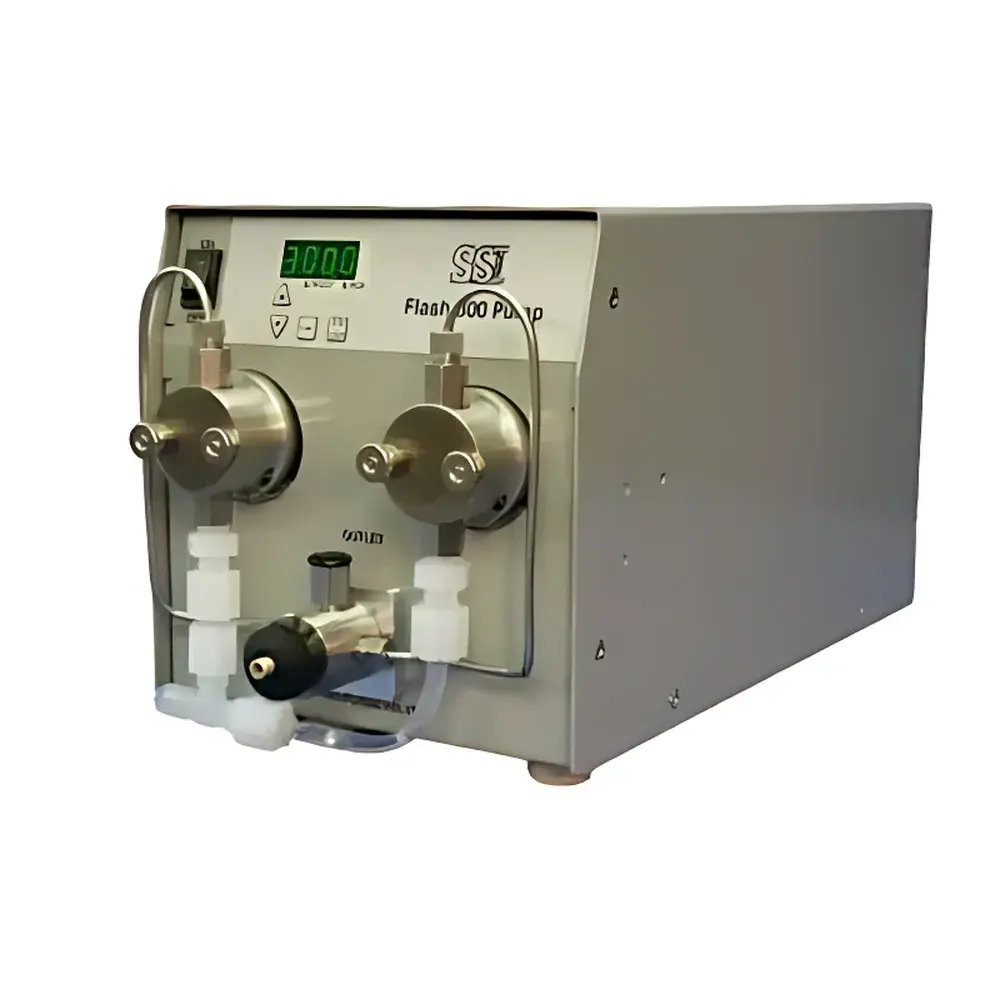
LabAlliance Flash 300 High-Speed Constant Flow Pump
| Brand | LabAlliance |
|---|---|
| Origin | USA |
| Model | Flash 300 |
| Flow Rate | 0.1–300.0 mL/min |
| Maximum Pressure | 200 psi |
| Flow Accuracy | ±3% (at 10–250 mL/min, with calibration enabled) |
| Power Supply | 90–260 VAC, 50–60 Hz |
| Dimensions | 178 × 305 × 191 mm (W × D × H) |
| Weight | 9.1 kg (20 lbs) |
| Control Interface | Front-panel digital keypad + RS-232 serial port |
| Pump Type | Dual-head positive displacement piston pump |
| Piston Material | Ceramic |
| Seal Material | UHMWPE (ultra-high-molecular-weight polyethylene), HPLC-grade |
| Check Valve | Sapphire ball |
| Fluidic–Electrical Isolation | Yes |
Overview
The LabAlliance Flash 300 High-Speed Constant Flow Pump is a dual-head, positive displacement piston pump engineered for robust performance in preparative and flash chromatography systems requiring high volumetric throughput and stable solvent delivery. Unlike peristaltic or syringe-based pumps, the Flash 300 employs a reciprocating ceramic piston mechanism operating under precise volumetric displacement principles—ensuring consistent flow generation independent of backpressure fluctuations within its rated pressure range (up to 200 psi). Its design prioritizes mechanical stability and chemical compatibility, making it suitable for gradient elution, multi-solvent switching, and extended unattended operation in both research and quality control laboratories. The pump’s architecture supports continuous flow delivery across a broad dynamic range (0.1–300.0 mL/min), with calibrated accuracy maintained through user-accessible front-panel solvent-specific flow correction—a critical capability when transitioning between solvents of differing compressibility and viscosity (e.g., hexane vs. acetonitrile/water mixtures).
Key Features
- Dual-head piston configuration enabling smooth, pulse-dampened flow output and extended service intervals
- Ceramic pistons paired with HPLC-grade ultra-high-molecular-weight polyethylene (UHMWPE) seals—resistant to abrasion, swelling, and chemical degradation across common organic and aqueous mobile phases
- Sapphire ball check valves offering superior wear resistance, minimal dead volume, and long-term sealing integrity under repetitive cycling
- Complete fluidic–electrical isolation to prevent ground-loop interference and enhance system safety in mixed-solvent environments
- Integrated digital keypad interface for direct parameter entry, real-time flow/pressure monitoring, and on-the-fly calibration adjustment
- RS-232 serial port supporting bidirectional communication with external controllers, chromatography data systems (CDS), or custom automation platforms
Sample Compatibility & Compliance
The Flash 300 is compatible with a wide spectrum of chromatographic solvents—including aliphatic hydrocarbons, chlorinated solvents, alcohols, esters, ketones, and aqueous buffers—provided they are chemically inert toward UHMWPE and ceramic surfaces. It is routinely deployed in ASTM D86, USP , and ICH Q2(R2)-aligned flash purification workflows where reproducible flow delivery under variable load conditions is essential. While the pump itself does not carry CE or UL certification as a standalone unit, its electrical design conforms to IEC 61010-1 requirements for laboratory equipment safety when operated within specified voltage and ambient conditions. For GLP/GMP-regulated environments, the RS-232 interface enables integration into audit-trail-capable CDS platforms compliant with FDA 21 CFR Part 11.
Software & Data Management
Although the Flash 300 operates autonomously via its front-panel interface, its RS-232 port allows seamless integration with third-party software environments—including LabAlliance’s own ChromaLink control suite, Agilent OpenLab CDS, or custom Python- or LabVIEW-based instrument drivers. All flow and pressure setpoints, calibration offsets, and operational timestamps can be logged externally. When connected to a validated chromatography data system, the pump supports electronic record retention, user access logging, and change-control tracking—meeting core ALCOA+ (Attributable, Legible, Contemporaneous, Original, Accurate, Complete, Consistent, Enduring, Available) data integrity expectations.
Applications
- Medium-pressure flash chromatography (10–200 psi) for compound purification in synthetic organic chemistry and natural product isolation
- Preparative-scale separations requiring rapid solvent delivery (e.g., 50–300 mL/min) without sacrificing gradient fidelity
- Automated fraction collection systems where precise timing and flow synchronization are critical
- Method development workflows involving multi-solvent screening and viscosity-dependent flow optimization
- Integration into modular purification platforms alongside UV detectors, fraction collectors, and mass-directed triggers
FAQ
What solvents are compatible with the Flash 300’s wetted components?
The pump’s UHMWPE seals and ceramic/sapphire fluidic path are compatible with most common HPLC- and flash-grade solvents, including dichloromethane, ethyl acetate, methanol, ethanol, isopropanol, THF, and aqueous buffers below pH 10. Avoid strong oxidizers (e.g., concentrated nitric acid), halogenated acids, or solvents known to degrade polyethylene.
Is flow calibration required for each solvent?
Yes. Due to solvent compressibility and viscosity differences, the front-panel calibration function must be executed for each mobile phase to achieve ±3% flow accuracy across the 10–250 mL/min range.
Can the Flash 300 be used in gradient elution mode?
While the Flash 300 itself is a single-solvent constant-flow pump, it is commonly paired with low-dead-volume solvent selection valves or external gradient mixers to support binary or ternary gradient methods in flash systems.
How often should maintenance be performed?
Under normal use (≤8 hrs/day, non-aggressive solvents), piston seals and check valves typically require inspection every 6–12 months; replacement intervals depend on solvent aggressiveness and daily runtime.
Does the pump support analog or Ethernet connectivity?
No. Communication is limited to RS-232 serial protocol. Analog 0–5 V or 4–20 mA outputs, as well as Ethernet or USB interfaces, are not available on this model.



