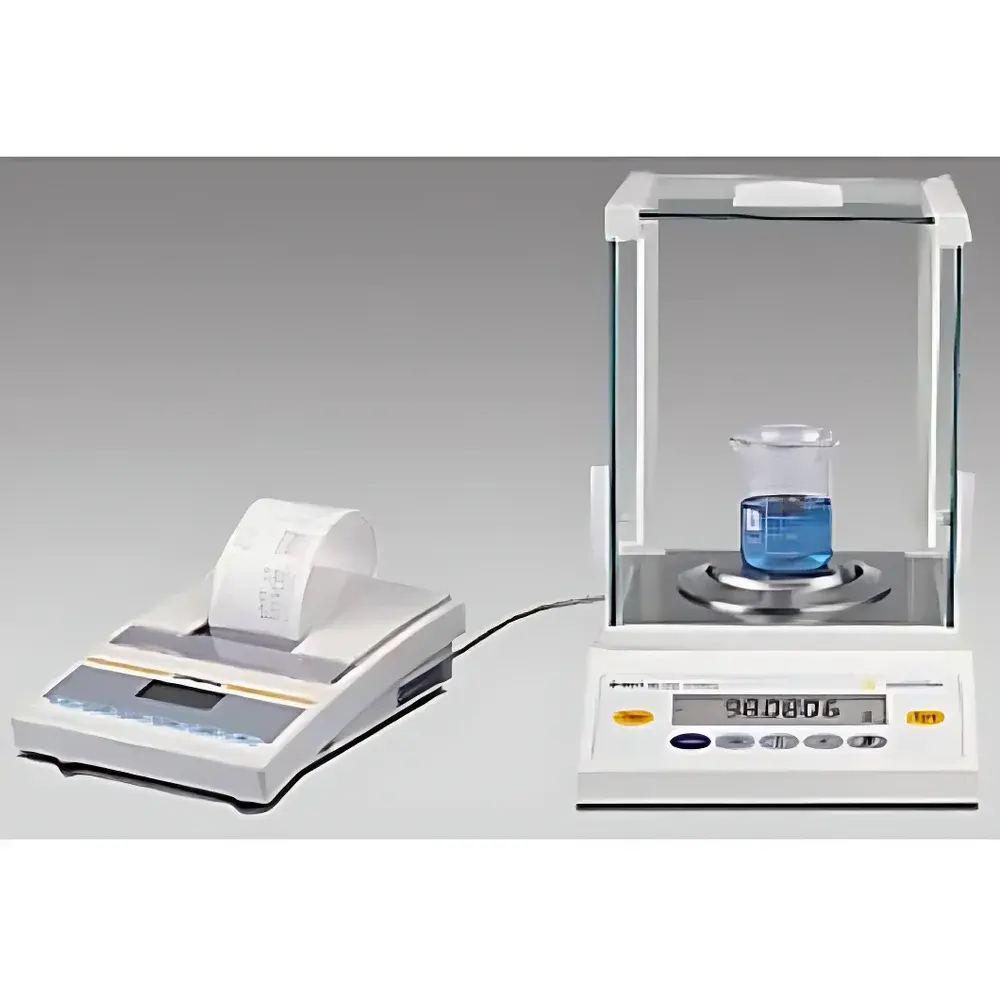
Sartorius BT125D Analytical Balance
| Origin | Germany |
|---|---|
| Manufacturer Type | Authorized Distributor |
| Origin Category | Imported |
| Model | BT125D |
| Instrument Type | Analytical Balance |
| Maximum Capacity | 120 g |
| Readability | 0.1 mg |
| Repeatability | ≤ 0.1 mg |
| Linearity | ≤ 0.2 mg |
| Calibration | Internal Automatic Calibration |
| Shock Protection | Four-Stage Damping |
| Temperature Compensation | Dynamic Real-Time Compensation |
| Connectivity | RS232 Interface (GLP-Compliant) |
| Draft Shield | Anti-Static Coated Glass |
| Weighing Pan Diameter | 80 mm |
| Application Modes | Counting, Animal Weighing, Percentage Weighing, Net Summation, 19 Unit Conversions |
| Overload Protection | Integrated |
| Processor | Sartorius MC1 (40 MHz) |
Overview
The Sartorius BT125D Analytical Balance is a high-precision laboratory instrument engineered for demanding quantitative analysis in regulated and research-intensive environments. Utilizing a proprietary monolithic dual-lever electromagnetic force compensation sensor architecture, the BT125D delivers exceptional stability and resolution at its 0.1 mg readability level across its full 120 g capacity range. Its measurement principle relies on real-time feedback control of the restoring electromagnetic force required to maintain the weighing pan at null displacement—ensuring traceable, drift-compensated mass determination compliant with ISO/IEC 17025 metrological requirements. Designed and assembled in Germany under stringent quality management systems (ISO 9001 certified), the BT125D meets the functional and documentation rigor expected in pharmaceutical QC labs, academic analytical chemistry facilities, and contract testing organizations operating under GLP or GMP frameworks.
Key Features
- Monolithic dual-lever electromagnetic force compensation sensor — minimizes mechanical hysteresis and enhances long-term repeatability (≤ 0.1 mg)
- Sartorius MC1 40 MHz microprocessor — enables rapid stabilization (< 2 s typical), dynamic temperature compensation, and real-time linearization algorithms
- Integrated internal calibration mass — automatically initiates calibration upon power-on, temperature shift (> 1.5 °C), or user command; supports scheduled calibration routines
- Four-stage mechanical damping system — isolates the sensor from floor vibrations and acoustic disturbances common in shared lab spaces
- Anti-static coated glass draft shield — reduces electrostatic interference during low-mass measurements of powders, filters, or lyophilized samples
- RS232 serial interface — fully compliant with GLP data integrity requirements; supports direct connection to label printers, PCs, and LIMS without middleware
- Downward hook assembly — enables below-balance weighing of large-volume or suspended samples (e.g., density kits, magnetic susceptibility fixtures)
- Full suite of application modes — including piece counting (with statistical evaluation), animal weighing (dynamic averaging), percentage weighing relative to reference mass, net accumulation, and conversion among 19 SI and non-SI units
Sample Compatibility & Compliance
The BT125D accommodates standard laboratory sample formats up to 120 g, including crucibles, volumetric flasks, filter papers, and small reaction vessels (max. 80 mm pan diameter). Its anti-static shield and optimized airflow design ensure reliable operation with hygroscopic, low-density, or electrostatically charged materials. The balance conforms to international regulatory expectations: it supports audit-trail–capable data export per FDA 21 CFR Part 11 when paired with compliant software (e.g., Sartorius LabX Lite); meets ISO 17025 traceability requirements via factory calibration certificate (included); and satisfies ASTM E898–22 and USP performance criteria for analytical balances used in pharmacopeial testing. All firmware and calibration records are stored internally with time-stamped metadata.
Software & Data Management
The BT125D operates autonomously but integrates seamlessly into digital lab workflows. Its RS232 port transmits raw mass values, timestamps, stability status, and calibration events in ASCII format—enabling direct ingestion into Excel, ELN platforms, or custom Python-based QA dashboards. When used with Sartorius’ free LabX Lite software, users gain automated report generation, electronic signature support, and configurable pass/fail limits aligned with SOPs. All data exports include mandatory GLP fields: operator ID, balance ID, date/time, environmental conditions (if external sensor connected), and calibration status. No cloud dependency or subscription is required for core functionality.
Applications
- Pharmaceutical formulation — active pharmaceutical ingredient (API) dispensing, excipient ratio verification, and tablet weight uniformity testing per USP
- Materials science — precise powder dosing for catalyst synthesis, ceramic slurry preparation, and nanomaterial dispersion protocols
- Environmental testing — gravimetric analysis of particulate matter (PM₂.₅/PM₁₀ filters), TSS (total suspended solids), and evaporative residue quantification
- Academic research — stoichiometric reagent weighing in synthetic organic chemistry, isotopic tracer mass balancing, and calorimetry sample preparation
- Quality control laboratories — routine calibration of secondary standards, reference material certification, and equipment verification per ISO/IEC 17025 clause 6.4.10
FAQ
What is the difference between readability and repeatability on the BT125D?
Readability (0.1 mg) defines the smallest increment displayed; repeatability (≤ 0.1 mg) reflects the standard deviation observed across ten consecutive weighings of the same test weight under identical conditions.
Does the BT125D support external temperature or humidity sensors?
No — environmental compensation is performed internally using embedded thermistors; however, ambient data can be manually appended to exported records.
Is the internal calibration mass NIST-traceable?
Yes — each unit ships with a factory-issued calibration certificate traceable to national standards (DAkkS or UKAS accredited labs).
Can the BT125D be used in a fume hood?
Not recommended — draft shields are not rated for corrosive vapors; use only in stable, vibration-isolated benchtop environments with laminar airflow.
How often should I perform automatic calibration?
Sartorius recommends calibration at startup, after significant ambient temperature changes (>1.5 °C), and before critical measurements — or per your site’s SOP-defined frequency (e.g., every 2 hours in high-throughput QC).