
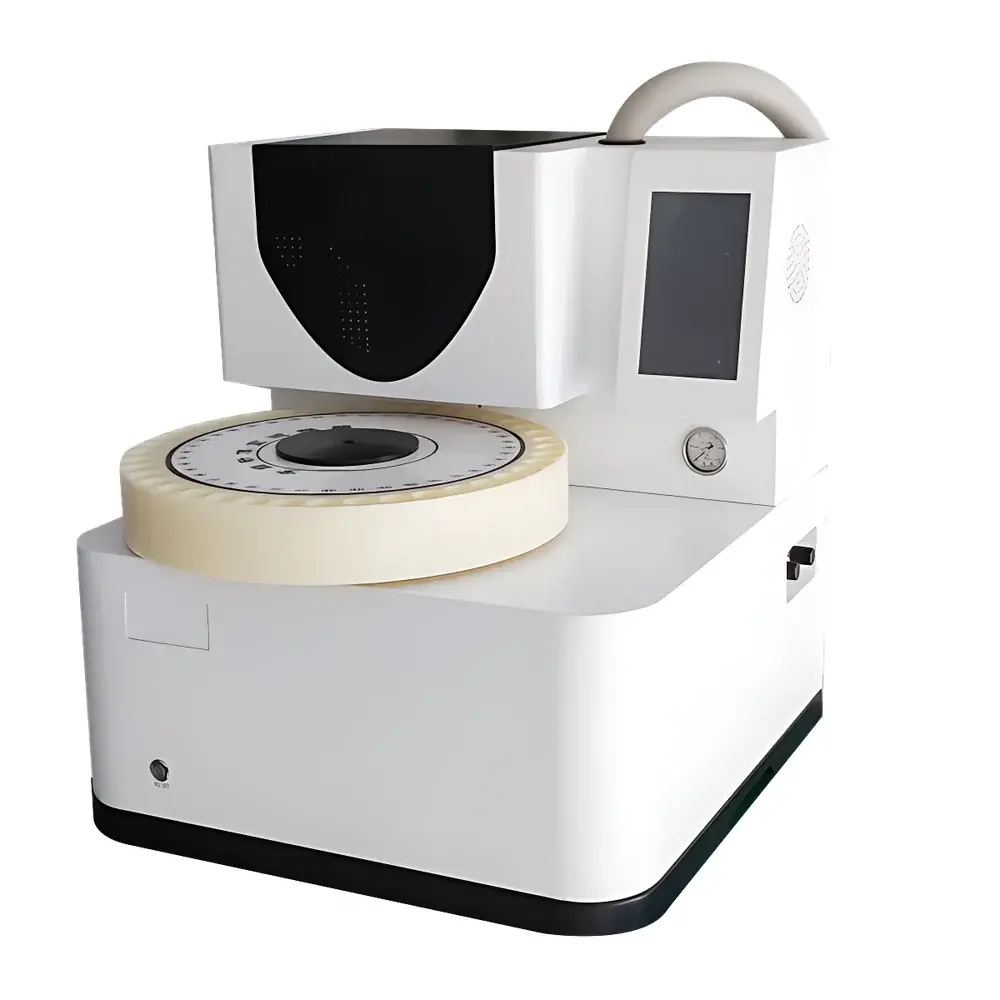
Beifen Sanpu AHS-40A Fully Automated Static Headspace Sampler
| Brand | Beifen Sanpu |
|---|---|
| Origin | Beijing, China |
| Manufacturer Type | Direct Manufacturer |
| Instrument Type | Static Headspace Sampler |
| Automation Level | Fully Automatic |
| Sample Tray Capacity | 40 positions |
| Vial Size Compatibility | 10 mL or 20 mL (customizable) |
| Vial Heating Range | 40–220 °C (±1 °C accuracy) |
| Valve & Transfer Line Heating Range | 40–220 °C (±1 °C accuracy) |
| Temperature Stability | < ±0.5 °C |
| Temperature Accuracy | ±0.5% of setpoint |
| Loop Volume | 1 mL (optional: 0.5 / 2 / 5 mL) |
| Pressurization Range | 0–0.25 MPa (continuously adjustable) |
| Sampling Time | 0–30 min |
| Injection Time | 0–999 s |
| Purge/Flush Time | 0–30 min |
| Pressure Control Resolution | 1 mPa |
| Timing Resolution | 1 ms |
| Carryover Reduction | Integrated backflush with 0–100 mL/min inert gas flow |
| RSD | <1.0% (measured on 100 ppm ethanol in water) |
| Interface | USB 2.0 for PC control |
| Compliance | HJ 679-2013, HJ 741-2015, HJ 1067-2019, HJ 642-2013, GB/T 5750.8-2006, GA/T 842-2019 |
Overview
The Beifen Sanpu AHS-40A Fully Automated Static Headspace Sampler is an engineered solution for high-throughput, reproducible volatile organic compound (VOC) analysis in compliance-critical laboratories. It operates on the principle of static headspace equilibrium—where solid or liquid samples are thermostatically incubated in sealed vials until volatile analytes partition into the headspace gas phase at thermodynamic equilibrium. This gas-phase aliquot is then transferred via pressurized displacement through a heated, inert transfer line and six-port valve into a gas chromatograph (GC) or GC-MS system. Designed for routine environmental, forensic, food safety, and pharmaceutical QC applications, the AHS-40A delivers precise thermal management across all critical zones (vial, valve, and transfer line), eliminating cold spots and ensuring quantitative integrity of thermally labile VOCs—including BTEX, chlorinated solvents, alcohols, and low-boiling esters—down to sub-ppb levels in aqueous matrices.
Key Features
- 40-position sample carousel with automatic vial position detection—no manual sample count entry required, reducing operator error and enabling unattended overnight runs.
- 15-zone independent heating block allows staggered or overlapping incubation cycles, optimizing throughput without compromising equilibration fidelity.
- Full thermal integration: vial oven, six-port valve, and fused-silica transfer line are all housed within a single insulated heating chamber (40–220 °C, ±1 °C), preventing condensation and adsorption losses.
- Positive-pressure sampling using inert carrier gas (N₂ or He) eliminates baseline drift and ensures compatibility with both split and splitless GC inlets.
- Motor-driven actuation system—no external air supply or pneumatic cylinders—enhances operational safety and simplifies facility integration.
- Onboard method storage (up to 10 user-defined methods) with real-time monitoring of pressure, temperature, timing, and system status via 7-inch graphical LCD interface.
- Integrated backflush functionality with adjustable purge flow (0–100 mL/min) minimizes carryover between samples, validated to <1.0% RSD on 100 ppm ethanol/water.
- USB 2.0 interface enables full parameter configuration from PC; supports bidirectional GC triggering and remote start/stop via TTL or relay signals.
- Comprehensive self-diagnostics: automatic power-on system check, over-temperature cut-off, pressure fault detection, and audible/visual alarm reporting.
- Inert flow path construction (silco-treated stainless steel and fluoropolymer components) prevents analyte adsorption and ensures long-term method robustness.
Sample Compatibility & Compliance
The AHS-40A accommodates standard 10 mL and 20 mL crimp-top or screw-cap headspace vials, with mechanical adaptability for custom formats (e.g., 50 mL, 100 mL) upon request. It handles diverse sample matrices—including aqueous solutions, soils, sediments, blood, beverages, polymers, and packaged foods—without modification. The instrument meets regulatory requirements for environmental and forensic testing as specified in HJ 679-2013 (acrylonitrile, acrolein), HJ 741-2015 (VOCs in soil), HJ 1067-2019 (benzene homologues in water), and GA/T 842-2019 (blood ethanol quantification). Its thermal stability (<±0.5 °C), pressure resolution (1 mPa), and timing precision (1 ms) support method validation per ISO/IEC 17025 and GLP guidelines. While not inherently 21 CFR Part 11 compliant, audit trails, electronic signatures, and method locking can be implemented via integrated LIMS or third-party chromatography data systems (CDS).
Software & Data Management
All operational parameters—including incubation temperature, pressurization time, loop fill duration, injection delay, and backflush volume—are configurable either locally via the touchscreen interface or remotely via USB-connected PC software. The embedded firmware logs timestamped system events (e.g., vial insertion, valve actuation, temperature deviation alerts) with retention up to 30 days. Method files store complete thermal and timing profiles, supporting traceable re-execution. When interfaced with major GC data systems (Agilent OpenLab, Thermo Chromeleon, Shimadzu GCsolution), the AHS-40A accepts external start commands and transmits completion signals, enabling synchronized acquisition and report generation. Optional EPC (Electronic Pressure Control) module provides closed-loop regulation of vial pressurization, improving inter-batch precision under variable ambient conditions.
Applications
The AHS-40A is routinely deployed in accredited environmental labs for EPA Method 502.2 and 8260D-compliant VOC screening in drinking water, wastewater, and leachates. In forensic toxicology, it supports quantitative ethanol and volatile solvent analysis in whole blood per ASTM E2021 and Chinese GA/T 842-2019 standards. Food and beverage laboratories utilize it for residual solvent testing (ICH Q3C), flavor profiling, and packaging migration studies (e.g., limonene in PET bottles). Pharmaceutical QC labs apply it to residual solvent determination in active pharmaceutical ingredients (APIs) per USP , particularly for Class 2 solvents such as dichloromethane and acetone. Its 40-vial capacity and 15-position heating capability make it suitable for batch processing in contract testing organizations requiring >100 samples/day throughput.
FAQ
What sample volumes and vial types are supported?
The AHS-40A natively accepts 10 mL and 20 mL headspace vials with standard crimp seals. Custom adapters for 50 mL and 100 mL vials are available upon request.
Can the instrument be integrated with GC-MS systems?
Yes—its universal GC interface supports all major GC and GC-MS platforms via TTL trigger, relay output, or direct USB handshake. No vendor-specific hardware is required.
Is method validation documentation provided?
Beifen Sanpu supplies factory calibration certificates for temperature and pressure sensors, along with a performance verification protocol (including RSD, carryover, and linearity data) aligned with ISO 17025 Annex B.
Does the system support 21 CFR Part 11 compliance?
The base configuration does not include electronic signature or audit trail features; however, full Part 11 compliance can be achieved when operated under validated CDS software with role-based access control and immutable log archiving.
What maintenance intervals are recommended?
Valve rotor seal replacement every 10,000 injections; transfer line bake-out weekly; vial tray cleaning after each 500-run cycle; annual thermocouple calibration by accredited service provider.





