
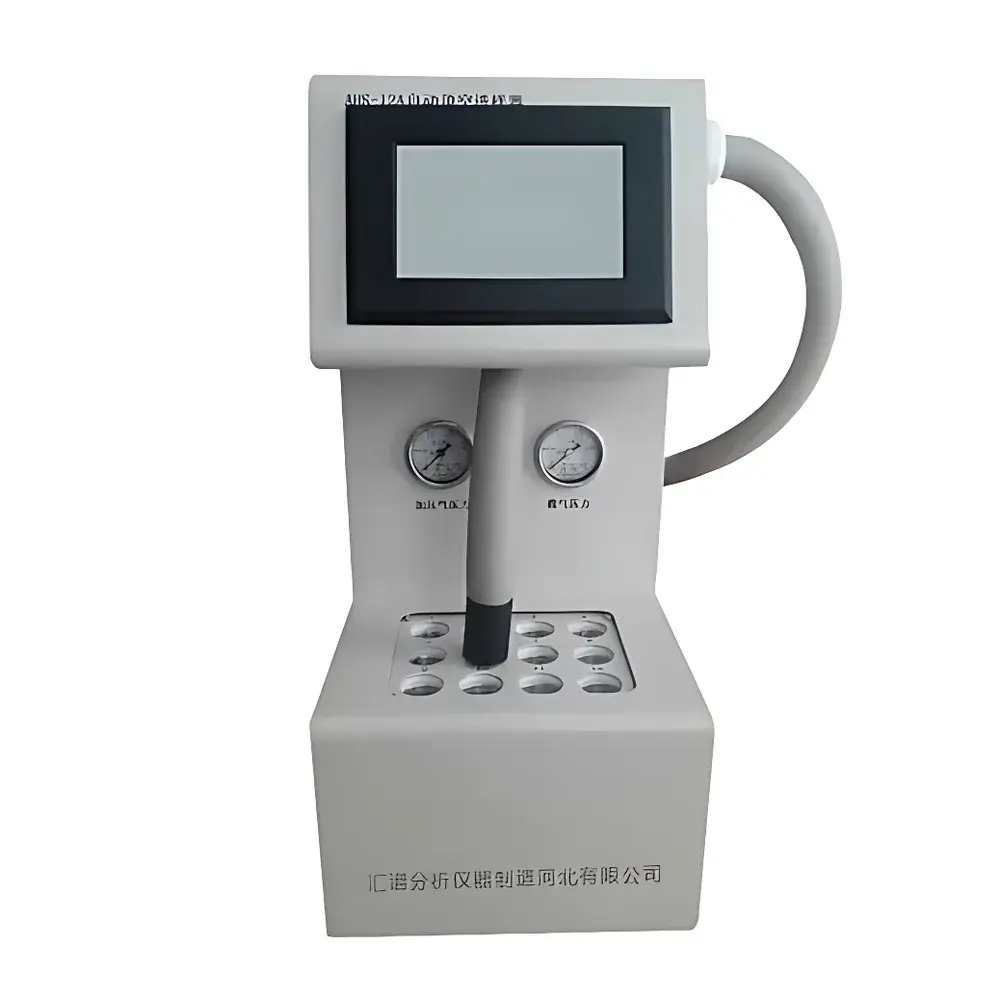
Beifen Sanpu AHS-10A 12-Position Automated Headspace Sampler
| Brand | Beifen Sanpu |
|---|---|
| Origin | Hebei, China |
| Manufacturer Type | OEM Manufacturer |
| Instrument Type | Dynamic Headspace Sampler |
| Automation Level | Semi-Automatic |
| Vial Heating Range | Ambient to 200 °C (1 °C increment) |
| Valve & Quantitative Loop Temperature Control | Ambient to 200 °C (1 °C increment) |
| Sample Transfer Line Temperature Control | Ambient to 200 °C (1 °C increment) |
| Quantitative Loop Volume | 1 mL (optional: 0.5 mL or 3 mL) |
| Vial Capacity | 20 mL (optional: 10 mL) |
| Vial Positions | 12 |
| Temperature Stability | ±0.5 °C |
| RSD (n=6, 40 ppm ethanol in water) | ≤1.5% |
| Purge/Backflush Flow | 0–500 mL/min (continuously adjustable) |
| Dimensions (L×W×H) | 200 × 360 × 420 mm |
| Weight | ~18 kg |
Overview
The Beifen Sanpu AHS-10A 12-Position Automated Headspace Sampler is a semi-automated dynamic headspace sampling system engineered for precise, reproducible extraction and introduction of volatile organic compounds (VOCs) from solid or liquid matrices into gas chromatographs (GC). It operates on the fundamental principle of phase equilibrium partitioning: samples are sealed in inert vials and heated to promote volatilization of analytes into the headspace above the matrix. A pressurized, temperature-controlled sampling loop then draws a representative aliquot of this equilibrated vapor phase—ensuring quantitative transfer without liquid-phase carryover. Designed for routine QC/QA laboratories in pharmaceutical, environmental, food safety, and forensic applications, the AHS-10A supports compliant workflows under GLP and ISO/IEC 17025 frameworks. Its triple-zone independent temperature control (vial block, valve/loop, and transfer line) eliminates condensation artifacts and maintains analyte integrity throughout the sampling path.
Key Features
- 5-inch full-color capacitive touchscreen interface with intuitive icon-driven navigation—enabling rapid method setup and real-time status monitoring without training overhead;
- Front-access 12-position vial carousel optimized for seated operation, minimizing ergonomic strain during high-throughput batch processing;
- Custom-engineered electrically actuated 6-port switching valve paired with a precision-machined 1 mL quantitative loop; delivers positive-pressure sampling for enhanced sensitivity and volumetric accuracy;
- Uniformly distributed heating elements across the vial block reduce inter-vial thermal gradients (<±0.5 °C), improving inter-sample repeatability and long-term method robustness;
- Independent thermal control of the sampling valve, quantitative loop, and transfer tubing (all up to 200 °C) prevents analyte adsorption or cold-trapping during transport;
- Integrated backflush/purge function (0–500 mL/min, continuously adjustable) clears residual analytes from the needle and valve pathways between injections—effectively eliminating cross-contamination;
- 10 user-editable, non-volatile method storage slots support rapid recall of validated protocols for regulated environments;
- Hardware-level GC synchronization via TTL trigger output ensures precise timing alignment between sample injection and data acquisition start;
- Comprehensive safety architecture includes overtemperature cutoff, thermal runaway detection, and automatic power disconnect on sensor failure;
- Modular needle interface compatible with standard GC inlet ferrules (e.g., Agilent, Shimadzu, Thermo Fisher), enabling seamless integration with global GC platforms.
Sample Compatibility & Compliance
The AHS-10A accommodates standard 20 mL crimp-top headspace vials (10 mL optional), compatible with common septa types (PTFE/silicone, BTO, or butyl). It supports aqueous, viscous, polymeric, and heterogeneous solid samples—including pharmaceutical tablets, soil slurries, polymer films, and food homogenates—without derivatization or solvent extraction. The instrument’s design aligns with key regulatory expectations: its temperature stability (±0.5 °C), RSD performance (≤1.5% at 40 ppm ethanol), and hardware-triggered GC synchronization facilitate compliance with USP , EP 2.4.24, ASTM D7691, and ISO 11843-7. Audit trail functionality is supported through external LIMS or chromatography data systems (CDS) that accept TTL timestamps and method metadata export.
Software & Data Management
The AHS-10A operates autonomously via embedded firmware—no PC dependency required for basic operation. All method parameters (heating profiles, loop fill time, purge duration, valve timing) are stored locally in non-volatile memory. For traceability in regulated labs, the unit outputs TTL pulses synchronized to each injection event, allowing CDS software (e.g., OpenLab CDS, Chromeleon, Empower) to log injection timestamps, method IDs, and operator annotations. Raw temperature logs and error codes are accessible via USB port for offline review. While the device does not include FDA 21 CFR Part 11-compliant electronic signatures, its deterministic hardware behavior and deterministic sequence execution make it suitable for GMP-aligned workflows when paired with validated CDS and procedural controls.
Applications
- Pharmaceutical quality control: Residual solvents (ICH Q3C) in APIs and excipients;
- Environmental analysis: Volatile halocarbons (e.g., chloroform, carbon tetrachloride) in drinking water per EPA Method 502.2;
- Food and beverage safety: Ethanol in vinegar, acetaldehyde in PET packaging, hexane in edible oils;
- Forensic toxicology: Quantification of ethanol, acetone, and isopropanol in blood and urine matrices;
- Polymer manufacturing: Aldehyde off-gassing from PET resins and epoxy curing agents;
- Medical device sterilization validation: Ethylene oxide residue testing per ISO 10993-7;
- Consumer product safety: VOC emissions from adhesives, coatings, and composite building materials.
FAQ
Is the AHS-10A fully automated or semi-automated?
The AHS-10A is classified as semi-automatic: it automates vial heating, loop pressurization, valve actuation, and GC triggering—but requires manual vial loading/unloading and septum piercing prior to run initiation.
Can the quantitative loop volume be changed without tools?
No. Loop replacement (e.g., from 1 mL to 0.5 mL) requires disassembly and re-calibration by qualified service personnel to maintain volumetric accuracy and pressure integrity.
Does the instrument support method validation per ICH guidelines?
Yes—its documented temperature precision (±0.5 °C), RSD performance (≤1.5%), and hardware-level GC synchronization provide foundational data for system suitability testing in ICH Q2(R2)-aligned validation protocols.
What maintenance is required for long-term reliability?
Routine maintenance includes quarterly inspection of septa integrity, annual verification of temperature calibration against NIST-traceable standards, and biannual cleaning of the backflush gas filter to maintain flow accuracy.
Is remote monitoring or network connectivity available?
The AHS-10A does not feature Ethernet or Wi-Fi connectivity; however, its TTL output and USB diagnostics port enable integration into centralized lab automation networks via programmable logic controllers (PLCs) or custom middleware interfaces.
Related Products





