
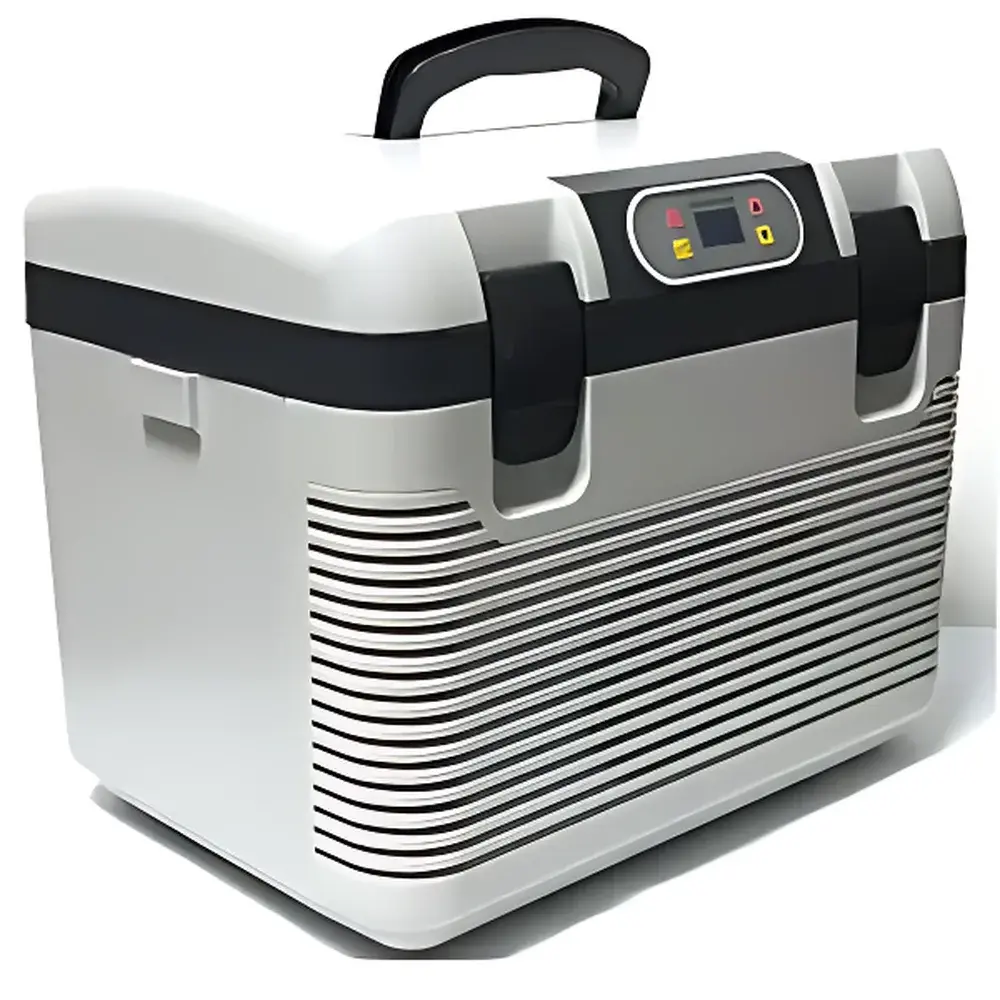
Beifen Sanpu HW-19L Portable Sample Preservation Heating Chamber
| Brand | Beifen Sanpu |
|---|---|
| Origin | Hebei, China |
| Manufacturer Type | Direct Manufacturer |
| Country of Origin | China |
| Model | HW-19L |
| Temperature Range | Ambient to 105 °C |
| External Dimensions | 44 cm × 30 cm × 35 cm |
| Internal Chamber Dimensions | 38 cm × 18 cm × 25 cm |
| Interior Material | Anodized Aluminum |
| Heating Method | Five-Side Circulating Convection Heating |
| Power Supply | 220 V, 50 Hz or DC 12 V (vehicle-compatible) |
| Rated Power | 90–110 W |
| Net Weight | ≈ 5 kg |
| Insulation | Polyurethane Foam |
| Control Interface | Digital Keypad with One-Touch 100 °C Preset |
| Heating System Lifetime | ≥ 8,000 h Continuous Operation |
Overview
The Beifen Sanpu HW-19L Portable Sample Preservation Heating Chamber is an engineered thermal management solution designed specifically for compliance with HJ 1261–2022 — the Chinese national standard for the determination of benzene-series compounds in stationary source exhaust gases using gas bag sampling and direct injection gas chromatography. This chamber addresses a critical analytical challenge: the condensation of volatile organic compounds (VOCs), particularly water vapor and semi-volatiles, during transport and interim storage of gas-phase samples. By maintaining precise, uniform temperature control across its entire internal volume, the HW-19L prevents phase separation, adsorption loss, and chemical degradation—especially for thermally labile analytes such as styrene, which exhibits significant decay (>60% loss within 24 h at ambient temperature). Its operational principle relies on five-side circulating convection heating, eliminating cold spots and ensuring thermal homogeneity without mechanical fans—thus delivering silent, stable, and reproducible thermal environments essential for regulatory-grade environmental analysis.
Key Features
- Five-side circulating convection heating system ensures uniform temperature distribution throughout the 19 L internal chamber—no localized hot/cold zones, no fan-induced vibration or noise.
- Digital microprocessor controller with one-touch 100 °C preset and adjustable setpoint (ambient to 105 °C in 1 °C increments) for method-specific thermal conditioning.
- Lightweight portable design (≈5 kg) with integrated carrying handle and optional shoulder strap—optimized for field deployment, mobile labs, and multi-site monitoring programs.
- Thermally insulated chamber constructed with high-density polyurethane foam (≥35 mm thickness), aluminum interior lining (anodized for corrosion resistance), and impact-resistant ABS exterior housing.
- Universal power compatibility: operates on standard 220 V/50 Hz mains or 12 V DC vehicle supply—enabling uninterrupted operation during transit or off-grid sampling campaigns.
- Robust heating element rated for ≥8,000 hours of continuous service life under nominal load—validated per IEC 60335-1 safety and endurance protocols.
Sample Compatibility & Compliance
The HW-19L is validated for use with standard Tedlar® and fluorinated ethylene propylene (FEP) gas sampling bags (0.5–10 L capacity), accommodating up to six 3-L bags simultaneously. Its temperature stability (±0.5 °C at 100 °C, measured per ASTM E220) meets the thermal consistency requirements specified in HJ 1261–2022 Section 6.3 for sample preservation containers. The unit supports GLP-aligned workflows: all heating cycles are manually initiated and logged via operator timestamp; no automated audit trail is embedded, but full traceability is maintained when used in conjunction with laboratory notebooks or LIMS-integrated SOP documentation. While not certified to ISO/IEC 17025 calibration standards out-of-box, it is suitable for use in ISO 17025-accredited laboratories when operated per documented validation procedures—including daily temperature uniformity verification using NIST-traceable PT100 probes.
Software & Data Management
The HW-19L operates as a standalone hardware device with no embedded firmware, network interface, or proprietary software. Temperature settings and operational status are managed exclusively via its front-panel keypad and LED display. This architecture eliminates cybersecurity risks, software obsolescence, and vendor lock-in—aligning with the preference of regulated environmental testing laboratories for deterministic, low-complexity instrumentation. For data integrity in GxP environments, users are advised to record setpoint, duration, and ambient conditions in hard-copy logbooks or electronic lab notebooks (ELN) compliant with 21 CFR Part 11 requirements (e.g., LabArchives, Benchling). No firmware updates, cloud connectivity, or remote diagnostics are provided or supported.
Applications
- Pre-injection thermal conditioning of gas bag samples prior to GC analysis per HJ 1261–2022, eliminating water condensate and restoring homogeneous vapor-phase composition.
- Stabilization of benzene, toluene, ethylbenzene, xylenes (BTEX), isopropylbenzene, and styrene during 1–72 h holding periods—particularly critical for styrene, which requires analysis within 12 h unless actively heated.
- Field-based thermal decontamination of sampling bags (60–80 °C for 30 min) to reduce carryover between high- and low-concentration runs.
- Transport conditioning for inter-laboratory proficiency testing schemes requiring identical thermal history across participating sites.
- Supporting EPA Method TO-15 and ISO 16017-1 workflows where controlled sample warming mitigates adsorptive losses on bag surfaces.
FAQ
Is the HW-19L compatible with both AC and DC power sources?
Yes—it accepts 220 V/50 Hz mains input and includes a DC input option for 12 V vehicle power, enabling seamless operation during mobile sampling missions.
Does the unit meet international regulatory standards such as ISO or ASTM?
It is engineered to support compliance with HJ 1261–2022 and functionally aligns with ASTM E220 temperature uniformity expectations; however, it carries no third-party ISO/IEC 17025 or CE certification.
Can the HW-19L be used for applications beyond benzene-series analysis?
Yes—any VOC or semi-VOC sampling protocol requiring thermal stabilization of gas-phase samples (e.g., aldehydes, chlorinated hydrocarbons, or sulfur compounds) may benefit from its uniform heating profile and condensate suppression capability.
What maintenance is required for long-term reliability?
No scheduled maintenance is needed. Periodic visual inspection of the aluminum chamber surface and cleaning with isopropyl alcohol is recommended. The heating element requires no servicing over its rated 8,000-hour lifespan.
Is calibration documentation provided with the instrument?
A factory-verified temperature accuracy statement (±1.0 °C at 100 °C) is included. Users must perform in-house verification using calibrated reference thermometers before first use and at defined intervals per their quality management system.



