
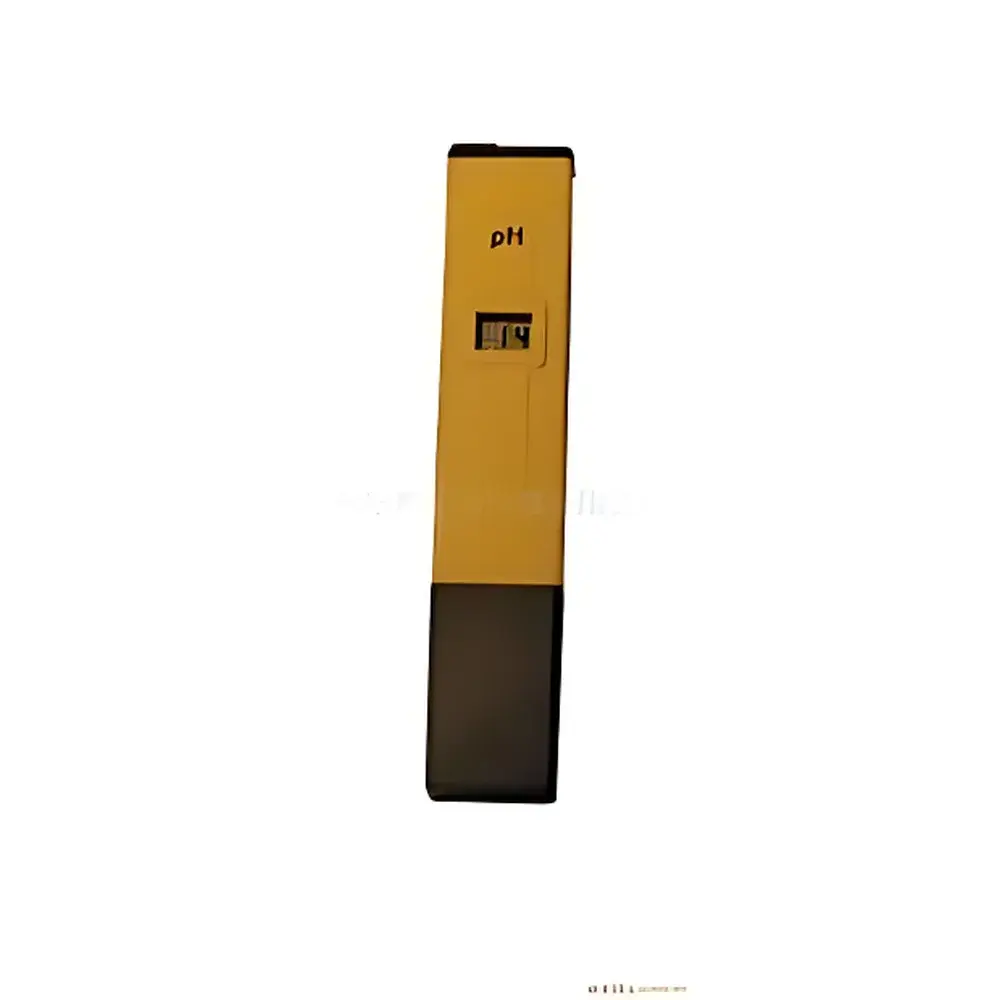
Sanpu PHS-2000 Portable Pen-Type pH Meter
| Brand | Sanpu |
|---|---|
| Model | PHS-2000 |
| Type | Portable Pen-Style pH Meter |
| Measurement Range | 0.0–14.0 pH |
| Resolution | 0.1 pH |
| Accuracy | ±0.2 pH |
| Temperature Compensation | Automatic (0–50 °C) |
| Power Supply | 4 × 1.5 V AG-13 button cells |
| Battery Life | ~1000 hours |
| Dimensions | 142 × 29 × 15 mm |
| Weight | 65 g |
| Calibration Buffers | pH 6.86 (phosphate), pH 9.18 (borax) or pH 14.00 (potassium hydrogen phthalate) |
| IP Rating | IP67 (dust-tight and immersion-resistant up to 1 m for 30 min) |
| Compliance | Meets GB/T 11165–2022 (Chinese national standard for laboratory pH meters) |
Overview
The Sanpu PHS-2000 is a compact, battery-powered pen-type pH meter engineered for rapid, reliable field and benchtop pH measurements in academic laboratories, quality control environments, and routine industrial process checks. Based on potentiometric measurement principles, it employs a glass combination electrode with integrated reference junction to detect the hydrogen ion activity difference between the sample and internal reference solution, converting the resulting electromotive force (EMF) into a digital pH reading via high-impedance analog-to-digital conversion. Its design emphasizes operational simplicity without compromising metrological integrity: the instrument features automatic temperature compensation (ATC) across 0–50 °C, enabling accurate readings across typical ambient and mild thermal conditions encountered in water analysis, food preparation, educational labs, and environmental sampling. Unlike benchtop meters requiring external electrodes and cables, the PHS-2000 integrates sensing, signal conditioning, and display into a single handheld unit—reducing contamination risk, minimizing setup time, and supporting GLP-aligned documentation when paired with manual log entries.
Key Features
- Single-handed operation with intuitive on/off switch located at the battery compartment base
- High-contrast LCD display with backlight-independent visibility under ambient lab lighting
- Integrated AG-13 button cell power system (4 × 1.5 V), delivering up to 1000 hours of continuous use per set
- Robust ABS housing rated IP67 for dust ingress protection and temporary submersion (1 m, 30 min)
- Manual zero-point adjustment via recessed calibration potentiometer for long-term baseline stability
- Self-contained electrode with replaceable pH-sensitive glass membrane and porous ceramic junction
- Compact form factor (142 × 29 × 15 mm) and lightweight construction (65 g) for portability and ergonomic handling
Sample Compatibility & Compliance
The PHS-2000 is validated for aqueous solutions with conductivity ≥100 µS/cm and total dissolved solids (TDS) < 5000 ppm. It is not intended for non-aqueous solvents, highly viscous media, or samples containing sulfides, heavy metals, or strong oxidizers that may poison the reference electrode. Calibration follows standardized two-point methodology using NIST-traceable buffer solutions—pH 6.86 (potassium dihydrogen phosphate / disodium hydrogen phosphate) and pH 9.18 (borax) at 25 °C—as specified in ISO 7888 and ASTM D1293. The device conforms to GB/T 11165–2022, China’s national standard for laboratory pH meters, which defines requirements for accuracy, repeatability, temperature compensation error, and electrical safety. While not FDA 21 CFR Part 11–compliant out-of-the-box (lacking electronic audit trail or user authentication), its manual calibration and measurement records support paper-based GLP/GMP workflows where traceability is maintained via dated lab notebooks.
Software & Data Management
The PHS-2000 operates as a standalone instrument with no embedded memory, Bluetooth, or USB connectivity. All measurements are displayed in real time and must be manually recorded. This architecture eliminates firmware vulnerabilities, ensures deterministic response latency (<2 s stabilization), and guarantees data sovereignty—no cloud transmission or third-party telemetry occurs. For regulated environments, users may integrate the meter into existing LIMS or ELN systems by transcribing readings alongside metadata (date/time, operator ID, sample ID, calibration status, ambient temperature). The absence of proprietary software reduces validation burden during IQ/OQ/PQ protocols, particularly in ISO 17025-accredited testing labs where instrument qualification focuses on physical verification and performance testing rather than software validation.
Applications
- Routine pH verification in university teaching labs for general chemistry and environmental science courses
- On-site monitoring of municipal drinking water, swimming pool water, and wastewater effluent
- Pre-screening of food and beverage samples (e.g., dairy, juice, vinegar) prior to full QC analysis
- Soil extract analysis (1:5 water suspension) in agricultural extension services
- Calibration verification of larger benchtop pH systems using portable cross-checking
- Field-based environmental assessments including stream, pond, and rainwater sampling
FAQ
What calibration buffers are required for initial setup?
The PHS-2000 requires two NIST-traceable standard buffer solutions: pH 6.86 (mixed phosphate) for the first point and either pH 9.18 (borax) or pH 14.00 (potassium hydrogen phthalate) for the second point. Buffers must be at ambient temperature during calibration.
Is temperature compensation automatic or manual?
Automatic temperature compensation (ATC) is built-in and active across 0–50 °C; no user input is needed beyond ensuring the sensor tip is fully immersed in the sample during measurement.
Can the electrode be replaced independently?
No—the pH sensing element is permanently integrated into the pen body. When performance degrades (e.g., slow response >60 s, drift >0.3 pH between calibrations), the entire unit is replaced per manufacturer recommendation.
Does the device meet international regulatory standards for QC use?
It complies with GB/T 11165–2022 and aligns with core metrological principles of ISO 7888 and ASTM D1293. For FDA-regulated environments, it may serve as a secondary check tool but cannot fulfill primary release testing requirements without supplementary procedural controls.
How often should recalibration be performed?
Recalibrate before each measurement session, after prolonged storage (>24 h), following exposure to extreme pH samples (e.g., pH 12), or whenever observed drift exceeds ±0.2 pH during verification with a fresh buffer.




