
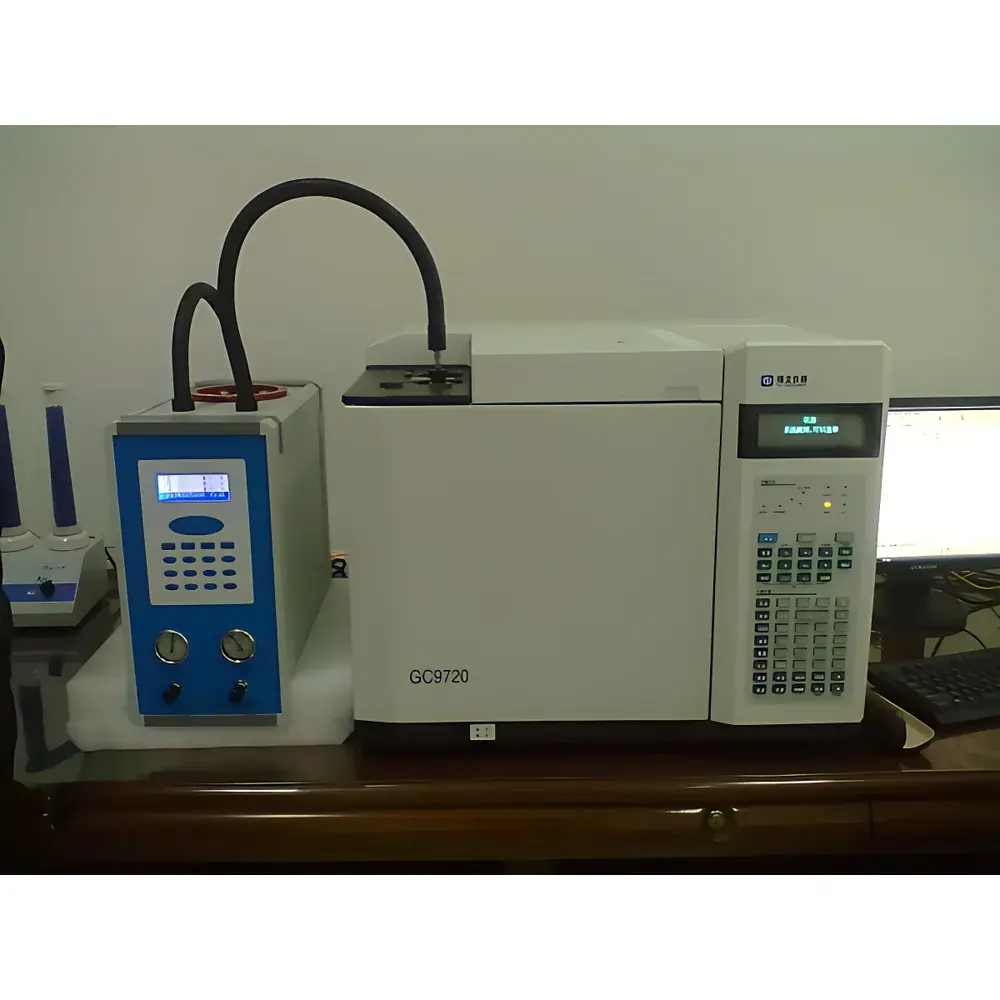
Beifen Sanpu AHS-610 Headspace Sampler Coupled with Fulai GC-9720 Gas Chromatograph for VOC Residue Analysis in Tobacco Packaging and Printing Inks
| Brand | Beifen Sanpu |
|---|---|
| Origin | Beijing, China |
| Manufacturer Type | Direct Manufacturer |
| Instrument Origin | Domestic (China) |
| Model | AHS-610 Headspace Autosampler + Fulai GC-9720 Gas Chromatograph |
| Pricing | Available Upon Request |
Overview
This integrated analytical system is engineered specifically for the quantitative determination of residual volatile organic compounds (VOCs) in tobacco packaging materials—including cigarette carton and wrapper papers—as well as printing inks and flexible packaging substrates. It implements the standardized headspace-gas chromatography (HS-GC) methodology, fully compliant with Chinese tobacco industry standards YC/T 207–2006 and YC 263–2008. The technique relies on thermally induced phase equilibrium: under controlled temperature and time conditions, VOCs partition from the solid or semi-solid matrix into the headspace vapor phase above the sample. A precise volume of this equilibrated headspace gas is then transferred to the GC inlet via a pressurized loop injection mechanism. Separation occurs on a fused-silica capillary column with optimized polarity and thermal stability, followed by detection using a flame ionization detector (FID). Quantification employs matrix-matched calibration curves with internal standard correction where applicable, ensuring trace-level accuracy and method robustness across heterogeneous packaging substrates.
Key Features
- Automated, programmable headspace sampling with precise temperature control (±0.1 °C) and equilibration timing (0.1–99.9 min), minimizing operator variability and enhancing reproducibility.
- Dual-channel GC configuration supports simultaneous analysis of multiple VOCs without co-elution interference; includes split/splitless injection mode and oven temperature ramping (35–250 °C at 0.1–40 °C/min).
- FID detection with linear dynamic range exceeding 10⁷ and baseline noise <0.03 pA, enabling reliable quantitation down to ≤0.002 mg/m² for benzene—meeting stringent regulatory thresholds for consumer-facing packaging.
- Integrated hardware-software synchronization ensures deterministic sequence execution, retention time locking, and automatic peak integration using calibrated response factors.
- Robust architecture designed for continuous operation in QC laboratories: stainless-steel gas pathways, leak-tight fittings, and redundant pressure monitoring throughout the carrier gas and headspace transfer lines.
Sample Compatibility & Compliance
The system accommodates diverse sample formats including coated paper, laminated films, gravure/offset inks, and composite packaging foils. Sample preparation follows standardized solvent extraction or direct headspace vial loading per YC/T 207–2006, with validated weighing protocols (±0.1 mg) and vial sealing integrity checks. Method validation adheres to ICH Q2(R2) guidelines for specificity, linearity (r² ≥ 0.999 over 0.005–5.0 mg/m²), accuracy (recovery 85–115%), precision (RSD ≤ 5% intra-day, ≤8% inter-day), and limit of quantitation (LOQ). Full audit trail functionality supports GLP-compliant documentation, and instrument control software is compatible with 21 CFR Part 11–enabled electronic signatures when deployed within validated IT environments.
Software & Data Management
Chromatographic data acquisition and processing are performed using Fulai’s GCStation v3.5 software, featuring multi-user role-based access control, electronic lab notebook (ELN) integration, and automated report generation in PDF/A format. All raw data files (.cdf), method parameters, sequence logs, and audit trails are stored with immutable timestamps and user attribution. Data archiving complies with ISO/IEC 17025:2017 requirements for record retention, and optional LIMS connectivity enables seamless workflow handoff to enterprise quality management systems. Calibration verification runs are scheduled automatically prior to each analytical batch, with deviation alerts triggered if system suitability criteria (e.g., resolution >1.5 between o-xylene/m-xylene, tailing factor <1.5) fall outside predefined limits.
Applications
- Regulatory compliance testing for VOC residues in cigarette packaging per YC/T 207–2006 and YC 263–2008.
- QC release testing of solvent-based and UV-curable inks used in high-speed flexographic and rotogravure printing.
- Supplier qualification audits for barrier film manufacturers supplying lamination-grade PET/AL/PE composites.
- Root cause analysis of odor complaints in finished tobacco products linked to migration from printed overwraps.
- Method development support for emerging solvents (e.g., bio-based esters, low-VOC glycol ethers) under evolving environmental stewardship programs.
FAQ
What VOCs are quantified using this system?
Benzene, toluene, ethylbenzene, xylene (o-, m-, p-), ethanol, isopropanol, n-butanol, acetone, 4-methyl-2-pentanone, methyl ethyl ketone, cyclohexanone, ethyl acetate, n-propyl acetate, n-butyl acetate, isopropyl acetate, and propylene glycol monomethyl ether—totaling 16 analytes specified in tobacco industry standards.
Is the system compliant with international regulatory frameworks beyond Chinese standards?
While method validation aligns with YC/T 207–2006, the underlying HS-GC-FID principle is universally accepted under ISO 11843, ASTM D6348, and USP <467> for residual solvent analysis; method transfer to ISO/IEC 17025-accredited labs is routinely achieved with minor revalidation.
Can the system be upgraded for mass spectrometric detection?
Yes—the GC-9720 platform supports retrofitting with a single-quadrupole MS detector (e.g., Fulai MS-900), enabling compound identification, enhanced selectivity in complex matrices, and expanded scope to semi-volatile organics (SVOCs) such as phthalates or nitrosamines.
What maintenance intervals are recommended for routine operation?
Daily: FID jet cleaning and baseline check; weekly: septum and liner replacement; quarterly: column trimming and detector optimization; annually: full pneumatic system leak test and temperature calibration verification per manufacturer SOPs.
Does the system support unattended overnight analysis?
Yes—AHS-610 supports up to 120 vial positions with auto-defrost and temperature-stabilized incubation; GC-9720 includes power-fail recovery and sequence resumption logic, enabling fully automated batch runs exceeding 24 hours.





