
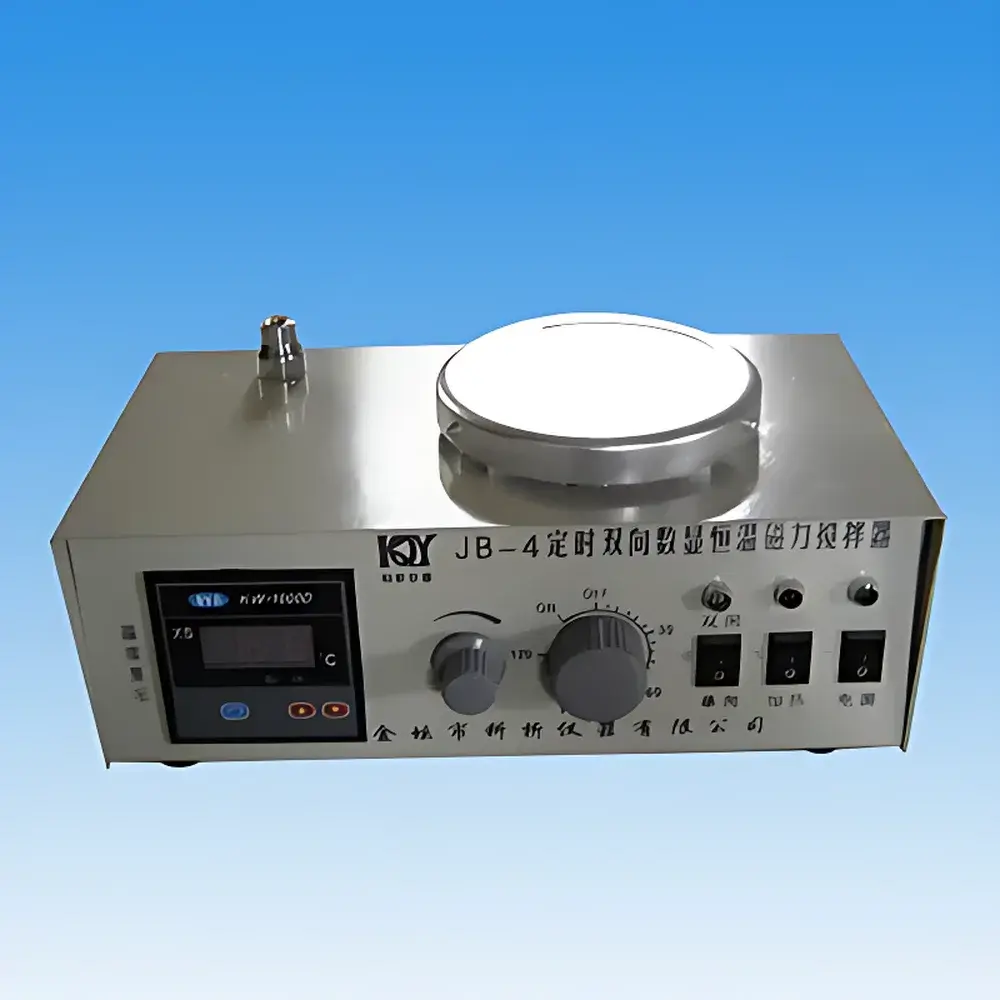
Beifen Sanpu JB-45 Digital Timer Bidirectional Magnetic Stirrer with Heating & Temperature Control
| Brand | Beifen Sanpu |
|---|---|
| Origin | Beijing, China |
| Manufacturer Type | Direct Manufacturer |
| Model | JB-45 |
| Power Supply | 220 V ±10%, 50 Hz |
| Motor Power | 25 W |
| Heating Power | 400 W |
| Speed Range | 0–2600 rpm (infinitely variable) |
| Bidirectional Cycle | 60 s forward / 60 s reverse |
| Timer Range | 0–120 min |
| Temperature Control Range | Ambient to 100 °C (digital PID display) |
| Construction | Cold-rolled steel housing with high-temp epoxy powder coating |
| Included Accessories | One PTFE-coated stir bar, one stainless-steel temperature probe, support rod set, power cord |
Overview
The Beifen Sanpu JB-45 Digital Timer Bidirectional Magnetic Stirrer with Integrated Heating and Precision Temperature Control is an engineered laboratory instrument designed for reproducible, low-maintenance mixing under thermally regulated conditions. It operates on the principle of magnetic coupling—where a rotating permanent magnet beneath the work surface induces synchronous rotation of a PTFE- or glass-coated magnetic stir bar immersed in the sample vessel. Unlike mechanical overhead stirrers, this design eliminates shaft seals and drive-train wear, ensuring long-term reliability and contamination-free operation. The JB-45 integrates three core functions into a single compact platform: bidirectional stirring (with programmable forward/reverse timing), infinitely variable speed control (0–2600 rpm), and digital PID temperature regulation (ambient to 100 °C). Its 25 W brushless DC motor delivers stable torque across the full speed range and is rated for >10,000 hours of continuous no-load operation—making it suitable for unattended overnight protocols in academic, environmental, pharmaceutical, and quality control laboratories.
Key Features
- True bidirectional operation with independent 60-second forward/reverse timing cycles—ideal for preventing vortex formation, enhancing particle suspension, and improving homogenization of viscous or heterogeneous samples.
- Digital timer with 1-minute resolution (0–120 minutes), supporting both timed runs and continuous “ON” mode for extended experiments.
- Infinitely variable speed control (0–2600 rpm) with soft-start logic—prevents stir bar ejection during acceleration and enables precise optimization for low-shear or high-turbulence applications.
- Integrated 400 W heating element with digital PID temperature controller and stainless-steel RTD probe—provides ±1 °C accuracy across the 25–100 °C range and supports ramp-hold thermal profiles when used with external software interfaces.
- Rugged cold-rolled steel chassis with high-temperature epoxy powder coating—resists corrosion from solvents, acids, and cleaning agents; compliant with ISO 14644-1 Class 8 cleanroom-compatible handling practices.
- Low-noise, vibration-damped motor architecture—meets IEC 60068-2-64 shock and vibration test standards for laboratory equipment stability.
Sample Compatibility & Compliance
The JB-45 accommodates standard round-bottom and flat-bottom glassware (up to 2000 mL capacity) placed centrally on its ceramic-coated aluminum plate. Its magnetic field geometry ensures efficient coupling with stir bars ranging from 10 mm to 40 mm in length. The unit is compatible with aqueous, organic, and mildly corrosive media—including buffered saline, ethanol/water mixtures, and dilute HCl/NaOH solutions—provided containers are chemically inert and thermally stable up to 100 °C. From a regulatory standpoint, the JB-45 conforms to IEC 61010-1:2010 (Safety Requirements for Electrical Equipment for Measurement, Control, and Laboratory Use) and meets EMC immunity per IEC 61326-1:2020. While not inherently 21 CFR Part 11 compliant, its digital timer and temperature logs can be exported via optional RS-232 or USB interface for integration into validated GxP workflows requiring audit trails.
Software & Data Management
The JB-45 features a front-panel LED display showing real-time speed (rpm), set temperature (°C), elapsed time (min), and active mode (HEAT/STIR/TIMER). For advanced data capture, optional communication modules enable connection to PC-based logging software (e.g., LabVIEW or custom Python scripts via PySerial). This allows timestamped export of temperature and speed profiles—supporting GLP-compliant record retention and retrospective analysis. All parameter changes are logged internally with timestamps (when equipped with firmware v2.1+), satisfying basic ALCOA+ data integrity principles for non-critical R&D environments.
Applications
- Preparation of calibration standards and reference solutions in analytical chemistry labs (e.g., ICP-OES, HPLC mobile phase blending).
- Controlled dissolution testing of solid dosage forms under USP conditions (when paired with appropriate vessels and temperature validation).
- Synthesis of metal-organic frameworks (MOFs) and nanoparticle dispersions requiring uniform shear and thermal history control.
- Environmental sample digestion (EPA Method 3050B) and extraction protocols where bidirectional agitation improves acid contact efficiency.
- Cell culture media equilibration and reagent pre-warming in biosafety cabinets—leveraging its low electromagnetic emission profile.
FAQ
What is the maximum recommended operating time at full speed?
Continuous operation at speeds above 1800 rpm is limited to 4 hours to maintain thermal stability of the motor windings and magnetic coupling efficiency.
Can the JB-45 be used with conductive or ferromagnetic containers?
No—only non-magnetic, non-conductive vessels (e.g., borosilicate glass, PP, or PTFE) should be used; metallic or induction-heating-compatible containers will disrupt magnetic field uniformity and may damage the heater plate.
Is the temperature probe calibrated traceable to NIST standards?
The included stainless-steel RTD probe is factory-calibrated to ±1 °C at 25 °C and 100 °C; NIST-traceable recalibration certificates are available upon request for IQ/OQ documentation.
Does the unit support external temperature feedback loops?
Yes—the analog output port (0–5 V DC) provides real-time temperature signal proportional to probe reading, enabling integration with PLCs or centralized lab monitoring systems.
What safety protections are built into the system?
Over-temperature cutoff (110 °C hardware limit), motor stall detection, open-probe fault alarm, and grounded chassis design per IEC 61010 Class I requirements.



