
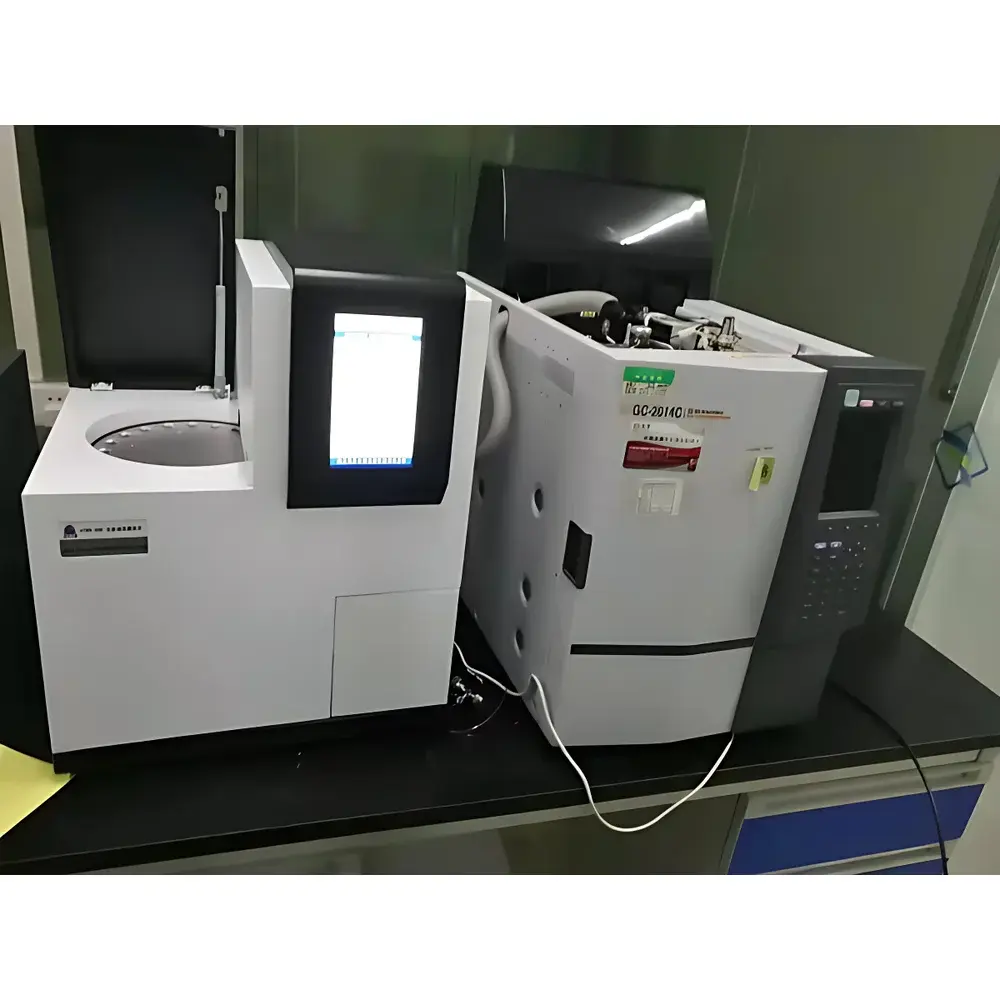
Beifen Sanpu AaTDS-20A Fully Automated Two-Stage Thermal Desorber for TVOC Analysis in Ambient Air
| Brand | Beifen Sanpu |
|---|---|
| Origin | Beijing, China |
| Manufacturer Type | Direct Manufacturer |
| Instrument Type | Two-Stage Thermal Desorber |
| Sample Position Count | 1 |
| Desorption Temperature Range | Ambient to 400 °C (programmable) |
| Cold Trap Temperature Range | –40 °C to +50 °C (cryo-cooled or Peltier-based) |
| Analyte Recovery Rate | ≥95% for C6–C12 VOCs (per ISO 16000-6 and GB/T 18883-2002) |
| Compliance | Designed for GB/T 18883-2002, HJ 644-2013, ISO 16000-6, ASTM D6196 |
Overview
The Beifen Sanpu AaTDS-20A is a fully automated two-stage thermal desorber engineered for precise, reproducible quantification of Total Volatile Organic Compounds (TVOC) in ambient and indoor air matrices. It operates on the principle of cryogenic focusing followed by rapid thermal desorption—enabling trace-level preconcentration and transfer of volatile organics from sorbent tubes (e.g., Tenax TA, Carbopack B/C, or multi-bed configurations) into gas chromatographic systems. Unlike single-stage desorbers, the AaTDS-20A integrates an actively cooled cold trap (–40 °C minimum) to refocus analytes prior to GC injection, significantly improving peak shape, resolution, and sensitivity—particularly critical for complex TVOC mixtures containing >50 co-eluting components. The system complies with regulatory frameworks governing indoor air quality assessment, including China’s GB/T 18883-2002, HJ 644-2013, and international standards such as ISO 16000-6 and ASTM D6196. Its architecture supports both method-defined calibration (e.g., using the 9-component EPA TO-17 surrogate mixture: benzene, toluene, ethylbenzene, xylenes, styrene, heptane, octane, nonane, and undecane) and response-factor-based quantification of unresolved peaks reported as toluene-equivalents.
Key Features
- Two-stage thermal desorption workflow: primary tube desorption + cryogenic trapping + secondary flash desorption into GC inlet
- Programmable desorption oven (ambient to 400 °C) with ±0.5 °C temperature stability and ramp rates up to 100 °C/min
- Independent cold trap control: adjustable range from –40 °C to +50 °C, with real-time temperature monitoring and overheat protection
- Integrated carrier gas management: helium or nitrogen flow control (0–100 mL/min), pressure-regulated, with leak-tight stainless-steel fluidic path
- Automated sample handling: single-position carousel with motorized tube insertion, ensuring uniform heating contact and minimal thermal lag
- Compatibility with standard 6-mm OD sorbent tubes (including Beifen Sanpu proprietary Tenax TA tubes meeting GB/T 18883 resistance specifications ≤25 kPa at 100 mL/min)
- Embedded microprocessor with USB/RS-232 interface for remote method upload, status logging, and audit trail generation
Sample Compatibility & Compliance
The AaTDS-20A is validated for use with air sampling media compliant with ISO 16000-6 and GB/T 18883-2002, including Tenax TA, Carbopack X, and dual-bed sorbents (e.g., Tenax GR + Carbograph 1TD). It accommodates sampling volumes from 0.5 L to 20 L at flow rates of 0.1–1.5 L/min, matching standard low-flow personal and area-sampling protocols. All thermal zones are calibrated per ISO/IEC 17025 requirements, and system performance verification includes breakthrough volume testing, desorption efficiency checks (≥95% recovery for target C6–C12 aliphatics/aromatics), and retention time stability (<0.02 min RSD over 20 injections). The instrument meets essential elements of GLP and GMP data integrity expectations—including electronic signature support, method versioning, and operator-access-controlled parameter locking—when paired with compliant chromatography data systems (CDS).
Software & Data Management
The AaTDS-20A operates via embedded firmware supporting ASCII-based command protocols, enabling seamless integration with third-party CDS platforms (e.g., Agilent OpenLab, Thermo Chromeleon, or Shimadzu GCsolution). Optional BF-2002 chromatography workstation provides full method configuration, real-time status visualization, and raw data export in .csv and .txt formats. Audit trails record all method changes, run start/stop timestamps, temperature profiles, and gas flow events—supporting compliance with FDA 21 CFR Part 11 when deployed in regulated laboratories. Calibration reports, system suitability test results, and QC check logs are automatically timestamped and user-attributed.
Applications
- Indoor air quality (IAQ) monitoring per GB/T 18883-2002 and ISO 16000-22
- Workplace exposure assessment for VOCs under occupational hygiene guidelines (e.g., OELs for benzene, toluene, xylene isomers)
- Building material emission testing (e.g., carpets, adhesives, paints) using small-chamber methods
- Environmental site assessment of fugitive emissions and ambient background VOC profiling
- Method development and validation for EPA TO-17, ASTM D6196, and HJ 644-2013 compliance
- Research applications requiring high-fidelity VOC speciation in complex matrices (e.g., urban air, hospital environments, cleanrooms)
FAQ
Does the AaTDS-20A support both single- and two-stage desorption protocols?
Yes—the instrument can be configured for direct tube desorption (single-stage mode) or full two-stage operation with cold trap focusing, selectable via method parameters.
Is the cold trap cooled by liquid nitrogen or thermoelectric (Peltier) technology?
The standard configuration uses a high-efficiency Peltier cooling module capable of reaching –40 °C without consumables; LN2-compatible cold trap modules are available as optional upgrades.
Can the AaTDS-20A be used with GC-MS systems?
Yes—its inert, low-dead-volume transfer line and precise timing control ensure compatibility with both FID and mass-selective detectors, including EI and CI sources.
What sorbent tube types are validated for use with this instrument?
Tenax TA (60/80 mesh), Carbopack B/C, and custom-packed multi-bed tubes (e.g., Tenax TA + Carbograph 1TD) have been verified per ISO 16000-6 Annex B and GB/T 18883-2002 Appendix A.
Does the system include built-in calibration verification tools?
It supports automated blank runs, standard spike recovery tests, and system suitability checks via programmable sequence templates; external calibration standards (e.g., TO-17 permeation tubes or dynamic dilution systems) are required for quantitative validation.
Related Products




