
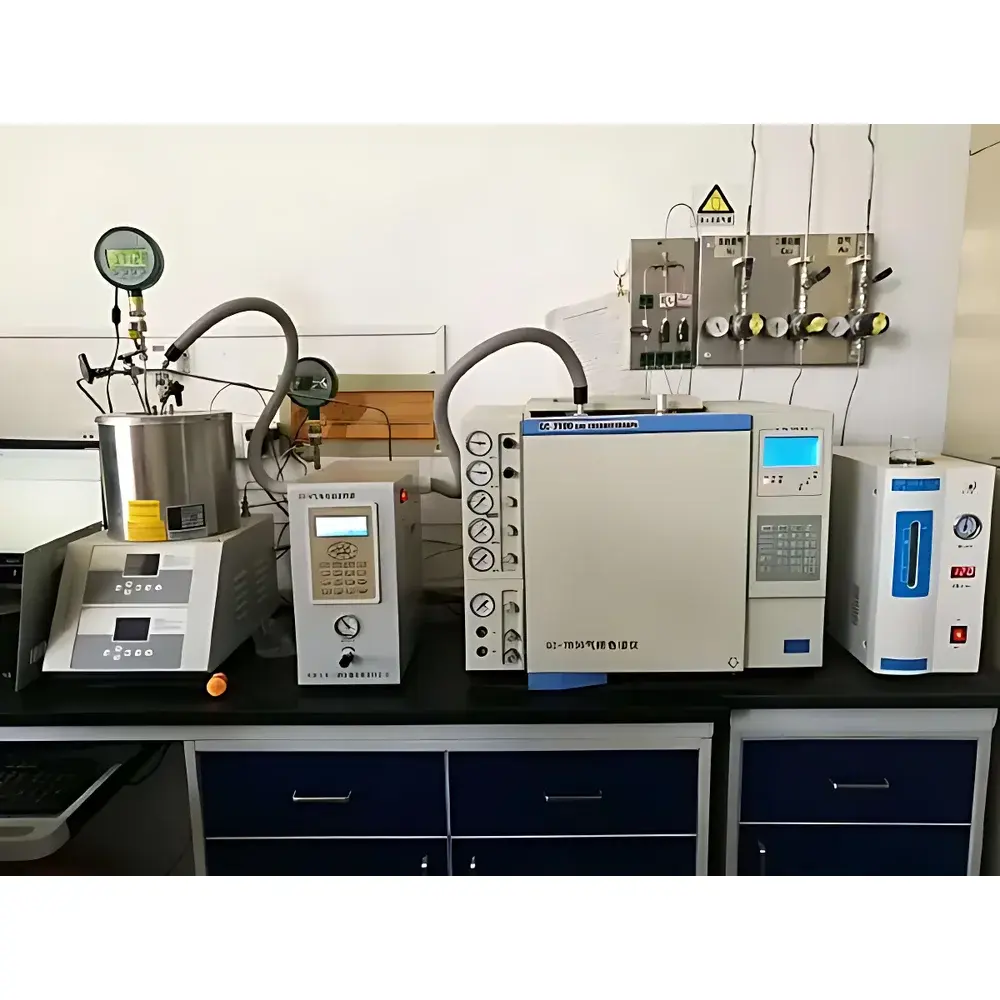
Beifen Sanpu ED-6 Fully Automated Gas Autosampler for Gas Chromatography
| Brand | Beifen Sanpu |
|---|---|
| Model | ED-6 |
| Origin | Hebei, China |
| Manufacturer Type | Direct Manufacturer |
| Instrument Type | Multifunctional Gas/Liquid Autosampler |
| Maximum Sample Capacity | 60 vials |
| Minimum Injection Volume | 0.1 µL |
| Quantitative Loop Volume | 1000 µL |
| Positioning Accuracy | <0.3 mm |
| Motion System | XYZ Three-Axis Stepper Motor Drive |
| Needle Wash Mode | Internal & External Wall Rinse, Unlimited Cycles |
| Repeat Injection Capability | Unlimited |
| Interface | USB 2.0 |
| Optional Features | 12-inch Touchscreen Display, Full-Path Thermal Insulation (RT–200 °C, ±0.5 °C), GC Start Trigger Output |
Overview
The Beifen Sanpu ED-6 Fully Automated Gas Autosampler is a precision-engineered sample introduction system designed specifically for gas chromatography (GC) applications requiring high reproducibility, long-term unattended operation, and compatibility with both gaseous and liquid-phase samples. Unlike manual syringe injection or fixed-loop valve systems, the ED-6 employs a programmable XYZ robotic arm architecture to deliver precise volumetric injections directly into the GC inlet—without occupying the instrument’s standard injection port. Its core operational principle relies on pressure-balanced loop filling and positive-displacement needle aspiration, ensuring minimal carryover and stable delivery across diverse matrix types. The system supports routine offline batch analysis as well as continuous online monitoring configurations, making it suitable for environmental air quality stations, petrochemical process control labs, and emission testing facilities where regulatory compliance demands strict adherence to ASTM D6420, ISO 16017-1, and EPA Method TO-15/TO-17 protocols.
Key Features
- Programmable XYZ three-axis motion system with sub-0.3 mm positioning repeatability ensures consistent needle placement at vial septa and GC liner entry points.
- Independent thermal management of all fluidic pathways—including sampling loop, transfer lines, and valve manifold—maintains temperature uniformity from ambient to 200 °C (±0.5 °C) to prevent condensation or adsorption losses in volatile compound analysis.
- Integrated dual-wash capability performs simultaneous internal and external needle rinsing using selectable solvents; rinse cycles are fully configurable and unlimited per injection sequence.
- USB 2.0 interface enables full parameter configuration and real-time status monitoring via Windows-based control software; no proprietary hardware drivers required.
- GC start synchronization output allows coordinated triggering of instrument acquisition upon successful sample aspiration—eliminating timing drift between autosampler action and data capture.
- Modular loop design accommodates standard 1 mL quantitative loops (with optional 0.5, 2, 3, or 5 mL variants); custom loop volumes available upon request for specialized method development.
- Compact footprint (W × D × H: 320 × 420 × 380 mm) and lightweight construction (<18 kg) facilitate benchtop integration without structural reinforcement.
Sample Compatibility & Compliance
The ED-6 accepts standard 10–22 mm crimp-top or screw-cap vials, including those used for headspace analysis, thermal desorption tubes, and pre-concentrated sorbent cartridges. It supports direct injection of compressed gases (via regulated pressure-controlled gas cylinders), liquefied petroleum gas (LPG), dissolved VOCs in aqueous matrices, and solvent-diluted standards. All wetted materials—including stainless steel loops, PTFE-coated needles, and chemically resistant valves—are compatible with common GC carrier gases (He, H₂, N₂) and organic solvents (methanol, acetone, CS₂). The system conforms to GLP-compliant audit trail requirements when paired with validated chromatography data systems (CDS), supporting 21 CFR Part 11 electronic signature readiness through time-stamped log files and user-accessible audit logs.
Software & Data Management
Control is executed via Beifen Sanpu’s dedicated GC Autosampler Software (v3.2+), a native Windows application offering intuitive method building, sequence scheduling, and real-time diagnostics. Each injection event records timestamp, loop fill pressure, needle depth, wash cycle count, and GC trigger confirmation. Raw logs export in CSV format for LIMS integration or statistical review. Optional touchscreen interface (12-inch capacitive display) provides local operation without PC dependency—ideal for cleanroom or mobile lab environments. Firmware updates are delivered via secure HTTPS portal; version history and change logs are embedded in each release.
Applications
- Continuous ambient air monitoring for BTEX, aldehydes, and halogenated hydrocarbons per EN 14662 and US EPA Compendium Method TO-15.
- Refinery process stream analysis including permanent gases (H₂, O₂, N₂, CO, CO₂, CH₄) and light hydrocarbons (C₁–C₅).
- Pharmaceutical residual solvent testing (ICH Q3C) using static/dynamic headspace-GC/FID configurations.
- Soil gas screening for chlorinated ethenes and petroleum hydrocarbons in site remediation projects.
- Calibration standard preparation and multi-level linearity verification for GC-MS quantitation workflows.
FAQ
Does the ED-6 require modification to the GC inlet?
No—the ED-6 interfaces externally via a dedicated transfer line connected to the GC’s standard split/splitless inlet; no hardware alteration or port occupation is necessary.
Can the ED-6 be integrated with third-party chromatography data systems?
Yes—through ASCII-based command protocol over USB, it supports bidirectional communication with Agilent OpenLab, Thermo Chromeleon, and Shimadzu GCsolution when configured with appropriate I/O mapping.
What maintenance intervals are recommended for long-term reliability?
Needle replacement every 5,000 injections; valve rotor seal inspection every 10,000 cycles; annual calibration verification using certified gas standards traceable to NIST.
Is remote monitoring supported?
Remote access is enabled via Windows Remote Desktop or VNC when deployed on a networked host PC; cloud-based telemetry requires additional IT infrastructure not supplied by Beifen Sanpu.
How does the ED-6 handle high-boiling-point compounds that may condense in transfer lines?
The optional full-path heating module maintains all fluidic surfaces above the dew point of target analytes; temperature zoning allows independent setpoints for loop, needle, and transfer line segments.





