
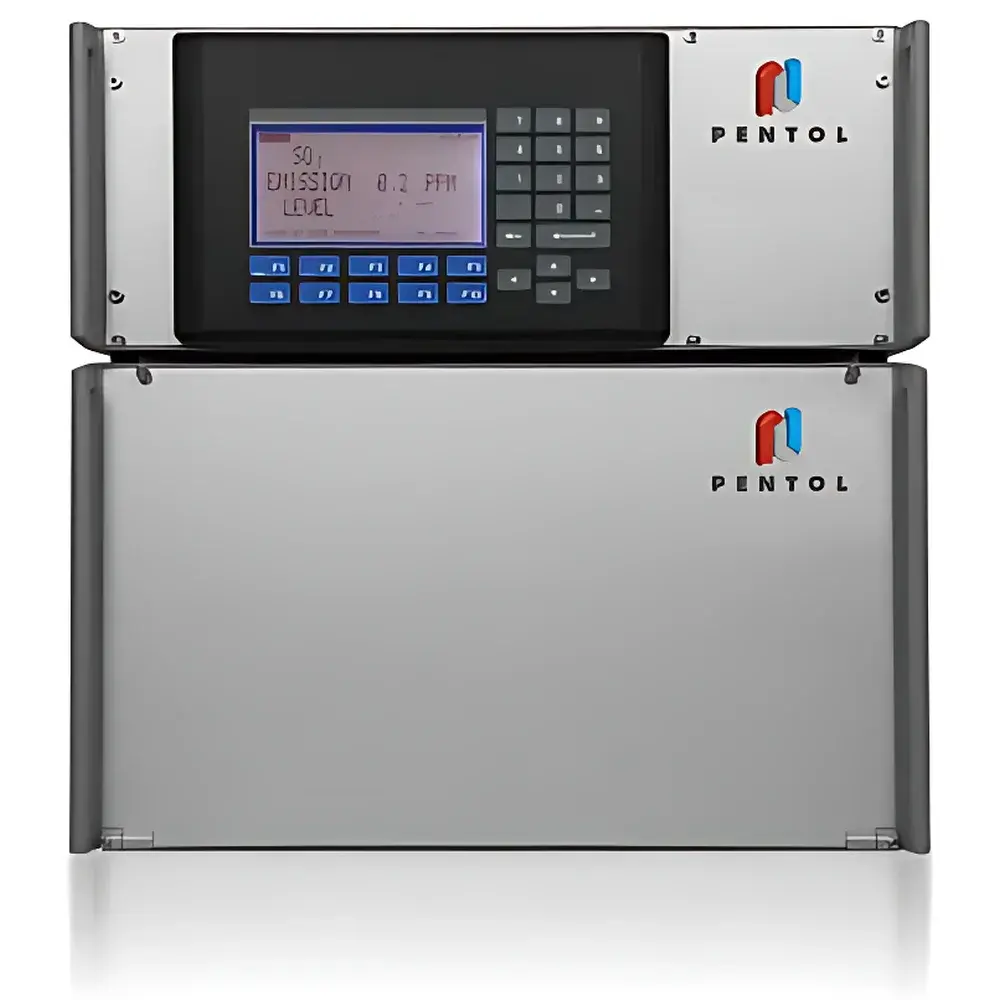
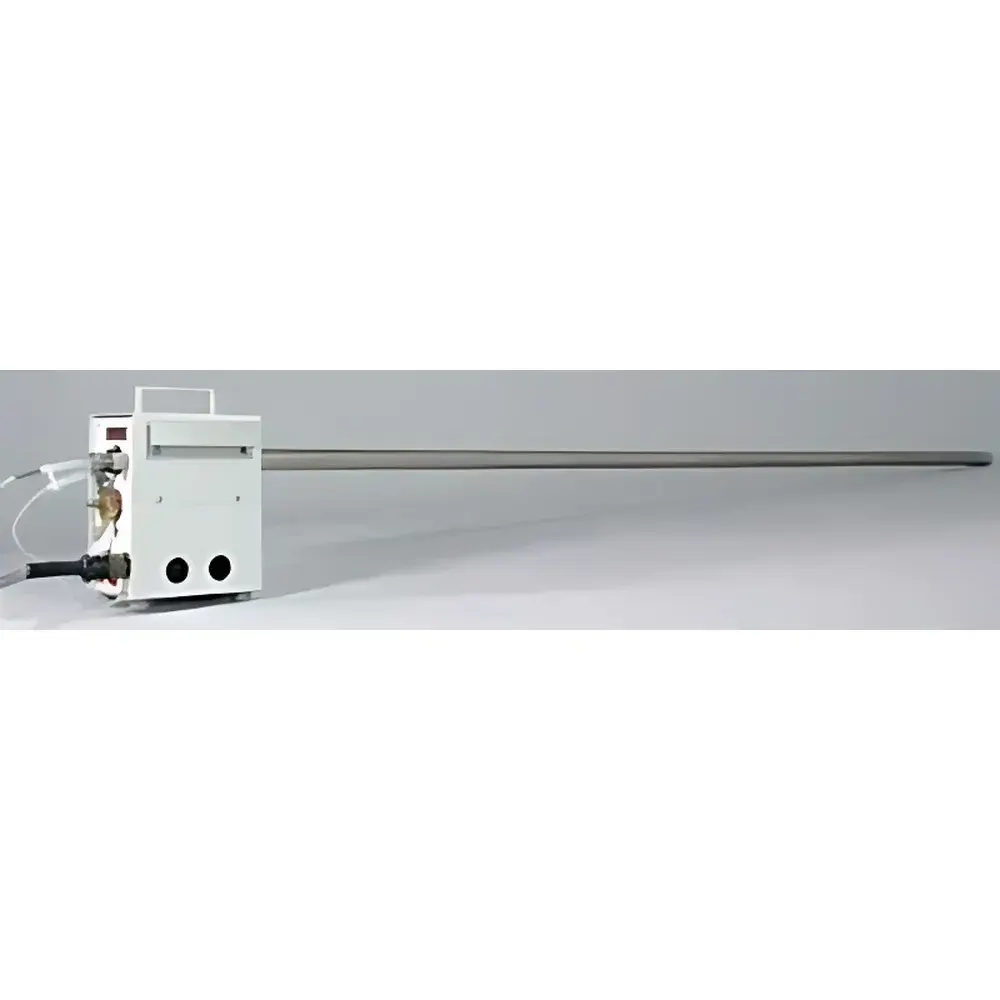
Pentol PENTOL SO₃ Monitor for Flue Gas Analysis
| Brand | Pentol |
|---|---|
| Origin | Germany |
| Manufacturer Type | Authorized Distributor |
| Origin Category | Imported |
| Model | PENTOL |
| Instrument Type | Continuous Emission Monitoring System (CEMS) |
| Measurement Principle | Turbidimetric Spectrophotometry |
| Measurement Range | 1–200 ppm SO₃ |
| Accuracy | ±5% of reading (calibrated range) |
| Repeatability | ±2% |
| Response Time (90% FSD) | <120 s |
| Drift Stability | ±5% over 30 days |
| T90 Delay | ~60 s |
| Sample Flow Control | Precise dual-pump liquid/gas flow regulation |
| Absorbent | Aqueous isopropanol solution |
| Reaction Chemistry | SO₃ → H₂SO₄ → SO₄²⁻ → BaClO₄⁻ complex formation |
| Reagent Consumption | 0.25–2 cm³/h (adjustable) |
| Operating Ambient Temperature | 0–40 °C |
| Power Supply | 230 V / 110 V, 50/60 Hz, 350 W |
| Analyzer Module | 19″ rack, 6U height, 500 mm depth, 27 kg |
| Control Module | 19″ rack, 4U height, 500 mm depth, 13 kg |
| Probe Length Options | 1.0, 1.2, 1.5, 2.0 m |
| Analog Output | 4–20 mA (isolated) |
| Digital Interface | RS232 (optional, factory-configurable) |
Overview
The Pentol PENTOL SO₃ Monitor is a dedicated, CE-marked continuous emission monitoring system (CEMS) engineered for the precise, real-time quantification of sulfur trioxide (SO₃) in hot, humid flue gas streams from coal-fired power plants, waste-to-energy facilities, sulfuric acid production units, and catalytic cracking installations. Unlike generic gas analyzers, this instrument employs a validated wet-chemical turbidimetric spectrophotometric method—fully compliant with EN 15267-3, VDI 3950 Blatt 3, and referenced in EPA Method 8 and ISO 10396—for trace-level SO₃ detection where conventional IR or electrochemical sensors lack specificity and suffer from cross-sensitivity to SO₂, H₂O, and NOₓ. The core measurement principle relies on quantitative absorption of gaseous SO₃ into an aqueous isopropanol solution, followed by stoichiometric conversion to sulfate ions (SO₄²⁻), which react with barium chloranilate to form a stable, light-scattering precipitate. Optical density at 520 nm is linearly proportional to SO₃ concentration across the 1–200 ppm range, enabling high reproducibility and long-term baseline stability under field conditions.
Key Features
- True CEMS-grade architecture with dual-rack modular design (analysis + control), facilitating integration into existing DCS/SCADA infrastructures via isolated 4–20 mA analog output.
- Automated zero/span calibration cycle programmable at user-defined intervals (e.g., every 8 or 24 hours), minimizing manual intervention and supporting unattended operation for >30 days.
- Temperature-controlled reaction manifold and precision peristaltic pumps ensure consistent absorbent flow (0.25–2 cm³/h) and sample gas residence time—critical for stoichiometric completeness and low drift.
- Rugged probe options (1.0–2.0 m, Hastelloy C-276 sheath) rated for flue gas temperatures up to 200 °C and particulate loading ≤10 g/Nm³; includes integrated thermocouple and purge air port for anti-clogging operation.
- Compliance-ready data handling: All calibration events, maintenance logs, and raw signal traces are timestamped and stored locally; optional RS232 interface enables export to LIMS or compliance reporting software (e.g., EPA’s CAMD).
Sample Compatibility & Compliance
The Pentol PENTOL SO₃ Monitor is validated for use in representative flue gas matrices containing SO₂ (≤5,000 ppm), NOₓ (≤1,000 ppm), CO₂ (≤15%), O₂ (0–21%), H₂O (saturated at 120–180 °C), and fly ash (≤50 mg/Nm³). It excludes interference from Cl₂, HF, and NH₃ through selective absorption chemistry and inline filtration. The system meets the performance criteria outlined in EN 14181 (QAL1/QAL2/QAL3) for automated monitoring systems and supports GLP/GMP-aligned audit trails per FDA 21 CFR Part 11 when paired with compliant data acquisition software. All wetted components comply with ASTM A240 Type 316 stainless steel and EN 10204 3.1 material certifications.
Software & Data Management
The embedded control module runs deterministic firmware with non-volatile memory for configuration retention during power loss. Calibration parameters (slope, offset, zero drift compensation), alarm thresholds (high/low limit, sensor fault), and pump duty cycles are configurable via front-panel keypad or RS232 terminal. Raw turbidity signals and calculated SO₃ values (ppm) are logged at 1-second resolution internally (≥30 days buffer); historical data export is supported in CSV format. No proprietary drivers or cloud dependency—full compatibility with Modbus RTU or standard OPC UA gateways for enterprise-level integration.
Applications
- Optimization of air preheater cold-end corrosion mitigation strategies by correlating real-time SO₃ levels with dew point calculations.
- Performance validation of low-NOₓ burners and SCR catalysts, where SO₃ formation increases under ammonia slip or high vanadium content.
- Commissioning and QA/QC of wet FGD systems—monitoring SO₃ breakthrough post-scrubber to assess mist eliminator efficiency.
- Regulatory compliance reporting for national emission limits (e.g., EU IED Annex V, China GB 13223-2011, US Clean Air Act §112).
- Process troubleshooting in sulfuric acid plants during converter staging or catalyst aging studies.
FAQ
What is the minimum detectable SO₃ concentration?
The lower limit of quantitation (LLOQ) is 1 ppm with a signal-to-noise ratio ≥10 under typical flue gas conditions (150 °C, 12% O₂, 10% H₂O).
Can the system measure SO₃ in sour gas streams containing H₂S?
No—H₂S interferes with the barium chloranilate reaction and must be removed upstream using a dedicated zinc oxide scrubber cartridge.
Is daily manual maintenance required?
No. With scheduled auto-calibration and verified reagent consumption rates, routine maintenance intervals are extended to once per 7–14 days, limited to absorbent reservoir refill and filter replacement.
Does the analyzer require external cooling water or compressed air?
No. It operates exclusively on electrical power (230 V or 110 V) and uses ambient-air-cooled electronics; no auxiliary utilities are needed.
How is traceability of calibration ensured?
Each calibration uses NIST-traceable SO₃ permeation tubes (certified ±2% uncertainty); calibration certificates and raw spectrophotometric scans are archived with instrument serial number and date stamp.
Related Products







