
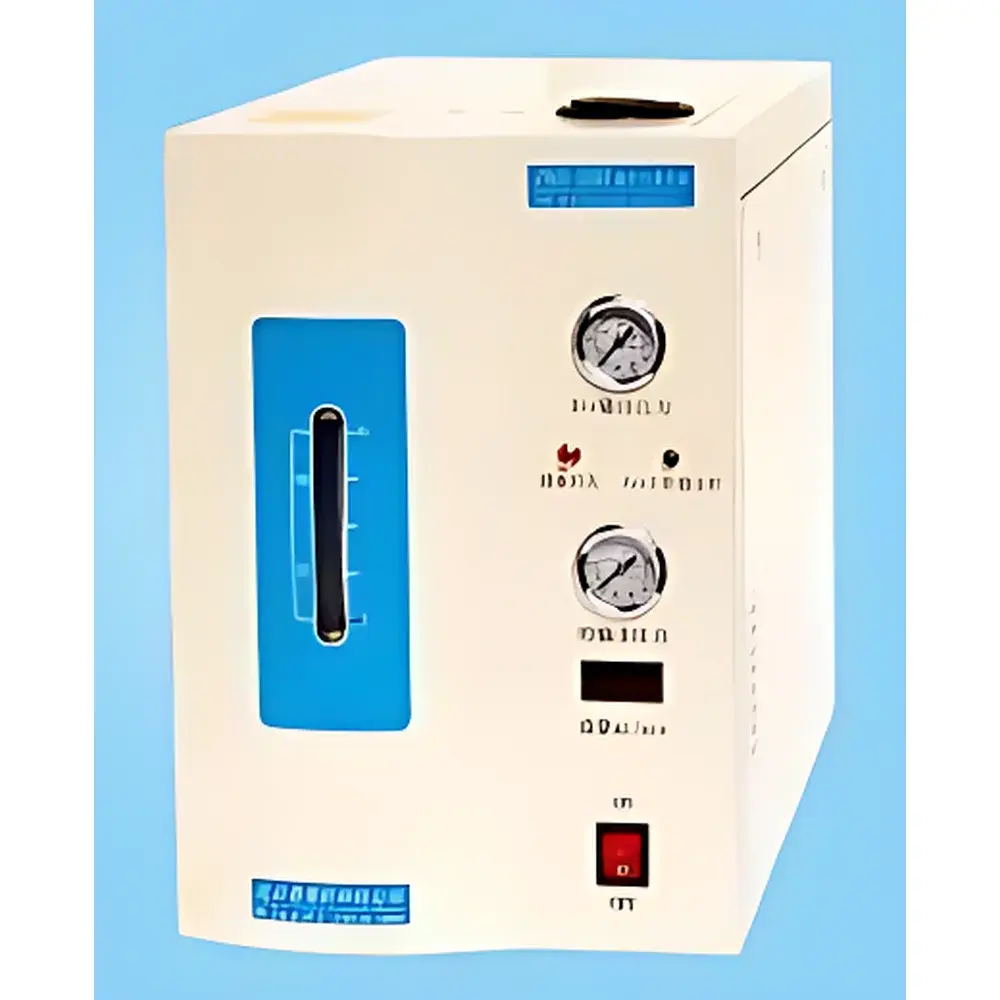
BF-300 Hydrogen & Air Integrated Gas Generator
| Brand | Beifen Sanpu |
|---|---|
| Origin | Beijing, China |
| Manufacturer Type | Direct Manufacturer |
| Model | BF-300 |
| Hydrogen Purity | 99.999% (v/v, O₂-equivalent basis) |
| Air Cleanliness | Oil-free, Class 3 filtration |
| H₂ Flow Range | 0–300 mL/min |
| Air Flow Range | 0–2 L/min |
| H₂ Output Pressure | 0.3 MPa |
| Air Output Pressure | 0.4 MPa |
| Input Voltage | AC 220 V, 50 Hz |
| Max Power Consumption | 260 W |
| Weight | 27 kg |
| Dimensions (L×W×H) | 540 × 280 × 480 mm |
| Operating Temperature | 0–40 °C |
| Relative Humidity | <85% RH (non-condensing) |
| Safety Features | Multi-stage overpressure protection, anti-backflow electrolyte design, thermal cutoff, leak detection circuitry |
| Water Requirement | Deionized or distilled water only |
| Compliance | Designed to meet general laboratory safety requirements per IEC 61010-1 |
Overview
The BF-300 Hydrogen & Air Integrated Gas Generator is an engineered solution for laboratories requiring continuous, on-demand supply of high-purity hydrogen and clean, oil-free air—primarily for gas chromatography (GC) fuel and detector support (e.g., FID, NPD, FPD). Unlike conventional high-pressure cylinder systems, this generator eliminates storage hazards, logistical overhead, and purity degradation over time. It employs membrane-separated alkaline electrolysis for hydrogen production and a multi-stage compression/filtration system for air generation. The hydrogen module utilizes a high-efficiency tubular electrolytic cell with large active surface area and low-temperature operation, enabling stable 99.999% purity (O₂-equivalent basis) without catalyst degradation or performance drift. Air output meets ISO 8573-1 Class 3 particulate and oil contamination requirements, ensuring compatibility with sensitive GC detectors and pneumatic actuators.
Key Features
- Tubular electrolytic cell architecture: Delivers consistent hydrogen purity (≥99.999%) across full flow range (0–300 mL/min) with minimal heat generation and no noble metal catalysts.
- Integrated dual-output design: Simultaneous, independently regulated hydrogen and air streams—each with dedicated pressure regulation, flow monitoring, and safety interlocks.
- Digital LED flow display: Real-time hydrogen flow readout (0.1 mL/min resolution) for precise method alignment and troubleshooting.
- Anti-backflow electrolyte system: Patented liquid-level control prevents electrolyte migration into gas lines—eliminating risk of column contamination or detector quenching.
- Three-stage air purification: Compressor-integrated coalescing filter, activated carbon adsorber, and ultrafine particulate barrier ensure oil-free, particle-free air at ≤0.1 µm filtration efficiency.
- Intelligent power management: Switch-mode power supply optimizes electrolysis efficiency, reducing energy consumption while maintaining thermal stability under variable load conditions.
- Comprehensive safety suite: Includes overpressure shutoff (H₂: 0.35 MPa; Air: 0.45 MPa), temperature-fused electrolyzer housing, audible/visual fault indicators, and automatic shutdown on low-water or leak detection.
Sample Compatibility & Compliance
The BF-300 is designed for integration into analytical workflows where gas quality directly impacts data integrity—particularly in regulated environments. Hydrogen output complies with ASTM D7217–22 specifications for GC-grade fuel gas, while air output satisfies ISO 8573-1:2010 Class 3 for total oil content (<0.1 mg/m³) and particulates (<5 µm). Though not pre-certified to 21 CFR Part 11, the unit supports audit-ready operation when paired with validated LIMS or chromatography data systems (CDS) that enforce electronic signature and change-control protocols. Its mechanical design adheres to IEC 61010-1:2010 for laboratory electrical equipment safety, including dielectric strength testing and creepage/clearance compliance. No external venting or exhaust ducting is required—suitable for standard fume hood or benchtop placement in ISO Class 7 or cleaner lab spaces.
Software & Data Management
The BF-300 operates as a standalone hardware platform without embedded firmware-based control software. All operational parameters—including flow setpoints, pressure thresholds, and alarm states—are managed via front-panel controls and analog/digital status outputs (0–5 V or 4–20 mA optional). For integration into automated labs, it provides dry-contact relay outputs for remote start/stop and fault signaling, enabling synchronization with GC instrument sequences or building management systems (BMS). Event logs (e.g., low-water alerts, overtemperature events) are retained locally via non-volatile memory and accessible through diagnostic mode—supporting root-cause analysis during GLP audits. Routine maintenance records (water top-up dates, filter replacement cycles) must be manually logged per internal SOPs to satisfy traceability requirements.
Applications
- Fuel gas supply for Flame Ionization Detectors (FID) in routine and method-validated GC analyses.
- Carrier or make-up gas source in GC-MS systems where hydrogen offers improved sensitivity and faster analysis times versus helium.
- Air supply for nitrogen-phosphorus (NPD), flame photometric (FPD), and electron capture (ECD) detectors requiring stable, oil-free combustion air.
- On-site hydrogen generation for small-scale catalytic hydrogenation screening in synthetic chemistry labs.
- Backup or primary gas source in QC/QA labs operating under ISO/IEC 17025-accredited test methods requiring documented gas sourcing and purity verification.
- Research environments where cylinder dependency introduces workflow disruption or safety constraints (e.g., confined spaces, mobile labs, teaching facilities).
FAQ
What water grade is required for optimal operation?
Deionized or distilled water (resistivity ≥1 MΩ·cm) is mandatory. Tap water or softened water will cause rapid scaling, membrane fouling, and irreversible electrolyzer damage.
Can the BF-300 be used with GC systems requiring >300 mL/min hydrogen flow?
No—the BF-300 is rated for maximum 300 mL/min H₂ output. For higher demand, the BF-500 model (0–500 mL/min) is recommended.
Is periodic calibration required?
No factory calibration is needed; however, users should verify hydrogen purity annually using a calibrated gas analyzer (e.g., GC-TCD) per internal quality procedures.
How often must the air filters be replaced?
Under typical lab use (8 hrs/day), coalescing and carbon filters require replacement every 6–12 months—frequency increases in high-dust or high-humidity environments.
Does the generator produce ozone or NOx as byproducts?
No—electrolytic hydrogen generation is a pure water-splitting process; air compression/filtration involves no chemical reaction or ozone-generating components.
Related Products



