
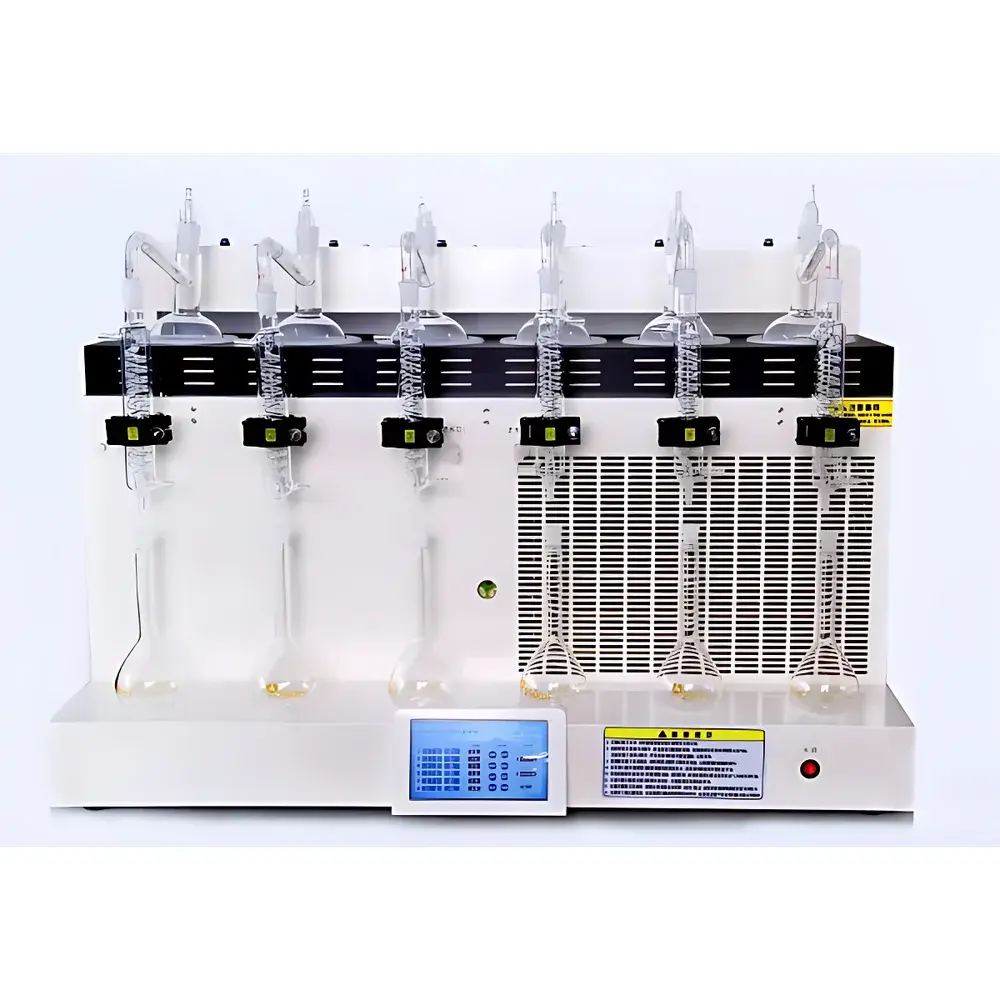
Sanpu CA-Z200 Integrated Distillation System
| Brand | Sanpu |
|---|---|
| Origin | Beijing, China |
| Manufacturer Type | Direct Manufacturer |
| Country of Origin | China |
| Model | CA-Z200 |
| Pricing | Upon Request |
| Heating Method | Far-infrared ceramic heating elements (domestic) |
| Endpoint Control | Time-based auto-stop, ±2 mL accuracy |
| Cooling System | Built-in compressor-based recirculating chiller, condenser temperature <30 °C |
| Display | 7-inch resistive color touchscreen |
| Heating Units | 6 independent channels, 1–800 W per unit (adjustable) |
| Ramp-up Time | 5–8 min |
| Sample Capacity | 1–6 samples, individually controllable |
| Total Rated Power | 4800 W (adjustable) |
| Distillation Rate | 8–12 mL/min |
| Anti-suckback Protection | Solenoid vacuum valve integrated |
| Timer Range | 0–999 min |
| Receiving Vessel Compatibility | Universal (volumetric flasks, Erlenmeyer flasks, graduated cylinders, beakers) |
| Power Input | Dual-input AC |
| Voltage/Frequency | 220 V / 50 Hz |
| Dimensions (L×W×H) | 1000 × 520 × 800 mm |
Overview
The Sanpu CA-Z200 Integrated Distillation System is an engineered solution for standardized, high-reproducibility distillation in regulated and research-grade chemical laboratories. Designed in accordance with standard laboratory pretreatment protocols—including those specified in EPA Method 410.1, ISO 6439 (cyanide), ISO 5667-16 (ammonia nitrogen), and HJ 503-2009 (phenols)—the system integrates three critical functional modules into a single compact architecture: programmable far-infrared heating, precision endpoint detection, and closed-loop refrigerated condensation. Unlike conventional steam or oil-bath distillation setups, the CA-Z200 eliminates open flame hazards and external water supply dependencies through its sealed ceramic heating array and on-board compressor chiller. Its operation relies on time-controlled thermal separation under controlled vapor pressure gradients, ensuring stoichiometric recovery of volatile analytes such as phenolic compounds, ammonia nitrogen, cyanide, Kjeldahl nitrogen, and moisture in oil matrices—without degradation or carryover artifacts. The system’s validated distillate recovery rate exceeds 95% across matrix-matched reference standards, meeting metrological requirements for accredited environmental testing labs (CNAS-CL01 compliant verification data available upon request).
Key Features
- Far-infrared ceramic heating elements provide uniform thermal distribution, rapid ramp-up (5–8 min), and extended service life (>10,000 h), with no open flame, splash risk, or electrical leakage hazard.
- Six independently addressable heating zones support parallel processing of 1–6 samples; each channel delivers 1–800 W adjustable power with real-time digital feedback control.
- Time-based endpoint logic enables precise termination within ±2 mL volumetric tolerance—critical for compliance with USP , EPA 524.2, and ISO 11466 methodologies requiring fixed distillate volume collection.
- Integrated compressor-driven recirculating chiller maintains condenser jacket temperature below 30 °C continuously, eliminating reliance on municipal tap water and enabling stable cold-trap performance across ambient fluctuations.
- Active anti-suckback protection uses a fast-response solenoid vacuum valve to isolate the distillation train during pressure transients—preventing sample backflow and cross-contamination between runs.
- 7-inch resistive touchscreen interface supports multilingual UI (English default), password-protected method storage, audit trail logging, and GLP-compliant user access levels.
Sample Compatibility & Compliance
The CA-Z200 accommodates standard glassware including 500 mL round-bottom flasks, 250 mL volumetric flasks, 250 mL Erlenmeyer flasks, and graduated cylinders—no proprietary consumables required. It complies with mechanical safety standards IEC 61010-1 and electromagnetic compatibility directive EN 61326-1. For regulatory workflows, the system supports 21 CFR Part 11–ready software add-ons (optional) with electronic signature, change history, and secure data export. Validation documentation—including installation qualification (IQ), operational qualification (OQ), and performance qualification (PQ) templates—is provided for GMP/GLP-aligned deployment in environmental monitoring, public health laboratories (CDC/NIOSH reference methods), and academic research settings.
Software & Data Management
The embedded firmware records timestamped operational parameters (heating power per channel, elapsed time, cooling status, endpoint trigger event) in non-volatile memory. Data export is supported via USB 2.0 port in CSV format for LIMS integration. Optional PC-based control software (Sanpu DistillLink v3.2) adds remote monitoring, method library management, automated report generation (PDF/Excel), and FDA 21 CFR Part 11–compliant audit trails with role-based permissions and electronic signatures. All stored logs retain integrity checksums and are write-protected post-acquisition.
Applications
The CA-Z200 serves core applications in environmental analysis (e.g., determination of volatile phenols in wastewater per HJ 502-2009), food safety testing (moisture content in edible oils by AOAC 925.10), pharmaceutical QC (residual solvent analysis per USP ), and public health surveillance (cyanide and ammonia nitrogen in drinking water per GB/T 5750.5–2023). Its modular design supports adaptation to ASTM D95 (water in petroleum), ISO 6618 (free fatty acids), and modified Kjeldahl digestion workflows where distillative nitrogen recovery is required.
FAQ
Does the CA-Z200 require external cooling water?
No—the system includes a self-contained compressor-based recirculating chiller; no tap water connection or external chiller is needed.
Can different sample types be processed simultaneously?
Yes—each of the six heating units operates independently, allowing concurrent distillation of heterogeneous matrices (e.g., phenol + ammonia + cyanide) with customized time/power profiles.
Is calibration traceable to national standards?
Yes—temperature sensors are NIST-traceable; volumetric endpoint accuracy is verified using certified Class A glassware and gravimetric validation per ISO/IEC 17025 guidelines.
What maintenance is required for long-term reliability?
Annual inspection of ceramic heater emissivity, condenser coil cleanliness, and solenoid valve actuation cycle count is recommended; no routine fluid replacement is required for the sealed refrigeration loop.
Is the system compatible with LIMS integration?
Yes—CSV export supports direct ingestion into most laboratory information management systems; optional API-enabled software provides real-time bidirectional communication.
Related Products





