
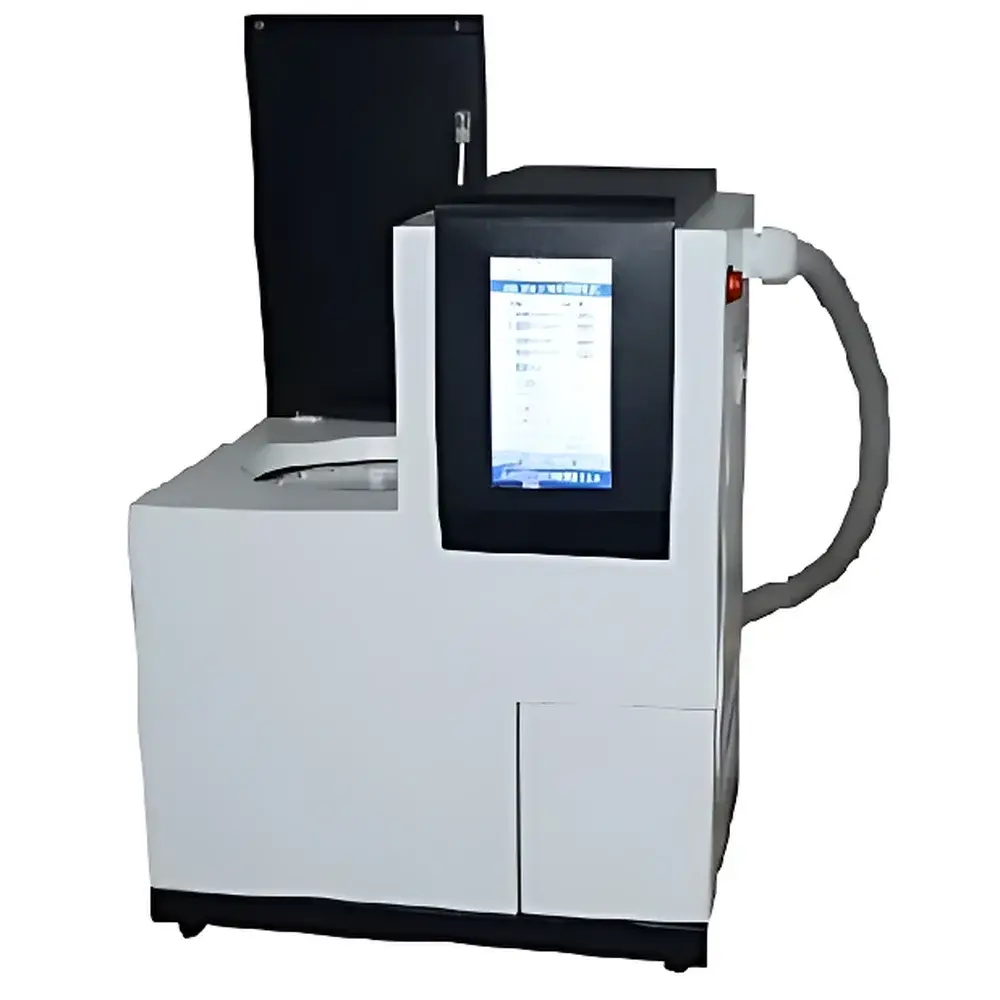
North分Sanpu TDAS-20A Automated Two-Stage Thermal Desorber
| Brand | North分Sanpu |
|---|---|
| Origin | Beijing, China |
| Manufacturer Type | Direct Manufacturer |
| Instrument Type | Two-Stage Thermal Desorber |
| Primary Desorption Temp Range | Ambient to 400 °C |
| Secondary Desorption Temp Range | 100–400 °C |
| Cryo-Trap Temp Range | Down to −35 °C |
| Desorption Recovery Rate | >90% |
| Sample Capacity | 20 positions |
Overview
The North分Sanpu TDAS-20A Automated Two-Stage Thermal Desorber is an engineered solution for quantitative trace volatile organic compound (VOC) analysis in environmental, occupational health, pharmaceutical, and materials testing laboratories. It operates on the principle of two-stage thermal desorption—first releasing analytes from sorbent tubes under controlled inert gas flow (primary desorption), followed by rapid focusing and re-desorption of the enriched analyte band onto a cryogenically cooled trap (secondary desorption)—before introduction into a gas chromatograph (GC) or GC–MS system. This architecture eliminates solvent use, minimizes breakthrough risk, and delivers superior sensitivity and reproducibility compared to single-stage systems. The instrument is fully compatible with standard 1/4″ × 3.5″ US EPA–compliant sorbent tubes (e.g., Tenax TA, Carbopack B/C, Carboxen 1000), and supports both standalone operation and direct coupling to GC inlet ports via heated transfer lines.
Key Features
- Two-stage thermal desorption architecture with independent temperature control for primary furnace (ambient to 400 °C), secondary furnace (100–400 °C), and cryo-trap (−35 °C to ambient)
- High-precision temperature regulation: ±0.5 °C stability across all zones, with 1 °C incremental setpoint resolution
- 20-position automated sample carousel enabling unattended batch processing; compatible with standard 1/4″ OD × 3.5″ L sorbent tubes
- Electronically cooled cryo-trap using solid-state Peltier technology—no liquid nitrogen or external chillers required
- Motor-driven 6-port switching valve for precise, repeatable injection timing and minimal carryover
- Heated sample transfer line (up to 300 °C) with low-voltage (24 V DC) power supply for intrinsic safety and thermal uniformity
- Touchscreen HMI interface with intuitive workflow navigation, real-time temperature monitoring, and method storage
- Configurable desorption parameters: primary/secondary dwell time (0–60 min), purge flow (0–100 mL/min), sampling flow (0–160 mL/min), and trap refocusing duration
Sample Compatibility & Compliance
The TDAS-20A accommodates a broad range of sorbent tube configurations and matrix types—including ambient air, indoor air, workplace breathing zone samples, polymer off-gas, building material emissions, and food headspace extracts. It meets core requirements for EPA Methods TO-17 and TO-14A, ISO 16000-6, and ASTM D6196, supporting compliance with regulatory frameworks governing indoor air quality (IAQ), industrial hygiene, and environmental VOC monitoring. All temperature zones are independently validated and logged, supporting GLP/GMP documentation needs. Audit trails for method changes, run logs, and calibration events can be exported in CSV format for internal QA review or regulatory submission.
Software & Data Management
The TDAS-20A operates without proprietary PC software—control and monitoring occur entirely via its embedded touchscreen interface. Method files are stored internally with timestamped versioning. For integration into laboratory information management systems (LIMS), the instrument provides RS-232 and USB host interfaces for external trigger synchronization and data export. All thermal profiles, valve actuation timestamps, and pressure/flow logs are retained per-run and exportable without post-processing. While not FDA 21 CFR Part 11–certified out-of-the-box, the system supports user-defined password access levels, electronic signature prompts for critical parameter changes, and immutable log archives—enabling customization for regulated environments upon validation.
Applications
- Environmental monitoring: quantification of benzene, toluene, ethylbenzene, xylenes (BTEX), aldehydes, and halogenated VOCs in ambient and indoor air per EPA TO-17
- Materials emission testing: determination of formaldehyde, styrene, and plasticizer volatiles from carpets, adhesives, insulation, and composite panels per ISO 16000-9 and ASTM D5116
- Pharmaceutical packaging: residual solvent analysis in blister foils, vial stoppers, and polymer containers
- Food and flavor science: headspace VOC profiling for shelf-life assessment and authenticity verification
- Occupational health: personal exposure monitoring using passive or active sampling with subsequent thermal desorption–GC analysis
- Electronics manufacturing: detection of outgassed organics from PCB laminates and conformal coatings
FAQ
What distinguishes a two-stage thermal desorber from a single-stage system?
Two-stage desorption separates analyte release from the sorbent tube (stage one) and subsequent refocusing/concentration on a cold trap (stage two), significantly improving sensitivity, peak shape, and recovery of low-boiling and polar compounds.
Can the TDAS-20A be used with any GC or GC–MS system?
Yes—it features universal heated transfer line connectivity and supports standard GC inlet configurations including split/splitless, PTV, and direct-coupled interfaces.
Is liquid nitrogen required for cryo-trapping?
No—the instrument employs an electronically cooled Peltier trap capable of reaching −35 °C without consumables or external infrastructure.
How is method validation supported?
The system enables full thermal profile logging, RSD testing (≤2.5% at 0.05 μg benzene), and recovery verification (>90% typical across C3–C12 hydrocarbons) in accordance with ISO/IEC 17025 guidelines.
What maintenance intervals are recommended?
Valve maintenance every 10,000 cycles; trap cleaning after 200 runs or when baseline drift exceeds specification; annual temperature sensor calibration advised.
Related Products




