
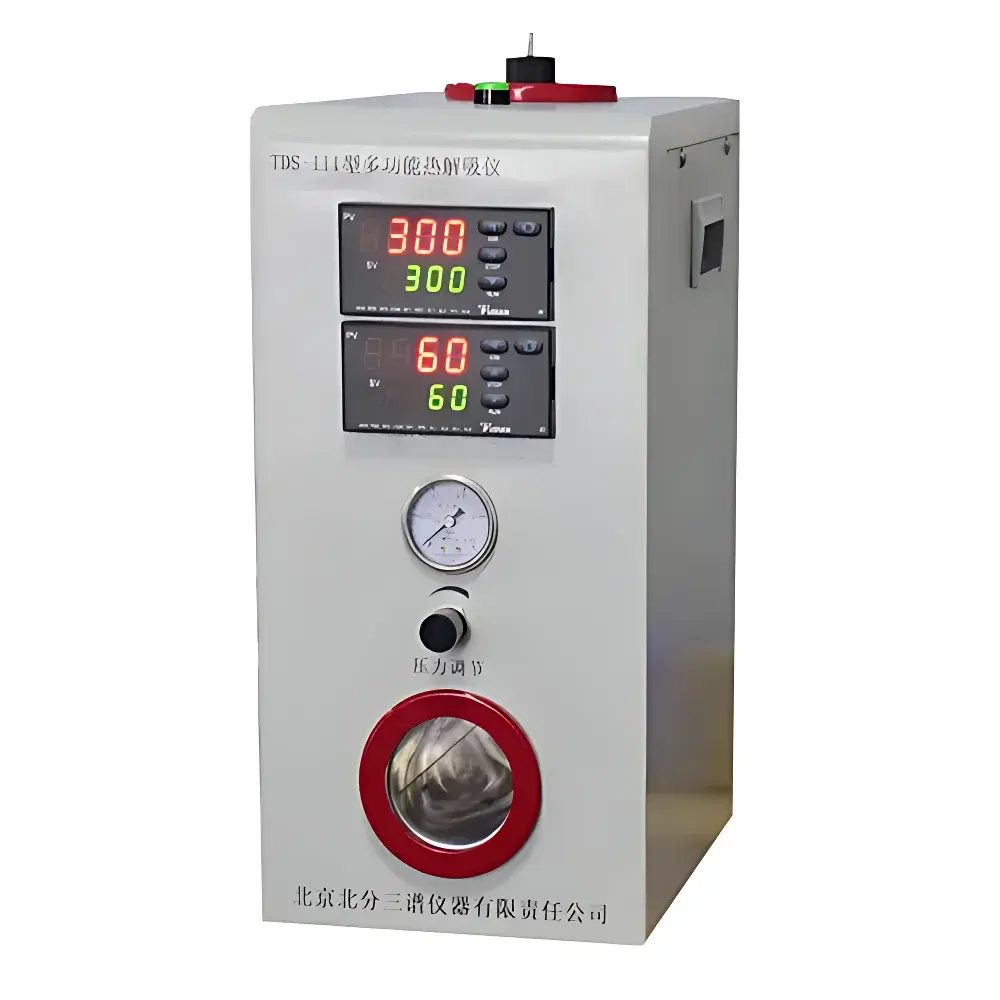
Beifen Sanpu FTDS-III Multi-Function Thermal Desorption Unit for Methanol Analysis by Gas Chromatography with Flame Ionization Detection
| Brand | Beifen Sanpu |
|---|---|
| Origin | Beijing, China |
| Manufacturer Type | Manufacturer |
| Product Origin | Domestic (China) |
| Model | FTDS-III |
| Pricing | Upon Request |
Overview
The Beifen Sanpu FTDS-III Multi-Function Thermal Desorption Unit is a dedicated sample pre-concentration and introduction system engineered for quantitative analysis of volatile organic compounds (VOCs), including methanol, in workplace air matrices. It operates on the principle of thermal desorption—where analytes adsorbed onto solid sorbent tubes (e.g., silica gel) are thermally released into a carrier gas stream and transferred to a gas chromatograph (GC) for separation and detection. When coupled with a GC equipped with a flame ionization detector (FID), the system implements the standardized method described in GBZ/T 300.62–2017 “Determination of Methanol in Workplace Air” and aligns with analytical requirements outlined in GB 50325–2006 for indoor air quality assessment. The FTDS-III enables precise, reproducible transfer of desorbed analytes into large-volume syringes (up to 100 mL), supporting manual injection into GC systems without automated valve switching or cryofocusing—making it especially suitable for laboratories performing routine occupational hygiene monitoring under GLP-aligned workflows.
Key Features
- Integrated dual-temperature control architecture: independent heating zones for thermal desorption furnace (room temperature to 400 °C) and large-volume syringe heater (room temperature to 100 °C), both with ±0.5 °C stability and 1 °C programmable resolution.
- Optimized desorption geometry: accommodates standard 6 mm OD (¼″) sorbent tubes of variable length; zero-dead-volume connection design minimizes analyte loss and carryover.
- High-efficiency desorption performance: >85% average recovery for methanol and other polar VOCs under defined conditions (160 °C, 50 mL/min N₂ flow), validated per ISO 16000-6 and ASTM D5197 protocols.
- Flexible sampling compatibility: supports silica gel tubes (200 mg), activated carbon, and Tenax-based sorbents—enabling method adaptation for TVOC, benzene, or mixed alcohol analyses per GBZ/T 300 series standards.
- User-centric operation: simplified tube loading mechanism; visual temperature and flow indication; manual syringe handling reduces dependency on specialized operator training—ideal for QC labs with mixed-experience personnel.
Sample Compatibility & Compliance
The FTDS-III is validated for use with silica gel sorbent tubes (200 mg) per GBZ/T 300.62–2017 methodology for methanol. It supports sampling at regulated flow rates (10–200 mL/min) using compatible air samplers such as BS-H2, ensuring adherence to OSHA ID-253 and NIOSH 2001 sampling guidelines. All thermal desorption parameters—including desorption temperature, carrier gas flow stability (<0.1% variation), and syringe heating uniformity—are traceable to internal calibration logs. While not inherently 21 CFR Part 11 compliant due to manual injection, the unit supports audit-ready documentation when integrated into laboratory SOPs that include instrument logbooks, calibration records, and analyst training verification—meeting core requirements for GLP and ISO/IEC 17025-accredited third-party occupational hygiene testing facilities.
Software & Data Management
The FTDS-III is a hardware-only thermal desorption platform with no embedded software or digital interface. It relies on external GC data systems (e.g., Shimadzu GCsolution, Agilent OpenLab CDS) for peak integration, calibration curve generation (linear regression, r ≥ 0.999), and report export. Users manually record desorption parameters (temperature, time, flow rate) in paper or electronic lab notebooks. To support data integrity, laboratories commonly implement controlled document procedures for method files, instrument usage logs, and raw chromatogram archiving—consistent with FDA expectations for non-automated analytical instrumentation used in regulated environments.
Applications
- Quantitative determination of methanol in workplace air per GBZ/T 300.62–2017 and ISO 16000-6.
- Analysis of benzene and total volatile organic compounds (TVOC) in indoor air per GB 50325–2006.
- Occupational exposure assessment for alcohols (e.g., propanol, octanol), ketones, and aromatic hydrocarbons using appropriate sorbent media.
- Method development and validation studies requiring flexible, low-cost thermal desorption prior to FID or ECD detection.
- Training and educational applications in environmental health and safety programs where manual injection reinforces fundamental GC principles.
FAQ
What is the primary application of the FTDS-III in occupational hygiene?
It is designed for thermal desorption of methanol and other VOCs from sorbent tubes, followed by manual syringe injection into gas chromatographs—supporting compliance with Chinese national occupational exposure standards.
How does the FTDS-III differ from headspace analysis?
Thermal desorption extracts analytes from solid-phase sorbents using heat and carrier gas, offering higher sensitivity for trace VOCs; headspace analyzes volatile species partitioned into the gas phase above liquid/solid samples, typically with lower enrichment capability.
Can the FTDS-III be used for automated GC injection?
No—it delivers desorbed analytes into a heated 100 mL syringe for manual transfer; fully automated systems require separate thermal desorbers with valve-based interfaces or robotic autosamplers.
Is the FTDS-III suitable for TVOC analysis using activated carbon tubes?
Yes—its adjustable desorption temperature and flow control allow optimization for less volatile compounds captured on carbon-based sorbents, as referenced in GB/T 18883–2022 Annex C.
What maintenance is required to ensure long-term accuracy?
Regular verification of temperature calibration (using NIST-traceable probes), leak checks at tube fittings, and periodic cleaning of the desorption chamber and syringe port are recommended per manufacturer guidelines and ISO/IEC 17025 clause 6.4.






