
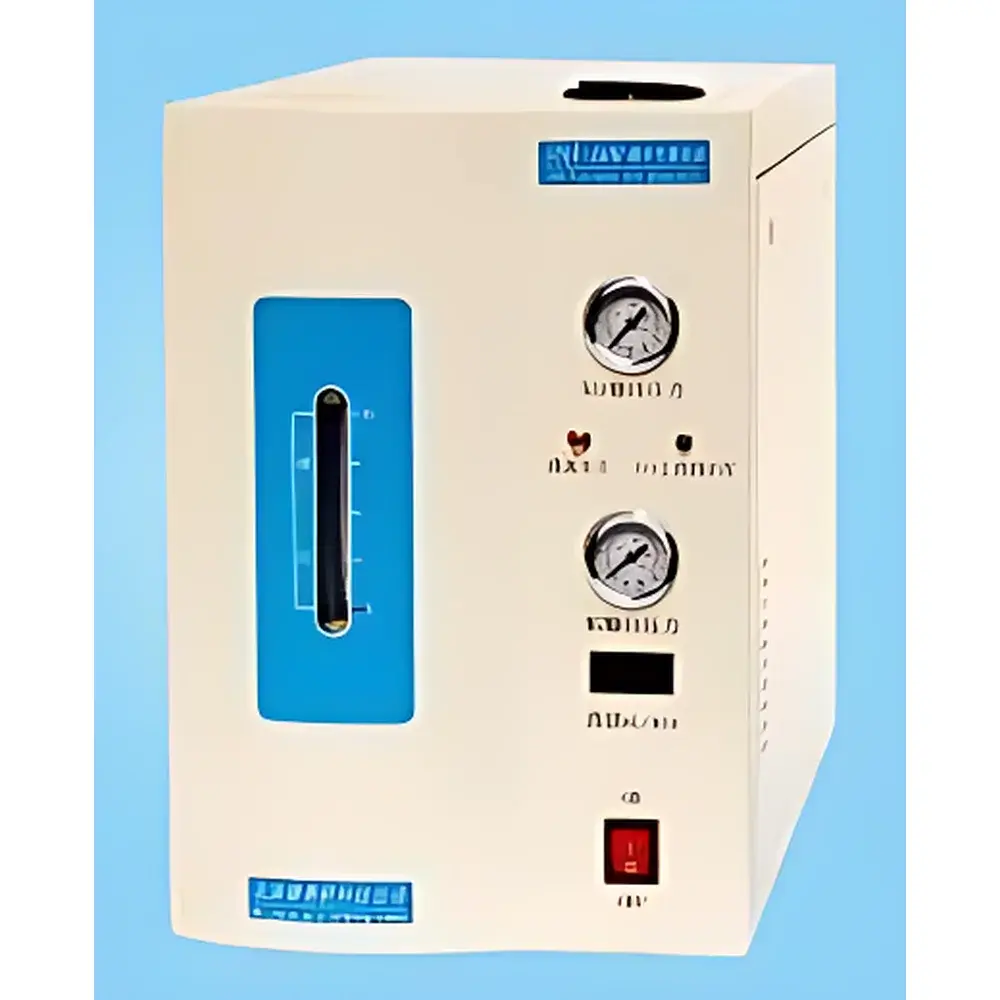
BF-300 Nitrogen & Zero-Air Generator
| Brand | Beifen Sanpu |
|---|---|
| Origin | Beijing, China |
| Manufacturer Type | Direct Manufacturer |
| Model | BF-300 |
| Nitrogen Purity | 99.9994% (v/v, O₂-equivalent) |
| Air Quality | Oil-Free, Class 1 Clean Air (ISO 8573-1:2010 Class 1.1.1) |
| Nitrogen Flow Rate | 0–300 mL/min |
| Air Flow Rate | 0–2 L/min |
| Nitrogen Output Pressure | 0.4 MPa |
| Air Output Pressure | 0.4 MPa |
| Input Voltage | AC 220 V, 50 Hz |
| Power Consumption | 330 W |
| Weight | 40 kg |
| Dimensions (L×W×H) | 480 × 300 × 420 mm |
| Operating Temperature | 0–40 °C |
| Relative Humidity | <85% RH (non-condensing) |
| Ambient Requirements | Low-dust, non-corrosive environment |
| Note | For use with ECD detectors, prior notification to manufacturer is required |
Overview
The BF-300 Nitrogen & Zero-Air Generator is a dual-output laboratory gas supply system engineered for analytical instrumentation requiring high-purity nitrogen and oil-free compressed air simultaneously. It integrates two independent gas generation modules—electrolytic nitrogen generation and membrane-based air compression and purification—within a single compact chassis. Nitrogen is produced via selective electrochemical separation of ambient air using a PEM (Proton Exchange Membrane) electrolyzer, achieving a certified purity of 99.9994% (v/v), equivalent to ≤0.6 ppm residual oxygen and ≤1 ppm total hydrocarbons. The zero-air stream is generated by drawing ambient air through a three-stage filtration train—including particulate pre-filters, activated carbon adsorption, and catalytic oxidation—followed by dual-stage pressure regulation and final coalescing filtration to meet ISO 8573-1:2010 Class 1.1.1 specifications (≤0.01 µm particles, ≤0.003 mg/m³ oil aerosol, dew point ≤−40 °C). Designed for continuous or intermittent operation, the BF-300 eliminates dependency on high-pressure cylinders while maintaining stable flow and pressure across variable demand profiles—critical for GC-ECD, GC-FID, LC-MS source gas, and sample dilution applications.
Key Features
- Integrated dual-gas architecture: Simultaneous, independent control of nitrogen and zero-air outputs with no cross-contamination risk
- PEM-based nitrogen generation: No consumable cartridges or desiccants; purity remains stable over time without decay
- Three-stage air purification: Particulate removal (0.1 µm), hydrocarbon adsorption, and catalytic CO/CO₂ oxidation ensure trace-level cleanliness
- Dual-stage pressure regulation: Precision regulators maintain constant 0.4 MPa output for both streams under dynamic load conditions
- No-backflow nitrogen module: Patented anti-siphon design prevents electrolyte migration into downstream instruments
- Intuitive LED digital display: Real-time monitoring of nitrogen flow rate (0–300 mL/min) with ±2% FS accuracy
- Low-maintenance operation: Only deionized water replenishment required every 7–10 days under continuous use
- Energy-efficient switching power supply: Optimized electrolysis efficiency reduces thermal load and extends component service life
Sample Compatibility & Compliance
The BF-300 is validated for use with electron capture detectors (ECD), flame ionization detectors (FID), nitrogen-phosphorus detectors (NPD), and electrospray ionization (ESI) sources in LC-MS systems. Its nitrogen stream meets ASTM D6299 requirements for instrumental gas purity in trace analysis, and its zero-air output complies with EPA Method TO-15 and ISO 10156 specifications for hydrocarbon-free calibration gas support. The unit conforms to IEC 61010-1:2010 safety standards for laboratory electrical equipment and includes overpressure relief valves, thermal cutoffs, and leak detection circuitry. While not certified to FDA 21 CFR Part 11, its analog control interface supports integration into GLP/GMP environments when paired with external audit-trail-capable data loggers.
Software & Data Management
The BF-300 operates via hardware-based analog control with no embedded firmware or network connectivity. All operational parameters—including flow, pressure, and status—are conveyed through front-panel LEDs and mechanical gauges. This design ensures electromagnetic compatibility (EMC) in sensitive analytical labs and eliminates cybersecurity vulnerabilities associated with connected devices. For laboratories requiring electronic recordkeeping, optional analog-to-digital signal adapters (0–5 V or 4–20 mA output) are available to interface with LabVantage, Empower, or custom SCADA systems. Calibration logs, maintenance records, and water top-up timestamps must be manually documented per ISO/IEC 17025 Clause 7.7.
Applications
- Gas chromatography: Carrier gas (N₂) for ECD and make-up gas for FID/NPD; zero-air for detector combustion and pneumatic controls
- LC-MS: Nebulizer and drying gas (N₂); curtain gas and collision gas (N₂); auxiliary air for ion source cooling
- Environmental testing: Calibration gas preparation for VOC analyzers and continuous emission monitoring systems (CEMS)
- Pharmaceutical QC: Residual solvent analysis per USP , where nitrogen purity directly impacts detection limits
- Materials science: Inert atmosphere purging during TGA/DSC sample loading and glovebox feedstock supply
FAQ
Is the BF-300 suitable for ECD applications?
Yes—its nitrogen purity of 99.9994% (≤0.6 ppm O₂) meets the stringent oxygen tolerance requirements of electron capture detectors. Notify the manufacturer at time of order to enable ECD-specific factory validation.
What type of water is required for operation?
Deionized water with resistivity ≥1 MΩ·cm must be used; tap water or distilled water alone will cause premature membrane fouling and reduced nitrogen purity.
Can nitrogen and air be used independently?
Yes—the two gas modules operate autonomously; either stream may be enabled or disabled without affecting the other’s performance or stability.
How often does the air filter require replacement?
Under typical lab conditions (25 °C, <60% RH), the three-stage air filter set has a service life of 6–12 months; replacement intervals should be adjusted based on local ambient particulate load.
Does the BF-300 generate ozone or NOx in the air stream?
No—the catalytic oxidation stage converts CO and hydrocarbons to CO₂ and H₂O without generating ozone or nitrogen oxides, as confirmed by independent GC-TCD verification per ISO 8573-5.



