
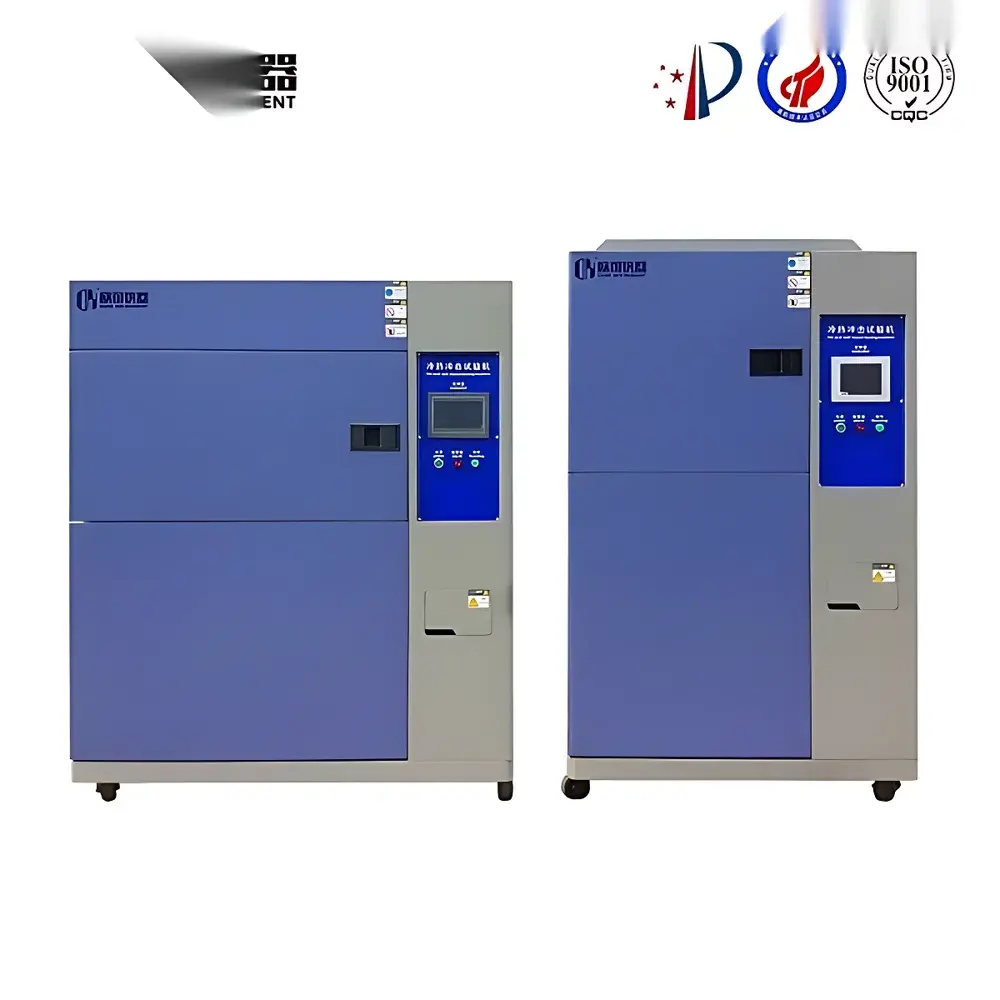
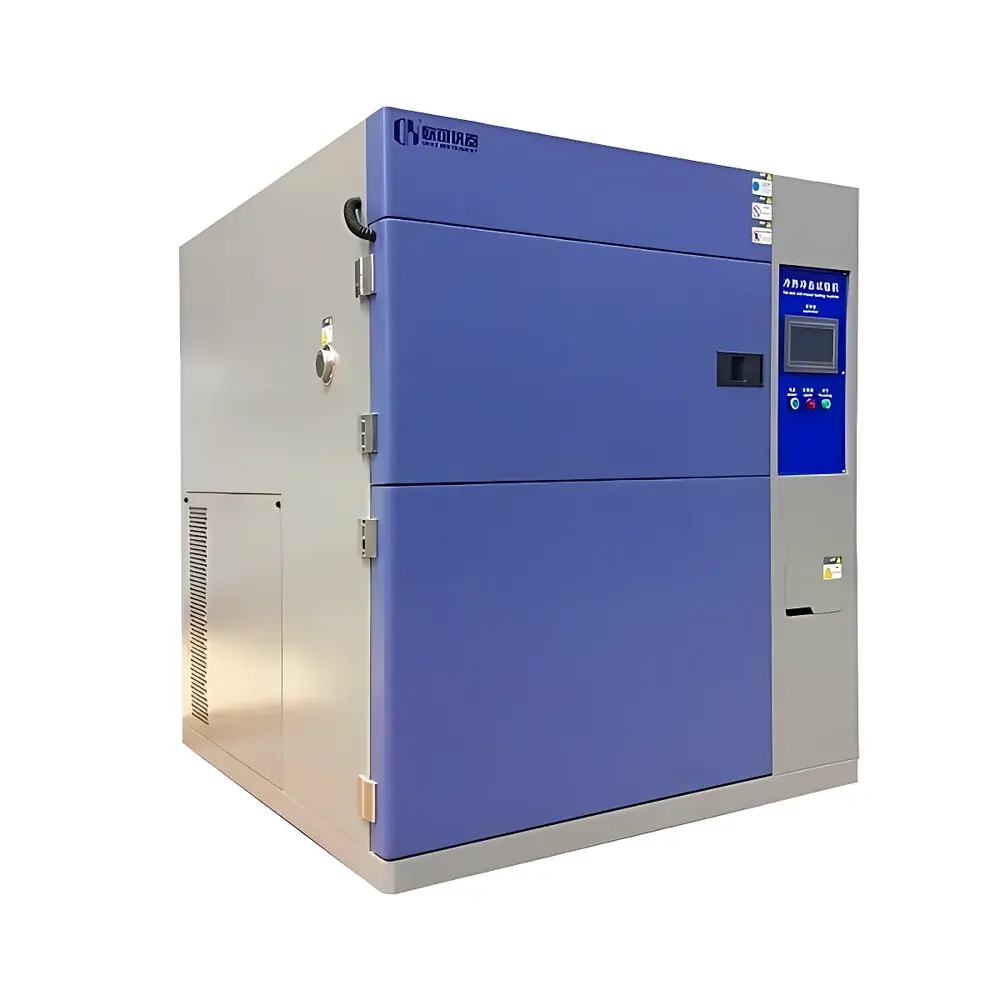
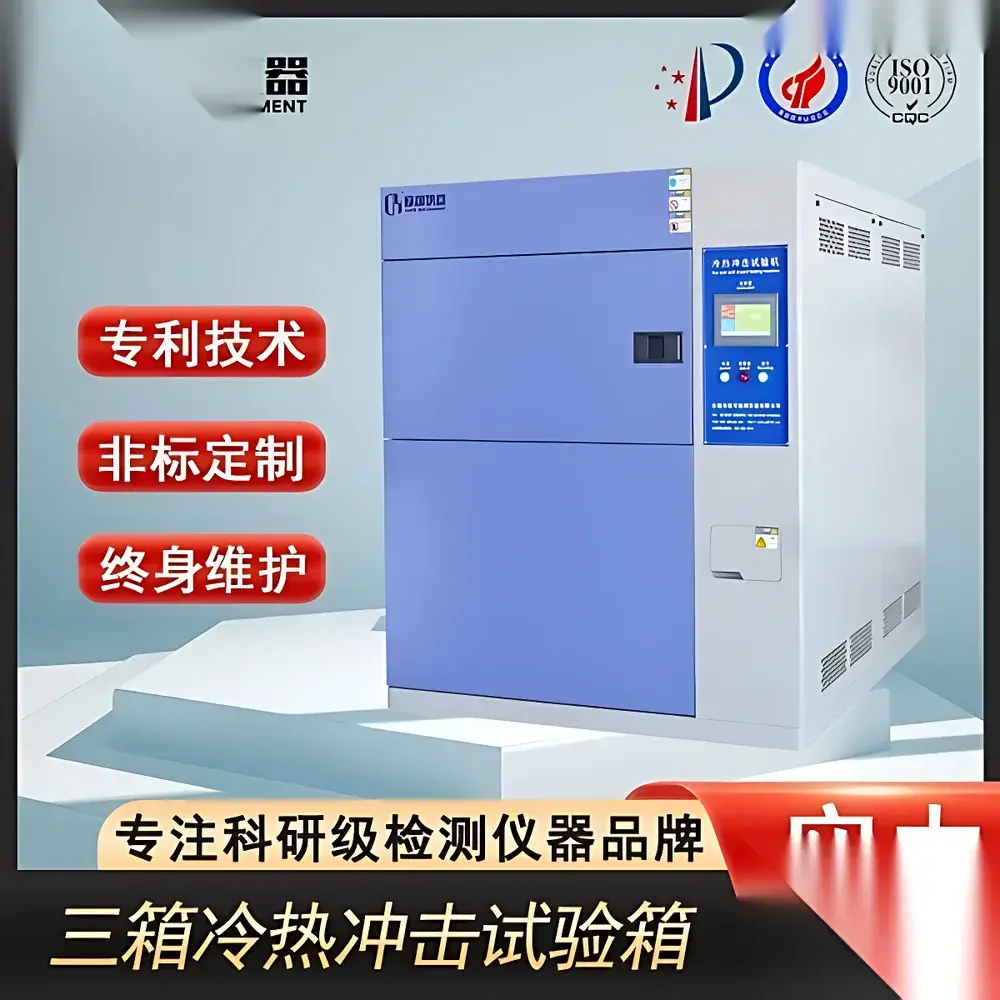
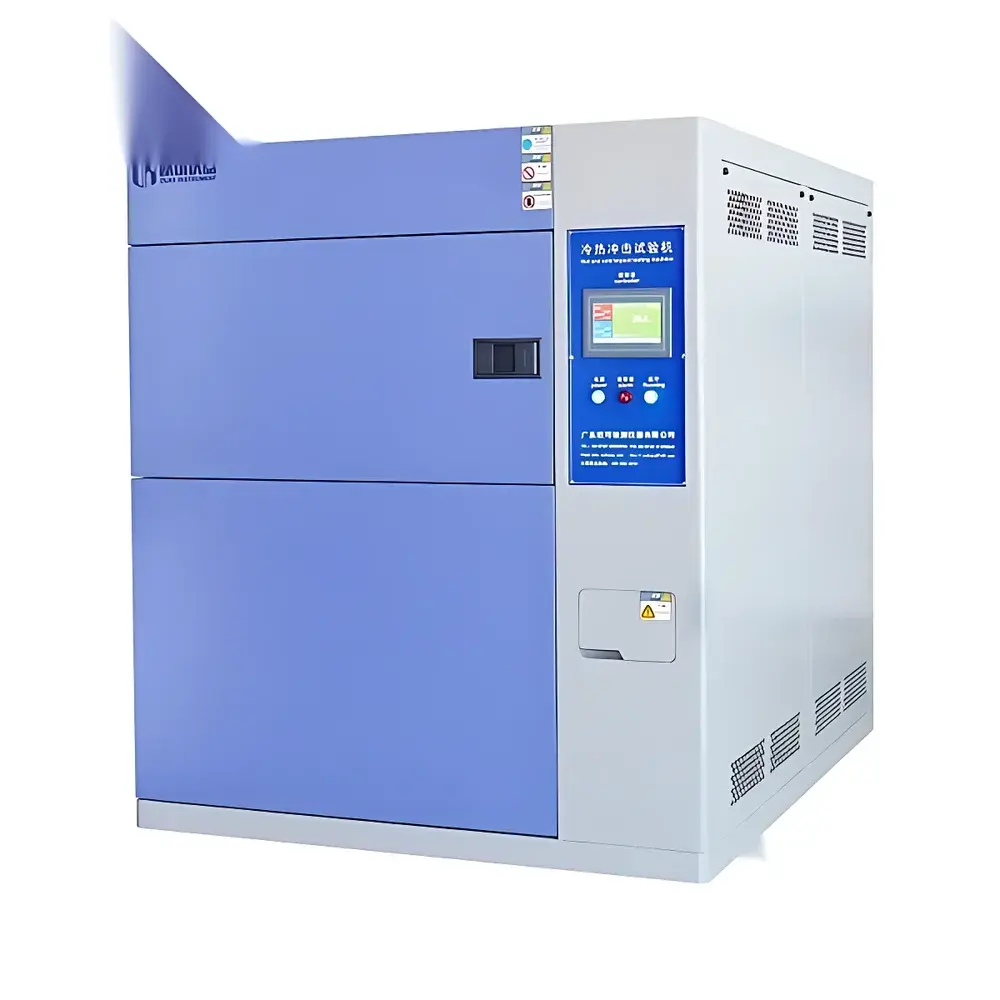
Thermal Shock Test Chamber – Dual- or Tri-Zone Configuration
| Brand | OEM |
|---|---|
| Origin | Imported |
| Manufacturer Type | Authorized Distributor |
| Price | USD 11,200 (FOB) |
| Cooling System | Twin-Stage Cascade Refrigeration with German Semi-Hermetic Compressors |
| Cooling Water Requirement | 10 m³/h External Cooling Tower |
| Compliance | GB/T 2423.1/2/22, GJB 150.3–150.5, IEC 60068-2-14, US MIL-STD-810G Method 503.5, ASTM D648, ISO 11359-2 |
Overview
The Thermal Shock Test Chamber is an engineered environmental simulation system designed to evaluate material and component reliability under rapid, extreme temperature transitions. It operates on the principle of controlled thermal inertia disruption—subjecting test specimens to abrupt shifts between high- and low-temperature zones to accelerate failure mechanisms such as interfacial delamination, solder joint fatigue, coating cracking, and coefficient-of-thermal-expansion (CTE) mismatch stress. Available in dual-zone (hot/cold chamber with mechanical basket transfer) and tri-zone (separate hot soak, cold soak, and test chamber) configurations, the system enables precise control over dwell time, transition time (<15 s typical), and temperature extremes (typically −65 °C to +150 °C, configurable per model). Its architecture supports both static and dynamic thermal shock profiles in accordance with internationally recognized accelerated life testing protocols.
Key Features
- Two-stage cascade refrigeration system utilizing imported German semi-hermetic compressors for stable sub-zero performance and rapid cooldown rates (≥10 °C/min from 25 °C to −55 °C)
- Evaporative condenser heat exchange interface enabling efficient thermal energy transfer between high- and low-temperature circuits
- Energy modulation control logic that dynamically adjusts refrigerant flow and compressor loading to maintain setpoint accuracy ±0.5 °C while minimizing power consumption and mechanical wear
- Water-cooled condensing unit requiring external 10 m³/h cooling tower (customer-supplied); compatible with industrial closed-loop chillers
- Stainless steel 304 inner chamber construction with electrostatically applied epoxy-coated outer housing for corrosion resistance and long-term stability
- Programmable controller with real-time data logging, alarm history, and USB export capability for traceability in GLP/GMP environments
Sample Compatibility & Compliance
This chamber accommodates a wide range of physical forms—including PCB assemblies, automotive ECUs, aerospace fasteners, polymer housings, and semiconductor packages—within standard internal dimensions (e.g., 400 × 400 × 400 mm, customizable). All operational parameters adhere strictly to regulatory and industry-standard test methodologies: GB/T 2423.1–2423.22 (China National Standards), GJB 150.3–150.5 (PLA General Specifications), IEC 60068-2-14 (Temperature Change), MIL-STD-810G Method 503.5 (Thermal Shock), and ASTM D648 (Deflection Temperature Under Load). The system’s thermal uniformity (±2 °C across working volume) and transition repeatability meet requirements for audit-ready qualification testing under ISO/IEC 17025-accredited laboratories.
Software & Data Management
Equipped with embedded Windows-based HMI software supporting multi-segment ramp-soak profiles, real-time graphing, and automatic report generation (PDF/CSV). Data integrity is preserved via timestamped audit trails, user-level access control (admin/operator/guest), and optional 21 CFR Part 11-compliant electronic signature modules. Raw sensor data (PT100 class A sensors at multiple chamber locations) is sampled at 1 Hz and stored internally for ≥30 days; external storage via Ethernet or USB is supported. Exported datasets include chamber ambient, specimen surface (optional thermocouple input), and system status flags—enabling correlation with post-test failure analysis (e.g., X-ray CT, SEM).
Applications
- Qualification testing of avionics modules per DO-160 Section 4.3 (Temperature Shock)
- Automotive electronics validation against QC/T 17–92 and ISO 16750-4 for engine bay components
- Reliability screening of lead-free solder joints in consumer electronics (JEDEC JESD22-A106)
- Material compatibility assessment for medical device enclosures undergoing sterilization cycling
- Accelerated aging of optical adhesives and lens assemblies exposed to diurnal thermal cycles
- Process validation support for conformal coating cure stability and reflow soldering residual stress evaluation
FAQ
What is the typical temperature transition time between zones?
Transition time from high- to low-temperature exposure is ≤15 seconds for standard configurations, verified per IEC 60068-2-14 Annex B.
Is the chamber suitable for testing sealed electronic enclosures?
Yes—chamber pressure remains ambient during operation; no vacuum or overpressure is applied unless specified in custom variants.
Can the system be integrated into a factory MES or LIMS platform?
Yes—Modbus TCP and OPC UA interfaces are available as optional hardware modules for bidirectional communication with enterprise systems.
Does the unit comply with FDA or EU MDR documentation requirements?
The system includes full IQ/OQ documentation templates and supports GAMP 5-aligned validation protocols upon request.
What maintenance intervals are recommended for the cascade refrigeration system?
Compressor oil analysis every 2,000 operating hours; refrigerant circuit leak check and filter-drier replacement annually; full calibration of all PT100 sensors every 12 months.



