
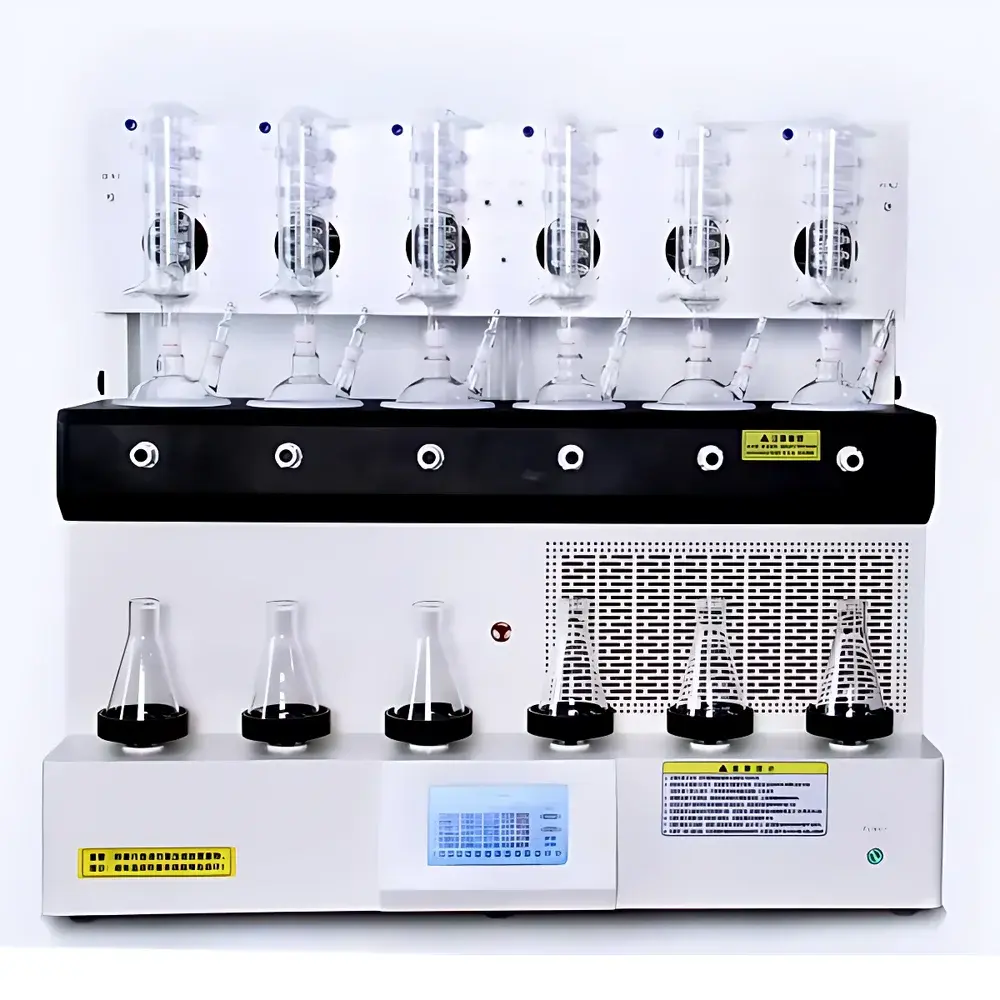
Beifen Sanpu CA-Z300S Fully Automated Intelligent Distillation System
| [Brand | Beifen Sanpu |
|---|---|
| Origin | Beijing, China |
| Manufacturer Type | Direct Manufacturer |
| Product Origin | Domestic (China) |
| Model | CA-Z300S |
| Pricing | Upon Request |
| Heating Units | 6 independent stations |
| Heating Method | Far-infrared ceramic heating (bowl-shaped, flameless, waterproof) |
| Power per Unit | 0–800 W (individually adjustable) |
| Temperature Range | Ambient to 420 °C (PID-controlled, per station) |
| Distillation Endpoint Control | Pressure-based load cell with weight feedback (1–500 g/ml, ±1 g accuracy) |
| Cooling System | Closed-loop internal recirculation with air-cooled condenser + built-in compressor (refrigeration capacity ≤2000 W |
| Anti-Suckback Protection | Vacuum-sensing solenoid valve |
| Condenser Cleaning | One-touch reverse-air purge |
| Display | 7-inch capacitive color touchscreen |
| Distillation Speed | 2–12 mL/min |
| Runtime Setting | 1–999 min |
| Max. Power Consumption | 5800 W (adjustable) |
| Dimensions (L×W×H) | 1000 × 520 × 800 mm |
| Flask Compatibility | Six 500 mL or 250 mL round-bottom flasks (custom configurations supported) |
| Receiving Vessels | Unrestricted — volumetric flasks, Erlenmeyer flasks, graduated cylinders, beakers, etc. |
| Water Reservoir | Auto-fill with overflow cutoff] |
Overview
The Beifen Sanpu CA-Z300S Fully Automated Intelligent Distillation System is an integrated laboratory distillation platform engineered for precision, repeatability, and unattended operation in regulatory-compliant chemical analysis workflows. It applies classical liquid-phase separation principles—based on differential volatility under controlled thermal input—to isolate and quantify volatile analytes from complex aqueous and semi-aqueous matrices. Unlike conventional manual or semi-automated setups, the CA-Z300S embeds real-time physical feedback loops (load-cell mass monitoring, pressure-responsive anti-suckback actuation, and PID-regulated far-infrared heating) to eliminate operator-dependent variability. Designed to meet routine requirements in environmental testing, public health surveillance, and industrial quality control, it delivers trace-level recovery performance validated against certified reference materials and interlaboratory comparison protocols—achieving ≥95% recovery for target analytes including phenols, ammonia nitrogen, cyanide, Kjeldahl nitrogen, and water in oils.
Key Features
- Independent six-station far-infrared heating: Bowl-shaped ceramic emitters provide uniform, flameless, moisture-resistant radiant heating; each unit features 0–800 W digital power adjustment and PID temperature control (ambient to 420 °C), minimizing thermal gradient-induced decomposition.
- Weight-based endpoint detection: High-resolution pressure load cells monitor distillate mass accumulation in real time; users define target collection mass (1–500 g/mL) with ±1 g repeatability, triggering automatic heater shutdown and valve closure.
- Dual-mode closed-loop cooling: Integrated air-cooled condenser and compressor-based refrigeration (≤2000 W, 5–30 °C setpoint range) eliminate dependency on external tap water—critical for high-throughput labs with variable municipal supply conditions.
- Intelligent anti-suckback protection: A vacuum-sensing solenoid valve dynamically monitors receiving flask headspace pressure during condensate transfer, preventing backflow during system cooldown or pressure transients.
- One-touch condenser maintenance: Reverse-air purge function clears residual condensate and particulate from the inner bore of borosilicate glass condensers without disassembly—reducing cross-contamination risk and downtime between runs.
- Modular receiver compatibility: No fixed-receiver constraints; standard volumetric flasks, conical flasks, graduated cylinders, or custom vessels can be accommodated via adjustable support trays and universal clamping geometry.
Sample Compatibility & Compliance
The CA-Z300S supports standardized distillation methods referenced in ISO 6439 (cyanide), ISO 5667-16 (ammonia nitrogen), HJ 502–2009 (phenols), and EPA Method 351.2 (total Kjeldahl nitrogen). Its all-glass vapor path (ground-glass joints, borosilicate construction) ensures inert sample contact and minimizes adsorption losses for polar and semi-volatile species. The system’s autonomous operation aligns with GLP and ISO/IEC 17025 documentation requirements: all run parameters—including start time, heating profile, endpoint mass, cooling temperature log, and auto-purge activation—are timestamped and stored locally. Optional audit-trail export supports FDA 21 CFR Part 11–compliant data integrity frameworks when integrated with validated LIMS environments.
Software & Data Management
Control and monitoring are executed via a 7-inch capacitive color touchscreen running embedded Linux firmware. The interface provides simultaneous visualization of real-time parameters per station: setpoint temperature, actual heater surface temperature, accumulated distillate mass, cooling circuit temperature, and runtime countdown. All method configurations—including multi-step ramp profiles, staggered start times, and conditional endpoint logic—are saved as reusable protocol files. Raw sensor logs (sampled at 1 Hz) are exportable in CSV format for post-run statistical analysis (e.g., RSD calculation across replicates, outlier detection via Grubbs’ test). No cloud connectivity or third-party dependencies are required; data residency remains fully on-device unless manually exported via USB 2.0 port.
Applications
The CA-Z300S is routinely deployed in accredited environmental laboratories for wastewater and drinking water compliance testing (e.g., ammonia nitrogen per ISO 5667-16); in public health institutions for cyanide screening in biological fluids; in food and feed testing labs for moisture determination in edible oils (AOAC 925.04 adaptation); and in academic research settings for method development involving thermally labile organics. Its robust thermal architecture enables reliable distillation of high-boiling-point matrices (e.g., glycerol/water mixtures, polymer extracts) where conventional steam distillation risks charring. The modular design also facilitates integration into automated sample preparation lines via dry-contact I/O signals (start/stop, fault alert, completion pulse).
FAQ
Does the CA-Z300S comply with ISO/IEC 17025 documentation requirements?
Yes—the system records full parameter logs with UTC timestamps, user ID (if configured), and digital signatures for method files. Audit trails are exportable and tamper-evident.
Can the instrument handle viscous or suspended samples without clogging?
Distillation feed must be pre-filtered or centrifuged; the system does not include inline filtration. However, its wide-bore glass joints and gravity-fed vapor path minimize blockage risk compared to capillary-based systems.
Is external cooling water required?
No—all cooling is self-contained via the dual-mode (air + compressor) recirculating system. No plumbing or drainage connections are needed.
What safety certifications does the unit carry?
It conforms to GB 4793.1–2019 (equivalent to IEC 61010-1) for electrical safety in laboratory equipment, including overtemperature cutoff, ground-fault detection, and enclosure IP20 rating.
How is calibration verified?
Load cells are factory-calibrated using NIST-traceable weights; temperature sensors are validated against PT100 reference probes. Users may perform periodic verification using certified reference standards per ISO/IEC 17025 Section 6.6.




