
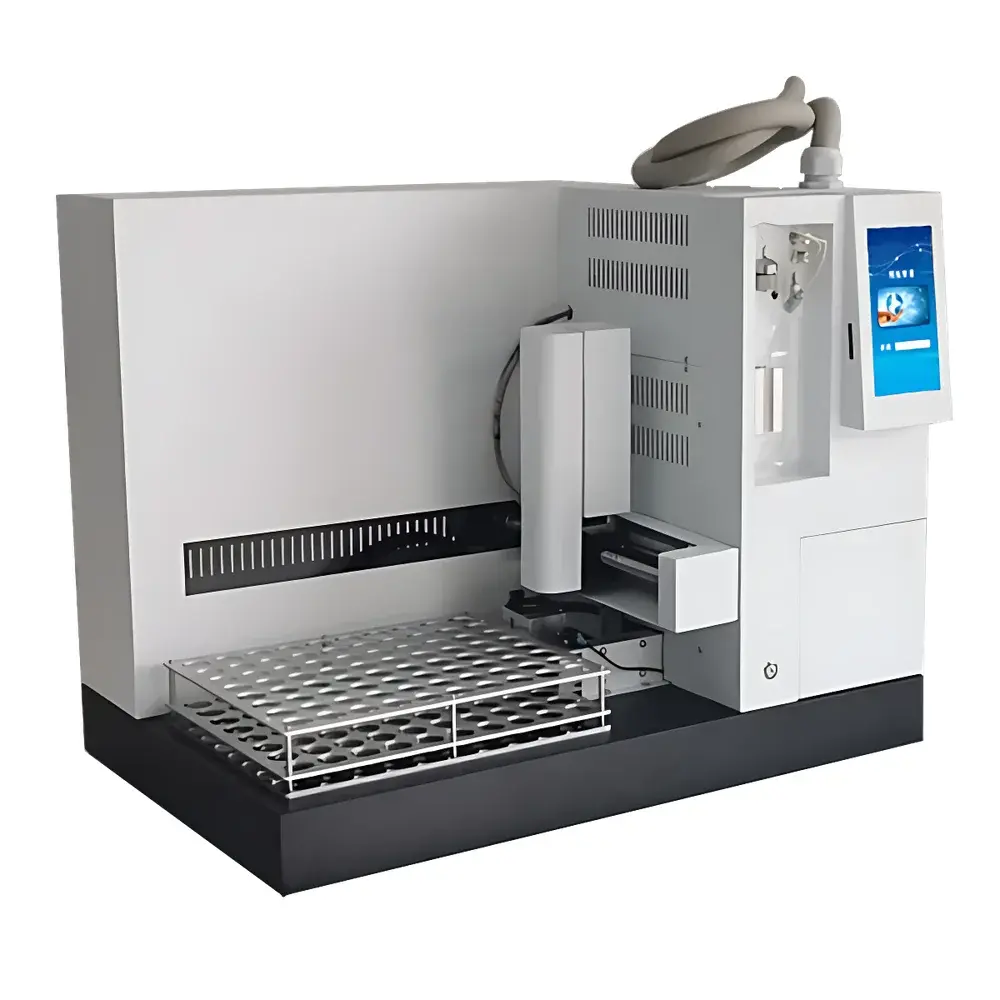
Beifen Sanpu P3T-80A Fully Automated Purge and Trap Concentrator
| Brand | Beifen Sanpu |
|---|---|
| Origin | Beijing, China |
| Manufacturer Type | Original Equipment Manufacturer (OEM) |
| Model | P3T-80A |
| Sample Capacity | 80 positions (40 mL VOA vials) |
| Injection Precision | RSD ≤ 3% |
| Trap Temperature Range | Ambient to 380 °C |
| Cooling | 250 °C → 35 °C in ≤ 90 s |
| Purge Heater Temperature | Ambient to 95 °C |
| Sample Chilling | Ambient only |
| Cold Trap Temperature | −40 °C to ambient (Peltier + air cooling, no liquid nitrogen required) |
| Transfer Line & Valve Heating | Ambient to 220 °C |
| Water Removal Trap | Ambient to 400 °C |
| Wash Water Temperature | Ambient to 90 °C |
| Solid Sample Heating | Ambient to 100 °C |
| Purge Flow Rate | 0–150 mL/min |
| Timing Resolution | 0.1 s–100 min |
| Timing Accuracy | < 0.1 s |
| Max System Pressure | ≤ 0.6 MPa |
| Power Supply | AC 220 V, 50 Hz |
| Power Consumption | 800 W |
| Dimensions | 750 × 500 × 550 mm |
| Weight | ~50 kg |
Overview
The Beifen Sanpu P3T-80A Fully Automated Purge and Trap Concentrator is a high-throughput, thermally controlled sample preparation system engineered for quantitative trace-level analysis of volatile organic compounds (VOCs) in aqueous, soil, sediment, and solid matrices. It operates on the fundamental principle of dynamic headspace extraction: inert gas purging volatilizes target analytes from the sample matrix into a carrier stream, which transports them through a cooled trap (typically packed with sorbent material) where they are retained and concentrated. Following purge completion, the trap undergoes rapid thermal desorption—enabled by resistive heating with >2000 °C/min ramp rates—and transfers the analytes quantitatively onto a coupled gas chromatograph (GC) or GC–mass spectrometer (GC–MS) for separation and detection. Designed for compliance-driven laboratories, the P3T-80A supports standardized methodologies including EPA Method 524.2, EPA Method 8260D, HJ 605–2011, HJ 639–2012, and HJ 686–2014, making it suitable for environmental monitoring, drinking water safety testing, and regulatory VOC screening under ISO/IEC 17025-accredited workflows.
Key Features
- 80-position autosampler with programmable carousel for 40 mL VOA vials—enabling unattended overnight operation and batch processing of large sample sets;
- Peltier-based cold trap capable of reaching −40 °C (at 20 °C ambient), eliminating dependency on cryogenic coolants while ensuring efficient VOC retention and minimal breakthrough;
- High-fidelity thermal control architecture: all critical zones—including transfer lines, six-port valves, purge tubes, and water removal traps—are independently heated (up to 220 °C and 400 °C respectively) to prevent condensation and analyte loss at cold spots;
- Integrated foam sensor within the purge tube detects foam formation during aqueous sample agitation, automatically pausing the method to prevent carryover and protect downstream instrumentation;
- Dual-path purge and desorption gas routing isolates trap desorption effluent from the purge gas stream—eliminating cross-contamination between samples during backflush cycles;
- PEEK-lined and silanized stainless-steel fluidic pathways minimize surface adsorption and memory effects, enhancing reproducibility for polar and reactive VOCs;
- Hot-water wash capability (up to 90 °C) for purge tubes and internal lines enables effective removal of non-volatile residues without disassembly;
- Configurable solid-sample module with programmable heating (ambient–100 °C) and integrated vortex mixing (5 mL distilled water addition) ensures consistent VOC release from heterogeneous soils and sediments;
- Two TTL-compatible synchronization outputs (1–2 s trigger delay) enable precise timing coordination with GC oven start, detector acquisition, and data system initiation;
- Full bidirectional software control via Windows-based interface: real-time temperature monitoring, remote parameter editing, method validation logging, and instrument status diagnostics.
Sample Compatibility & Compliance
The P3T-80A accommodates diverse sample types per regulatory requirements: liquid (drinking water, wastewater, leachates), semi-solid (soils, sludges, sediments), and solid matrices (compost, plant tissue). Its design adheres to key analytical standards governing VOC analysis—including ASTM D5016 (determination of VOCs in water), ISO 15681-2 (water quality—determination of VOCs by purge-and-trap GC–MS), and Chinese national standards HJ 605–2011 and HJ 639–2012. The system supports GLP-compliant operation through audit-trail-enabled software, user-access-level permissions, electronic signatures, and method versioning—aligning with FDA 21 CFR Part 11 readiness when deployed with validated LIMS integration. All thermal profiles, pressure events, and sequence logs are timestamped and exportable in CSV or XML formats for QA/QC review and regulatory submission.
Software & Data Management
The embedded control software provides a unified platform for method development, execution, and reporting. Users define multi-step sequences—including purge duration, trap conditioning, dry purge, desorption time/temperature, bake-out cycles, and needle/wash protocols—with granular resolution down to 0.1 seconds. Real-time graphical displays show temperature trajectories across all heated zones, pressure trends, and valve actuation status. Data integrity safeguards include automatic backup of method files, encrypted raw log storage, and configurable auto-save intervals. Export options support direct interfacing with third-party chromatography data systems (CDS) such as Thermo Fisher Chromeleon, Agilent OpenLab CDS, and Shimadzu LabSolutions via ASCII or vendor-specific drivers. Audit trail records capture operator ID, timestamp, parameter changes, and error events—fully traceable for ISO 17025 internal audits or external accreditation assessments.
Applications
- Regulatory compliance testing for VOCs in municipal drinking water per GB/T 5750.8–2023 and Standard Methods 524.2;
- Environmental site assessment per HJ 605–2011 (soil/sediment VOCs) and HJ 686–2014 (wastewater VOCs);
- Food safety screening for residual solvents (e.g., ethyl acetate, dichloromethane) and off-flavor compounds (e.g., geosmin, 2-methylisoborneol);
- Pharmaceutical stability studies involving residual solvent profiling in excipients and final dosage forms;
- Forensic toxicology labs analyzing volatile substances in biological fluids (blood, urine) using GC–MS/MS confirmation workflows;
- Research applications in atmospheric chemistry, biogeochemical cycling, and microbial VOC emissions profiling.
FAQ
Does the P3T-80A require liquid nitrogen for cold trapping?
No. It utilizes a dual-stage Peltier thermoelectric cooler combined with forced-air heat dissipation to achieve −40 °C at ambient room temperature (20 °C), eliminating logistical and safety constraints associated with cryogens.
Can the system handle both water and soil samples without hardware modification?
Yes. The instrument includes dedicated modules for aqueous vial placement and solid-sample vial heating/mixing, enabling seamless switching between liquid and solid matrices within a single method sequence.
What level of data integrity support does the software provide for regulated environments?
The software supports electronic signatures, role-based access control, immutable audit trails, and full method version history—meeting baseline expectations for FDA 21 CFR Part 11 and ISO/IEC 17025 documentation requirements when implemented with appropriate IT infrastructure controls.
Is the system compatible with GC–MS instruments from non-Chinese manufacturers?
Yes. It features universal TTL and RS-232 interfaces, and its synchronization logic is vendor-agnostic—successfully interfaced with Agilent, Thermo Fisher, Shimadzu, and PerkinElmer GC and GC–MS platforms in routine laboratory use.
How is carryover minimized between high-concentration and low-concentration samples?
Through multiple orthogonal strategies: independent hot-water washing of purge tubes and needles, post-desorption trap bake-out up to 380 °C, separate purge/desorb gas paths, and automated foam-triggered pause-and-recover logic to prevent over-pressurization-induced splashing.





