
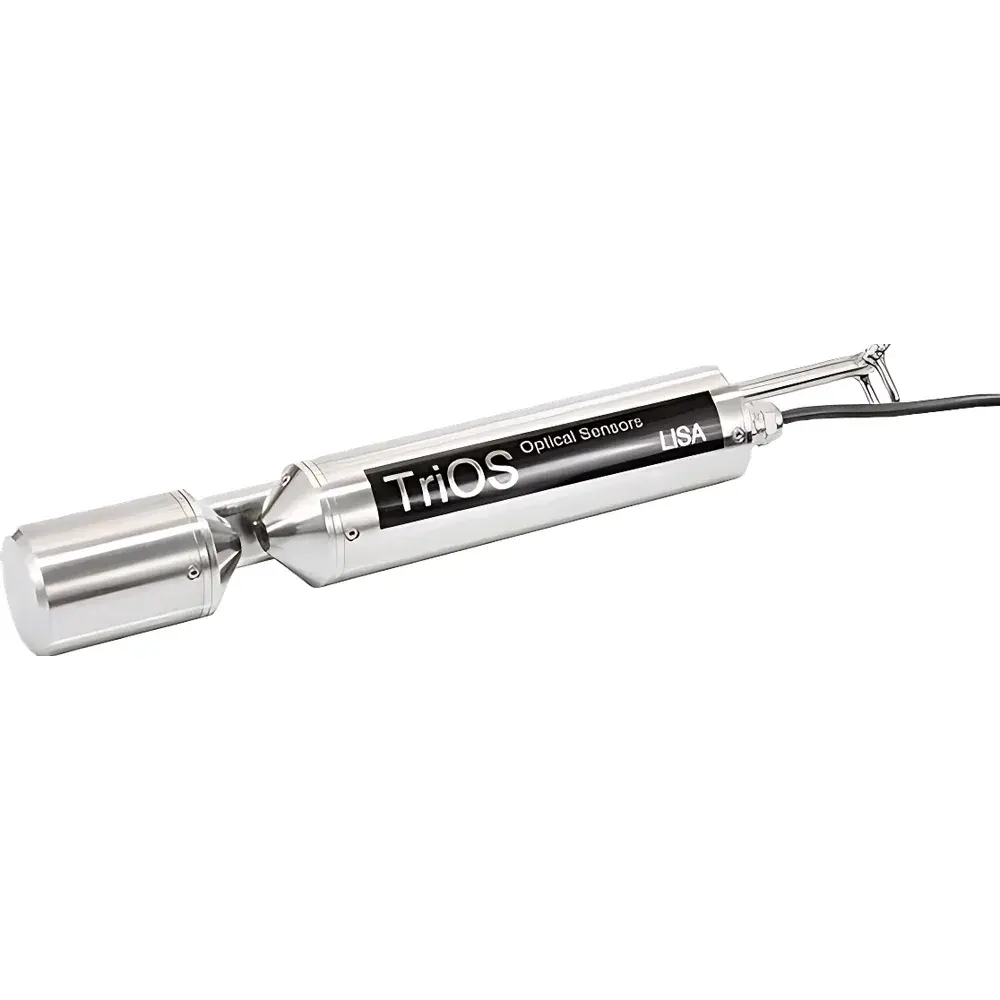
TriOS LISA 254 BOD Online Monitor
| Brand | TriOS |
|---|---|
| Origin | Germany |
| Manufacturer Type | Authorized Distributor |
| Origin Category | Imported |
| Model | LISA 254 BOD |
| Instrument Type | Online BOD Analyzer |
| Measurement Principle | Dissolved Oxygen (DO)-Based Optical Correlation |
| Measurement Range | 0–700 mg/L BODeq |
| Detection Limit | 0.1 mg/L BODeq |
| Accuracy | ±5% of reading |
| Single Measurement Time | 1 min |
| Repeatability | ±2% RSD |
| Light Path Options | 1, 2, 5, 10, or 50 mm |
| Dual-Channel Turbidity Compensation | Yes (530 nm reference channel) |
| Output Interfaces | Ethernet (TCP/IP), RS-232/RS-485 (Modbus RTU), 4–20 mA analog |
| Power Supply | 12–24 VDC (±10%), ≤1 W |
| Operating Temperature | 2–40 °C (sample & ambient) |
| Pressure Rating | Up to 30 bar (SubConn), 3 bar (fixed cable), 1 bar (flow cell) |
| Enclosure Material | Stainless Steel 1.4571 / 1.4404 or Titanium Grade 3.7035 |
| IP Rating | IP68 |
| Dimensions (10 mm path) | 300 mm × 48 mm |
| Weight (10 mm, stainless) | 1.6 kg |
| Data Storage | 2 MB internal |
| Response Time | 4 s |
| Measurement Interval | 2 s |
| UV Source | Dual LED (254 nm + 530 nm) |
| Detector | Filtered Photodiode |
| SAC254 Calibration | Traceable to NIST-traceable standards |
Overview
The TriOS LISA 254 BOD Online Monitor is an optical, reagent-free sensor engineered for continuous, real-time estimation of biochemical oxygen demand equivalents (BODeq) in aqueous environments. Unlike conventional respirometric or dilution-based BOD methods requiring 5-day incubation, the LISA 254 applies a robust, physics-based correlation between ultraviolet absorbance at 254 nm (SAC254) and surrogate organic load parameters—specifically BODeq, CODeq, and TOCeq—derived from extensive empirical calibration across municipal wastewater, surface water, and treated effluent matrices. Its measurement principle relies on Beer–Lambert attenuation of 254 nm UV light through the sample, with simultaneous 530 nm reference channel compensation for turbidity-induced scattering effects. This dual-wavelength architecture ensures stable performance under variable suspended solids conditions without mechanical moving parts or consumables. The sensor operates directly in-line or in bypass flow cells, eliminating sample extraction, conditioning, or chemical dosing—thereby reducing operational complexity, maintenance frequency, and long-term cost of ownership.
Key Features
- UV-LED light source (254 nm primary, 530 nm reference) with >10,000-hour lifetime and minimal thermal drift
- Nano-coated sapphire optical window combined with compressed-air purge system for fouling resistance and extended maintenance intervals
- Configurable optical path lengths (1, 2, 5, 10, or 50 mm) to optimize sensitivity and dynamic range for low- or high-strength applications
- Titanium (3.7035) or acid-resistant stainless steel (1.4571/1.4404) housing rated IP68 and pressure-certified up to 30 bar (SubConn)
- G2 digital interface supporting seamless integration with TriOS controllers, third-party SCADA systems, and PLCs via Modbus RTU or TCP/IP
- Dual-output capability: digital (Ethernet, RS-485) and analog (4–20 mA) for redundancy and legacy system compatibility
- On-device calculation of BODeq, CODeq, and TOCeq using application-specific calibration models stored in non-volatile memory
- Low power consumption (≤1 W) enabling deployment in solar-powered or remote monitoring stations
Sample Compatibility & Compliance
The LISA 254 is validated for use in raw influent, secondary effluent, tertiary treated water, drinking water distribution networks, and UV disinfection pre-/post-chambers. It tolerates chloride concentrations up to 20,000 mg/L when configured with titanium housing, making it suitable for coastal or industrial-impacted sites. Flow velocity range (0.1–10 m/s) and temperature operating window (2–40 °C) align with standard EN ISO 5815-1:2012 and ASTM D5210-19 requirements for online organic load monitoring. While not a direct replacement for standardized 5-day BOD5 (ISO 5815-1, APHA 5210B), the instrument supports trend analysis, process control, and early-warning detection per EPA Guidance for Real-Time Water Quality Monitoring (EPA 817-R-20-001). Its data audit trail, timestamped measurements, and firmware version logging support GLP-aligned documentation practices.
Software & Data Management
Data acquisition and configuration are managed via TriOS SensorControl software (Windows-based) or RESTful API over Ethernet. Internal 2 MB flash memory logs time-stamped BODeq, SAC254, turbidity-corrected absorbance, and diagnostic flags at user-defined intervals (minimum 2 s). All stored records include UTC timestamps, sensor ID, firmware revision, and checksum validation. The G2 interface enables secure Modbus TCP mapping of real-time values and status registers—including self-diagnostic codes for window fouling, LED degradation, or temperature excursions. Optional integration with cloud platforms (e.g., AWS IoT Core, Siemens MindSphere) supports automated alerting, historical trending, and multi-sensor correlation analytics. Firmware updates are delivered via signed .bin files to ensure integrity and traceability in regulated environments.
Applications
- Real-time optimization of activated sludge aeration basins by correlating BODeq spikes with dissolved oxygen demand
- Early detection of sanitary sewer overflows (SSOs) or industrial discharges in combined sewer systems
- Performance verification of membrane bioreactors (MBRs) and moving bed biofilm reactors (MBBRs)
- Monitoring UV transmittance (UVT) and organic fouling potential upstream of UV disinfection units
- Compliance reporting support for discharge permits where surrogate parameters (e.g., SAC254) are accepted under site-specific variance agreements
- Long-term trend analysis of watershed organic loading in conjunction with nitrate, phosphate, and turbidity sensors
FAQ
Does the LISA 254 measure true BOD5?
No—it provides BODeq, a statistically derived surrogate parameter correlated with 5-day BOD through site-specific or matrix-specific calibration. It is intended for process control and trend monitoring, not regulatory compliance testing unless explicitly approved by local authorities.
Can it be installed in pressurized pipelines?
Yes—when equipped with SubConn wet-mateable connector and mounted with appropriate pressure-rated flow cell (max. 30 bar for SubConn interface; 1 bar for standard flow cell). Engineering review of pipeline dynamics and mounting orientation is recommended.
How often does the optical window require cleaning?
Under typical wastewater conditions with compressed-air purge enabled, cleaning intervals exceed 6–12 months. Field data from municipal plants show <5% signal drift over 200 days without manual intervention.
Is the 4–20 mA output linear across the full BODeq range?
Yes—the analog output is factory-calibrated to span 0–700 mg/L BODeq (or user-defined range) with NIST-traceable linearity verification per IEC 61298-2.
Does it comply with FDA 21 CFR Part 11 for electronic records?
The LISA 254 itself does not provide audit trails or electronic signatures required for Part 11 compliance; however, when integrated into a validated SCADA or LIMS platform with appropriate procedural controls, it contributes to compliant data acquisition workflows.
Related Products







