
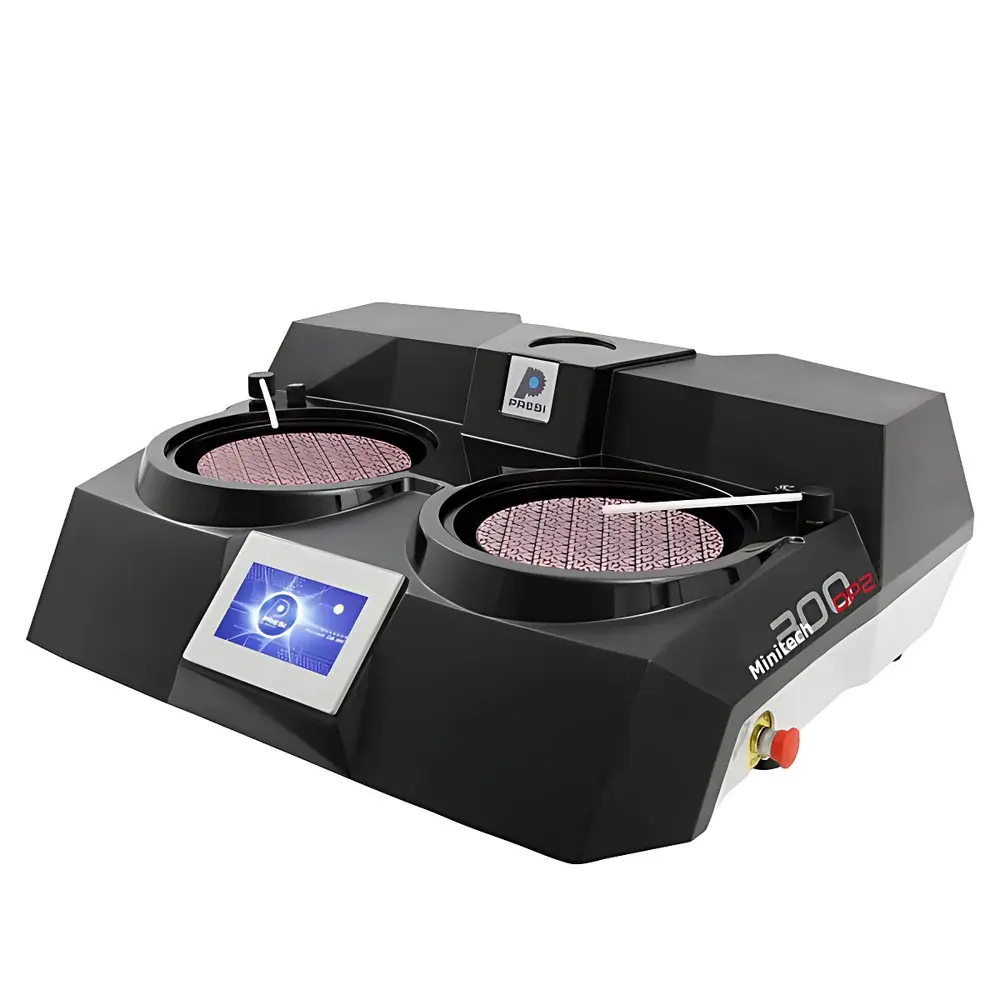
PRESI MINITECH 300 DP2 Manual Dual-Plate Dual-Motor Grinding and Polishing System
| Brand | PRESI |
|---|---|
| Origin | France |
| Manufacturer Type | Authorized Distributor |
| Origin Category | Imported |
| Model | MINITECH 300 DP2 |
| Dimensions (L×W×D) | 1100 × 810 × 330 mm |
| Number of Grinding/Polishing Plates | 2 |
| Plate Diameter | Ø 250 mm or Ø 300 mm |
| Speed Range | 20–700 rpm |
| Motor Power | 900 W × 2 |
| Display | 7-inch color LCD touchscreen |
| Real-time load feedback | Yes |
| Safety | Dual emergency stop buttons, IP-rated enclosure design, splash guard integrated |
| Base | Tilted drainage base with elevated spindle bearing housing |
| Sample Holder Bowl | Removable polymer bowl with corrosion resistance |
| Spin-dry function | Yes |
Overview
The PRESI MINITECH 300 DP2 is a precision-engineered manual dual-plate grinding and polishing system designed for consistent, reproducible metallographic and materials science sample preparation. Built in France and compliant with CE machinery directives (2006/42/EC) and electromagnetic compatibility standards (2014/30/EU), this system employs independent dual-motor architecture—each driving a separate Ø 250 mm or Ø 300 mm plate—to enable simultaneous or asynchronous operation for coarse grinding, fine grinding, and polishing steps. Its core operational principle relies on controlled mechanical abrasion under operator-applied load, with real-time force feedback enabling quantitative pressure management—a critical factor in minimizing subsurface deformation and achieving planar, artifact-free surfaces across diverse material classes including ferrous alloys, non-ferrous metals, ceramics, composites, and geological specimens.
Key Features
- Dual independent 900 W AC motors with vector-controlled frequency inverters ensure stable torque delivery across the full speed range (20–700 rpm), supporting high-load applications on large-section or ultra-hard samples (e.g., tungsten carbide, hardened steels, sintered oxides).
- Real-time load monitoring via calibrated force sensor provides dynamic feedback of operator-applied pressure (displayed in Newtons on-screen), facilitating standardized manual technique and reducing inter-operator variability.
- 7-inch full-color LCD touchscreen interface enables intuitive programming of rotational speed, direction (clockwise/counter-clockwise), water valve activation, timer-based step sequencing, and spin-dry cycles—all accessible from the front panel without tools or software installation.
- Multi-level password-protected software architecture supports role-based access control: technicians adjust runtime parameters, while lab supervisors define and lock master protocols (e.g., “Aluminum Alloy 6061 – 3-step polish”), ensuring compliance with internal SOPs and external quality frameworks such as ISO/IEC 17025.
- Ergonomically optimized base features a 3° tilt angle for efficient coolant drainage, elevated main shaft bearings to prevent fluid ingress, and an integrated splash ring to contain abrasive slurry—enhancing both operator safety and long-term mechanical integrity.
- Removable high-performance polymer sample holder bowl resists corrosion, staining, and chemical degradation from common lubricants (e.g., glycerol-based suspensions, ethanol-based cleaners) and simplifies routine decontamination and maintenance.
- Automated spin-dry function engages post-cycle to remove residual coolant and particulate from mounted abrasive papers, diamond discs, or woven polishing cloths—extending consumable life and minimizing cross-contamination between preparation stages.
- Redundant safety systems include dual illuminated emergency stop buttons (EN 60204-1 compliant), automatic motor shutdown upon abnormal current draw, and IP54-rated electrical compartment sealing.
Sample Compatibility & Compliance
The MINITECH 300 DP2 accommodates specimens up to 150 mm in diameter (with optional extended holders) and supports standardized mounting geometries per ASTM E3, ISO 14487, and EN 10365. Its modular plate configuration permits use of all major consumable formats—including silicon carbide papers (P80–P2500), diamond-impregnated discs (15–90 µm), and synthetic or natural cloth polishing pads—with compatibility verified for both aqueous and oil-based lubricants. The system meets requirements for GLP-compliant laboratories through audit-trail-capable parameter logging (when paired with optional PRESI LabLink software), and its mechanical design aligns with ISO 15190:2020 laboratory safety standards for equipment layout and operator interaction zones.
Software & Data Management
While fully functional in standalone mode, the MINITECH 300 DP2 integrates with PRESI LabLink PC software (Windows 10/11, USB or Ethernet connection) for protocol archiving, remote parameter synchronization across multiple units, and export of preparation logs—including timestamp, applied load profile, speed history, and cycle completion status—in CSV or PDF format. All user actions are time-stamped and logged with operator ID (where configured), satisfying documentation requirements under FDA 21 CFR Part 11 when deployed in regulated environments (e.g., medical device QA labs, aerospace metallurgy centers). No cloud dependency or subscription model is required; data remains local unless explicitly exported.
Applications
This system is routinely deployed in R&D laboratories, failure analysis centers, and third-party testing facilities for preparing specimens prior to optical microscopy (OM), scanning electron microscopy (SEM), electron backscatter diffraction (EBSD), and microhardness testing (Vickers/Knoop). Typical use cases include cross-sectional analysis of additive-manufactured components, grain structure evaluation in heat-treated superalloys, interface characterization in brazed joints, and porosity quantification in powder metallurgy parts. Its manual control paradigm—augmented by digital feedback—makes it especially valuable for method development, teaching laboratories, and low-throughput high-variability workflows where automated systems lack flexibility.
FAQ
Is the MINITECH 300 DP2 compatible with both water-cooled and dry grinding processes?
Yes—integrated programmable water valve control supports timed or continuous coolant delivery, while the sealed motor housing and elevated bearing design permit safe operation in dry mode using dust-extraction-compatible abrasives.
Can I retrofit my existing MINITECH 250 DP2 with components from the 300 DP2?
No—motor housings, drive belts, plate adapters, and control boards are not interchangeable due to dimensional and power rating differences between the two platforms.
Does the system support ASTM E3-compliant specimen orientation during polishing?
Yes—the adjustable sample holder arm includes angular indexing detents at 0°, 45°, and 90°, allowing precise alignment relative to grinding direction per ASTM E3 Annex A2 guidelines.
What maintenance intervals are recommended for the belt drive system?
PRESI recommends visual inspection of timing belts every 500 operating hours and replacement every 2,000 hours or 24 months—whichever occurs first—using OEM-specified HTD-profile belts.
Is technical support available in English for North American customers?
Yes—PRESI’s global technical support team provides multilingual assistance (including English, German, Spanish, and French) via email, remote diagnostics, and certified field service engineers across the US, Canada, and Mexico.



