
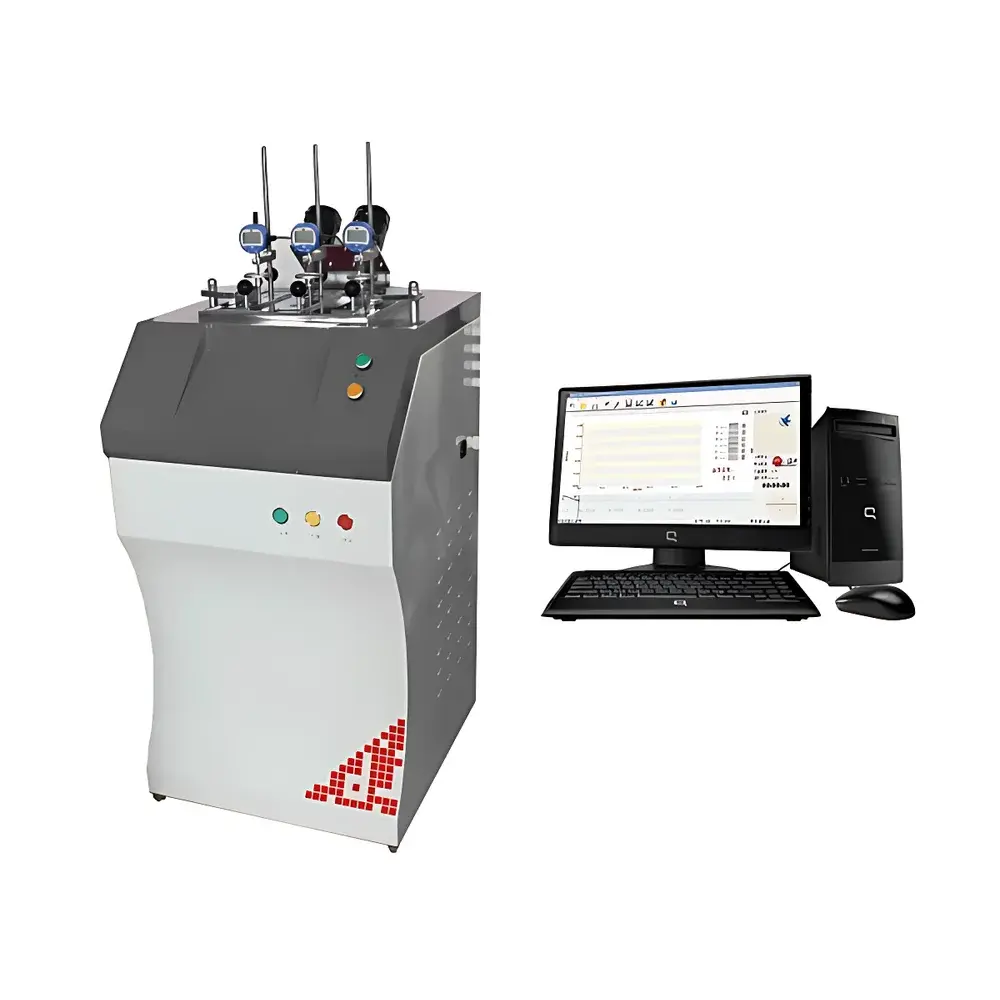
TianYuan TY-5006HB Heat Deflection Temperature (HDT) and Vicat Softening Temperature (VST) Tester
| Brand | TianYuan |
|---|---|
| Origin | Jiangsu, China |
| Manufacturer Type | Direct Manufacturer |
| Region Category | Domestic (China) |
| Model | TY-5006HB |
| Temperature Range | RT–300 °C |
| Heating Rate Options | (120±10) °C/h, (12±1) °C/6 min, (50±5) °C/h, (5±0.5) °C/6 min |
| Temperature Accuracy | ±0.1 °C |
| Deflection Measurement Range | 0–1.5 mm |
| Deflection Resolution | ±0.001 mm |
| Sample Supports | 3 independent test stations |
| Support Span Options | 64 mm or 100 mm |
| Load Rod Mass | 68 g |
| Thermal Expansion Coefficient of Test Frame | <0.005 mm/100 °C |
| Heating Power | 2.4 kW |
| Dimensions | 540 × 520 × 970 mm |
| Calibration Medium | Methyl silicone oil (200 cSt) or transformer oil |
| Cooling Method | Natural convection above 150 °C |
| Standard Compliant | GB/T 1633, GB/T 1634.1–3, GB/T 8802, ISO 306:2022, ISO 75-1:2013, ISO 75-2:2013, ISO 75-3:2013, ASTM D1525, ASTM D648, ISO 2507:2016 |
Overview
The TianYuan TY-5006HB Heat Deflection Temperature (HDT) and Vicat Softening Temperature (VST) Tester is a precision-engineered instrument designed for standardized thermal performance evaluation of thermoplastics, thermosets, elastomers, and fiber-reinforced composites. It operates on two internationally recognized test principles: the Vicat softening temperature method (ISO 306, ASTM D1525), which measures the temperature at which a needle of defined geometry penetrates a specimen under specified load and heating rate; and the heat deflection temperature method (ISO 75, ASTM D648), which determines the temperature at which a loaded test bar deflects by a predetermined amount under controlled flexural stress. These tests provide critical data for material selection, process validation, quality assurance, and regulatory compliance in polymer manufacturing, R&D labs, and third-party testing institutions.
Key Features
- Triple-station test configuration enabling parallel evaluation of up to three specimens—improving throughput without compromising inter-test reproducibility.
- Dual-mode temperature control system featuring four selectable heating rates: (120±10) °C/h, (12±1) °C/6 min, (50±5) °C/h, and (5±0.5) °C/6 min—ensuring strict adherence to both ISO and ASTM procedural requirements.
- High-precision deflection measurement using calibrated digital micrometer transducers with ±0.001 mm resolution and full-scale range of 0–1.5 mm.
- Embedded real-time control architecture based on ARM Cortex-M3 microcontroller (120 MHz clock, 32-bit processing), delivering deterministic response, low-latency feedback loops, and robust thermal regulation via advanced PID algorithms.
- Σ-Δ 16-bit error-free ADC acquisition with CRC-protected master-slave communication protocol—guaranteeing integrity of temperature and deformation data streams throughout test execution.
- Motorized sample frame lift mechanism allows automated elevation/descent before and after testing—reducing operator intervention and minimizing thermal disturbance during specimen loading/unloading.
- Integrated thermal safety architecture including overtemperature cutoff, heater current monitoring, and automatic shutdown upon test completion or anomaly detection.
Sample Compatibility & Compliance
The TY-5006HB supports standardized test geometries for diverse polymeric materials per major international standards. Compatible specimens include rigid plastics (e.g., ABS, PC, PP), thermosetting laminates (e.g., phenolic, epoxy-glass), hard rubber compounds, electrically insulating polymers, and long-fiber reinforced composites. The instrument accommodates dual support spans (64 mm and 100 mm) and provides a comprehensive set of calibrated weights (A–I, T, W series) to meet load requirements across HDT Class A, B, and C as defined in ISO 75-2 and ASTM D648. All hardware—including test frames, load rods, and spacers—is engineered to minimize parasitic thermal expansion (<0.005 mm/100 °C), ensuring measurement fidelity under prolonged thermal cycling. The system fully complies with ISO/IEC 17025 traceability expectations when operated within accredited laboratory environments.
Software & Data Management
The TY-5006HB operates via embedded firmware with optional PC-based supervisory software for enhanced workflow integration. Real-time temperature and deflection curves are continuously logged with timestamped metadata. Exportable data files conform to CSV and XML formats, supporting post-processing in statistical analysis tools (e.g., Minitab, JMP) or LIMS integration. Audit trails record operator ID, test parameters, calibration events, and system diagnostics—meeting GLP/GMP documentation requirements and aligning with FDA 21 CFR Part 11 principles for electronic records where validated software modules are deployed. Raw sensor outputs undergo on-device linearization and temperature-compensated scaling prior to storage, eliminating post-hoc correction dependencies.
Applications
- Quality control of incoming polymer resins and finished parts in automotive, electronics, and construction sectors.
- Thermal stability benchmarking during formulation development of flame-retardant compounds and high-heat-resistant composites.
- Validation of molding and extrusion process windows—correlating HDT/VST values with cycle time and mold temperature settings.
- Regulatory submission support for medical device housings (ISO 10993-1), electrical enclosures (UL 746B), and piping systems (ISO 2507).
- Academic research into structure–property relationships in novel biopolymers and nanocomposites.
FAQ
What standards does the TY-5006HB fully support?
It meets all requirements of GB/T 1633, GB/T 1634.1–3, GB/T 8802, ISO 306:2022, ISO 75-1:2013 through ISO 75-3:2013, ASTM D1525, ASTM D648, and ISO 2507:2016.
Is the instrument suitable for routine QC in ISO/IEC 17025-accredited labs?
Yes—when used with documented calibration procedures, traceable reference materials, and validated operational protocols, it satisfies technical requirements for accredited thermal property testing.
Can test data be exported for LIMS integration?
Yes—CSV and XML exports include full metadata (test ID, date/time, operator, specimen ID, environmental conditions) and support automated ingestion into laboratory information management systems.
What heating medium is recommended for optimal thermal uniformity?
Methyl silicone oil with kinematic viscosity of 200 cSt is preferred for stable convection and minimal oxidative degradation up to 300 °C.
Does the system support automated reporting?
Yes—built-in print functionality generates standardized reports with test curves, pass/fail indicators, and compliance statements aligned with selected standard clauses.





