
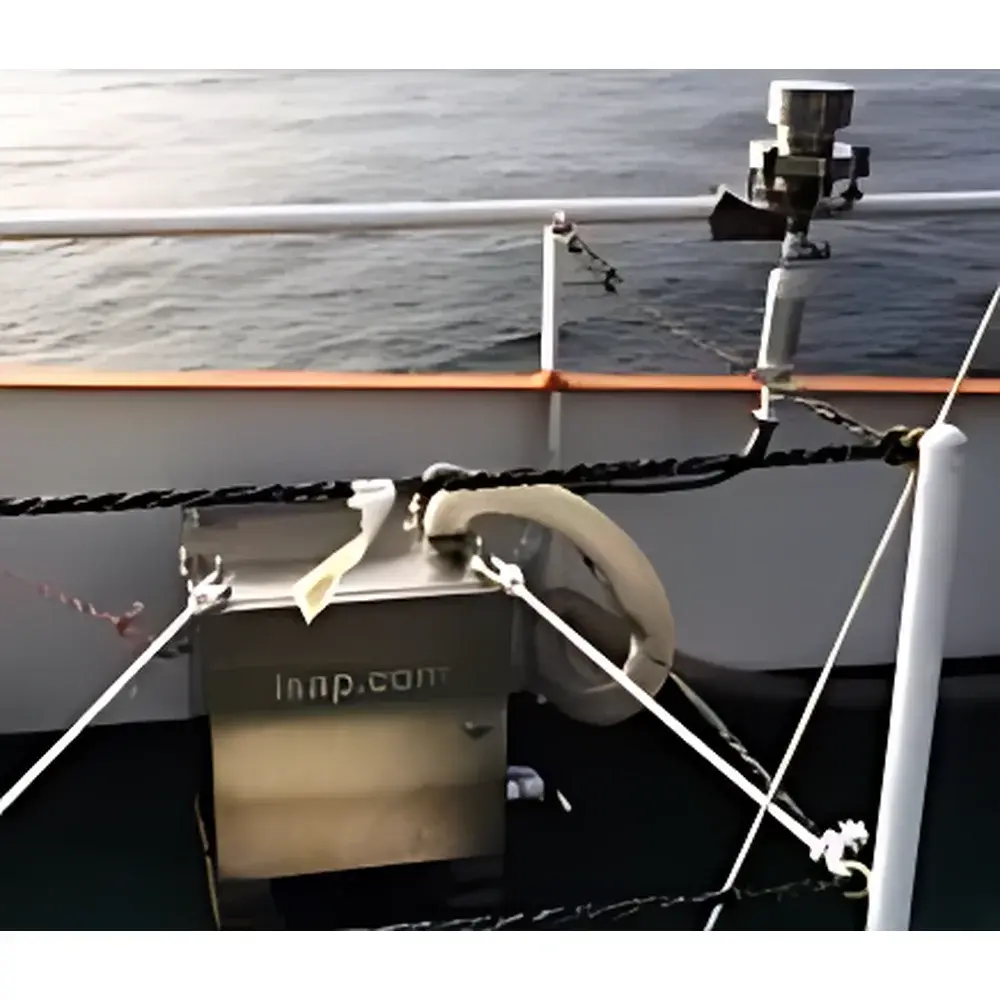
ISAP Marine Aerosol Sampler
| Brand | ISAP |
|---|---|
| Origin | Germany |
| Model | ISAP Marine Aerosol Sampler |
| Sampling Flow Rate | 500 L/min (adjustable) |
| Particle Size Cutpoints | TSP, PM10, PM2.5 |
| Environmental Sensors | Ultrasonic Anemometer (wind speed/direction), Temperature, Relative Humidity, Rain Gauge, Solar Radiation, UV Index, Ambient Noise, Vibration Sensor |
| Corrosion Protection | Marine-grade stainless steel & conformal-coated electronics |
| Compliance | Designed for EU FerryBox Project (2002–2005) deployment standards |
| Data Logging | Time-synchronized, auto-accumulated sampling duration |
| Flow Control | Closed-loop mass flow controller with pressure/temperature compensation |
Overview
The ISAP Marine Aerosol Sampler is a purpose-engineered environmental monitoring system designed for continuous, unattended aerosol collection aboard research vessels, ferries, and commercial maritime platforms. Based on the operational framework of the EU-funded FerryBox project (2002–2005), this sampler integrates robust marine-grade hardware with meteorological sensing to deliver high-integrity particulate matter data across oceanic transects. It operates on the principle of inertial separation and gravitational sedimentation, utilizing standardized impactor-based cutpoints (TSP, PM10, and PM2.5) compliant with ISO 7708 and EN 12341. The system maintains constant volumetric flow (up to 500 L/min) via a closed-loop mass flow controller that dynamically compensates for ambient pressure, temperature, and humidity fluctuations—ensuring metrological traceability under dynamic maritime conditions. Its deployment supports long-term atmospheric composition studies, shipborne air quality mapping, and validation of satellite-derived aerosol optical depth (AOD) products.
Key Features
- Marine-hardened construction: 316L stainless steel housing with IP66-rated enclosures and conformal-coated PCBs to resist salt fog, humidity, and thermal cycling per IEC 60068-2-52.
- Wind-direction–controlled sampling: Integrated ultrasonic anemometer enables real-time azimuthal alignment of the inlet to avoid contamination from vessel exhaust stacks and stack plumes—critical for source apportionment in boundary-layer studies.
- Stable flow regulation: Mass flow controller with NIST-traceable calibration ensures ±2% flow accuracy over 0–50°C and 30–95% RH, independent of ship motion or barometric drift.
- Multi-stage particulate collection: Interchangeable sampling heads support concurrent or sequential TSP, PM10, and PM2.5 fractionation using EPA-compliant sharp-cut cyclones and inertial impactors.
- Synchronized environmental monitoring: Co-located ultrasonic wind sensor eliminates mechanical wear and ship-motion-induced bias; paired with calibrated sensors for temperature, relative humidity, solar irradiance (pyranometer), UV-A/B radiometry, acoustic noise (IEC 61672-1), and triaxial vibration (ISO 5349-1).
- Automated time-stamped logging: Internal SD card records synchronized timestamps for sample duration, flow history, sensor readings, and diagnostic flags—supporting GLP-compliant audit trails.
Sample Compatibility & Compliance
The ISAP Marine Aerosol Sampler is validated for use with standard 47-mm and 25-mm quartz fiber, PTFE, and polycarbonate membrane filters compatible with gravimetric analysis, ion chromatography (IC), XRF, and GC-MS workflows. Filter substrates meet ASTM D1357 and ISO/IEC 17025 requirements for mass stability and low blank variability. The system adheres to European Union Marine Strategy Framework Directive (MSFD) Annex III monitoring protocols and supports compliance with IMO MARPOL Annex VI emission monitoring frameworks. All firmware and data handling routines are structured to facilitate future alignment with FDA 21 CFR Part 11 electronic record requirements through optional secure user authentication and audit log export.
Software & Data Management
Data acquisition is managed via embedded Linux-based firmware with dual-mode operation: autonomous batch logging (CSV/NetCDF) and real-time TCP/IP streaming to onboard servers or shore-side cloud platforms. The included desktop configuration utility (Windows/macOS/Linux) allows parameter scheduling (e.g., duty cycling, flow ramping), sensor calibration offset entry, and diagnostic self-tests. Raw sensor outputs are timestamped using GPS-synchronized PPS signals, enabling precise spatiotemporal correlation with AIS vessel track data and meteorological model outputs (e.g., ECMWF IFS, NOAA GFS). Export formats include CF-compliant NetCDF-4 for interoperability with Ocean Data View (ODV), Panoply, and Python-based analysis pipelines (xarray, pandas).
Applications
- Long-range transport studies of anthropogenic and biogenic aerosols across major shipping lanes (e.g., North Atlantic, Mediterranean, South China Sea).
- Validation of remote-sensing aerosol products from Sentinel-3 OLCI, MODIS, and PACE missions using collocated shipborne AOD and size-resolved mass concentration.
- Source identification of black carbon, sulfate, and sea-salt aerosols via offline chemical speciation of filter samples.
- Co-location with FerryBox water-quality sensors (pH, pCO₂, Chl-a, CDOM) to investigate air–sea exchange fluxes and marine boundary layer chemistry.
- Baseline monitoring for IMO Emission Control Areas (ECAs) and national maritime air quality management plans.
FAQ
Is the ISAP Marine Aerosol Sampler certified for Class II marine environments per IEC 60945?
Yes—the system meets IEC 60945:2020 Clause 8 (Environmental Conditions) for Class II installations, including vibration, shock, and electromagnetic compatibility testing.
Can the sampler operate autonomously for >30 days without manual intervention?
Yes—configured with external power buffering and redundant SD card storage, it supports unattended operation for up to 90 days at 10-minute logging intervals.
Does the ultrasonic anemometer require periodic recalibration?
No—ultrasonic transducers are factory-calibrated and drift-compensated in firmware; field verification is recommended annually per ISO 16622.
Are filter cassettes supplied with the system?
Standard 47-mm quartz fiber and PTFE cassettes are available as optional accessories; custom substrate configurations can be ordered upon request.
How is data integrity ensured during satellite communication blackouts?
All measurements are stored locally with cyclic overwrite protection and CRC-32 checksum validation; gaps are automatically flagged and reconciled upon reconnection.







