
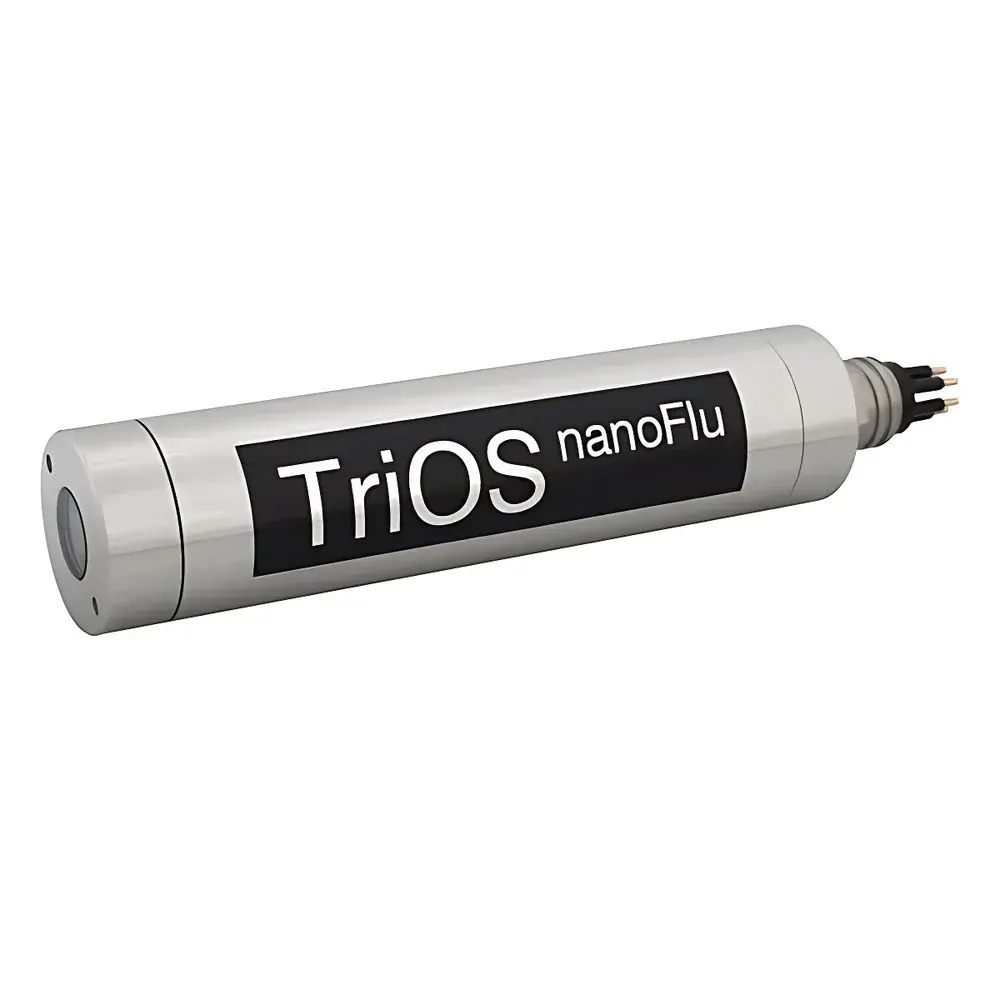
TriOS oFlu Miniature Fluorometer
| Brand | TriOS |
|---|---|
| Origin | Germany |
| Model | oFlu Miniature Fluorometer |
| Measurement Principle | Dual-wavelength fluorescence excitation & emission detection |
| Target Analytes | CDOM (colored dissolved organic matter), Chlorophyll a, Phycocyanin, Rhodamine WT, Tryptophan |
| Detection Range | 0–200 µg/L |
| Accuracy | ±3 % FS |
| Response Time | <2 s |
| Sampling Interval | <1 s |
| Housing Material | Stainless Steel 1.4571/1.4404 or Titanium Grade 2 (3.7035) |
| Dimensions | 186 mm × 36 mm (L × Ø) |
| Weight | ~0.6 kg (stainless steel), ~0.5 kg (titanium) |
| Pressure Rating | SubConn connector: 30 bar |
| Fixed cable version | 3 bar |
| Flow cell version | 1 bar (2–4 LPM) |
| IP Rating | IP68 |
| Operating Temperature | +2 °C to +40 °C |
| Storage Temperature | −20 °C to +80 °C |
| Flow Velocity Range | 0.1–10 m/s |
| Power Supply | 12–24 VDC (±10 %) |
| Power Consumption | ≤1 W |
| Digital Interfaces | Ethernet (TCP/IP), RS-232 / RS-485 (Modbus RTU) |
| Analog Outputs | 4–20 mA or 0–5 V |
| Data Storage | ~10 MB internal flash memory |
| Calibration Interval | 24 months |
| Turbidity Compensation | Not supported |
Overview
The TriOS oFlu Miniature Fluorometer is an immersion-grade, submersible optical sensor engineered for continuous, in-situ quantification of fluorescent dissolved organic compounds in aquatic environments. Based on dual-wavelength fluorescence spectroscopy, the oFlu employs high-stability LEDs as excitation sources and silicon photodiodes as detectors—enabling selective, interference-resistant measurement of key water quality indicators including chlorophyll a (as a proxy for phytoplankton biomass), phycocyanin (for cyanobacterial detection), CDOM (colored dissolved organic matter), rhodamine WT (tracer dye), and tryptophan-like fluorescence. Its compact cylindrical form factor, low power draw (≤1 W), and robust pressure-rated housing (up to 30 bar with SubConn interface) make it suitable for long-term deployment in rivers, lakes, coastal zones, drinking water intakes, wastewater effluents, and recirculating aquaculture systems. The instrument’s optical path incorporates a proprietary nanocoated quartz window that resists biofouling and maintains signal stability over extended field campaigns without frequent cleaning.
Key Features
- High Sensitivity & Selectivity: Optimized LED excitation wavelengths paired with narrow-band optical filtering ensure minimal spectral overlap between analytes—critical for distinguishing chlorophyll a from phycocyanin in mixed algal blooms.
- Nano-Coated Optical Window: Hydrophobic, anti-fouling coating reduces microbial adhesion and preserves optical transmission integrity under prolonged submersion.
- Real-Time Electronic Reference Compensation: An integrated reference photodiode monitors LED output drift in real time, correcting for aging effects and thermal fluctuations—eliminating the need for periodic lamp recalibration.
- Submersible & Pressure-Rated Design: Available in stainless steel (1.4571/1.4404) or titanium (Grade 2, 3.7035) housings, rated to 30 bar (≈300 m depth) when equipped with SubConn wet-mateable connectors.
- Low-Power Embedded Architecture: Designed for solar- or battery-powered remote stations; operates continuously at ≤1 W under 12–24 VDC input with ±10 % tolerance.
- Fast Temporal Resolution: Full measurement cycle completed in under 2 seconds, supporting sampling intervals as short as 1 second—ideal for high-frequency monitoring of dynamic events such as algal bloom onset or tracer breakthrough.
Sample Compatibility & Compliance
The oFlu is validated for direct immersion in natural and engineered water matrices—including freshwater, brackish water, seawater, potable water, and secondary-treated wastewater—without sample pre-filtration or dilution. Its optical design inherently rejects scattering artifacts from suspended solids below turbidity thresholds where fluorescence dominates the signal (i.e., <50 NTU typical). While not equipped with active turbidity compensation, its excitation/emission geometry minimizes scatter-induced bias through optimized optical path length and detector angular placement. The device complies with IEC 60529 (IP68 ingress protection), EN 61000-6-2/-6-3 (EMC immunity/emissions), and meets mechanical requirements for underwater instrumentation per ISO 14644-1 Class 8 cleanroom handling during assembly. It supports audit-ready data logging aligned with GLP principles, though full 21 CFR Part 11 compliance requires integration with validated third-party SCADA or LIMS platforms managing user authentication, electronic signatures, and change control.
Software & Data Management
Data acquisition and configuration are managed via TriOS’s standardized firmware interface, accessible through Ethernet (TCP/IP), RS-232, or RS-485 (Modbus RTU protocol). All communication channels support asynchronous polling and event-triggered reporting. Internal flash memory stores up to ~10 MB of timestamped, calibrated measurement records (including raw counts, temperature, and diagnostic flags), enabling autonomous operation for >30 days at 1-minute intervals. Analog outputs (4–20 mA or 0–5 V) provide seamless integration into legacy PLCs and DCS systems. Firmware updates are performed remotely via HTTP or local USB, with checksum verification and rollback capability. TriOS provides open Modbus register maps and ASCII command sets—facilitating custom integration with Python-based data pipelines, Node-RED dashboards, or commercial platforms like Ignition or Wonderware.
Applications
- Surface Water Monitoring: Early detection of cyanobacterial blooms via phycocyanin/chlorophyll a ratio tracking in reservoirs and lakes.
- Bathing Water Safety: Real-time assessment of algal toxin risk at recreational beaches using chlorophyll a concentration trends.
- Drinking Water Intake Protection: Continuous screening for CDOM spikes indicating terrestrial runoff or wastewater intrusion.
- Wastewater Treatment Optimization: Monitoring effluent fluorescence to assess biodegradation efficiency and detect nitrification/denitrification shifts.
- Tracer Studies & Hydrological Modeling: Quantitative tracking of rhodamine WT plumes in groundwater or surface flow experiments.
- Research Vessels & Moored Arrays: Compact size and low power enable integration into multi-sensor buoys, AUVs, and profiling platforms.
FAQ
What is the recommended calibration frequency?
Calibration is required every 24 months under normal operating conditions; however, field validation using certified reference standards (e.g., quinine sulfate solutions or chlorophyll a suspensions) is advised quarterly for regulatory-grade deployments.
Can the oFlu be used in saline or hypersaline environments?
Yes—the titanium housing variant is explicitly qualified for long-term deployment in seawater and brine; stainless steel models require periodic inspection for crevice corrosion in chloride-rich media.
Does the instrument compensate for temperature-induced fluorescence quenching?
Yes—internal NTC thermistors feed real-time temperature data to the firmware, applying empirically derived correction coefficients to fluorescence intensity values.
Is there built-in self-diagnostic functionality?
Yes—the device continuously monitors LED drive current, photodiode baseline, supply voltage, and memory integrity, reporting fault codes via Modbus register 40001 and system log entries.
How is biofouling mitigation achieved without wipers or chemical dosing?
The nanostructured quartz window coating reduces surface energy and inhibits initial microbial attachment; combined with laminar flow design around the optical path, this extends maintenance-free operation to ≥6 months in eutrophic waters.
Related Products







