
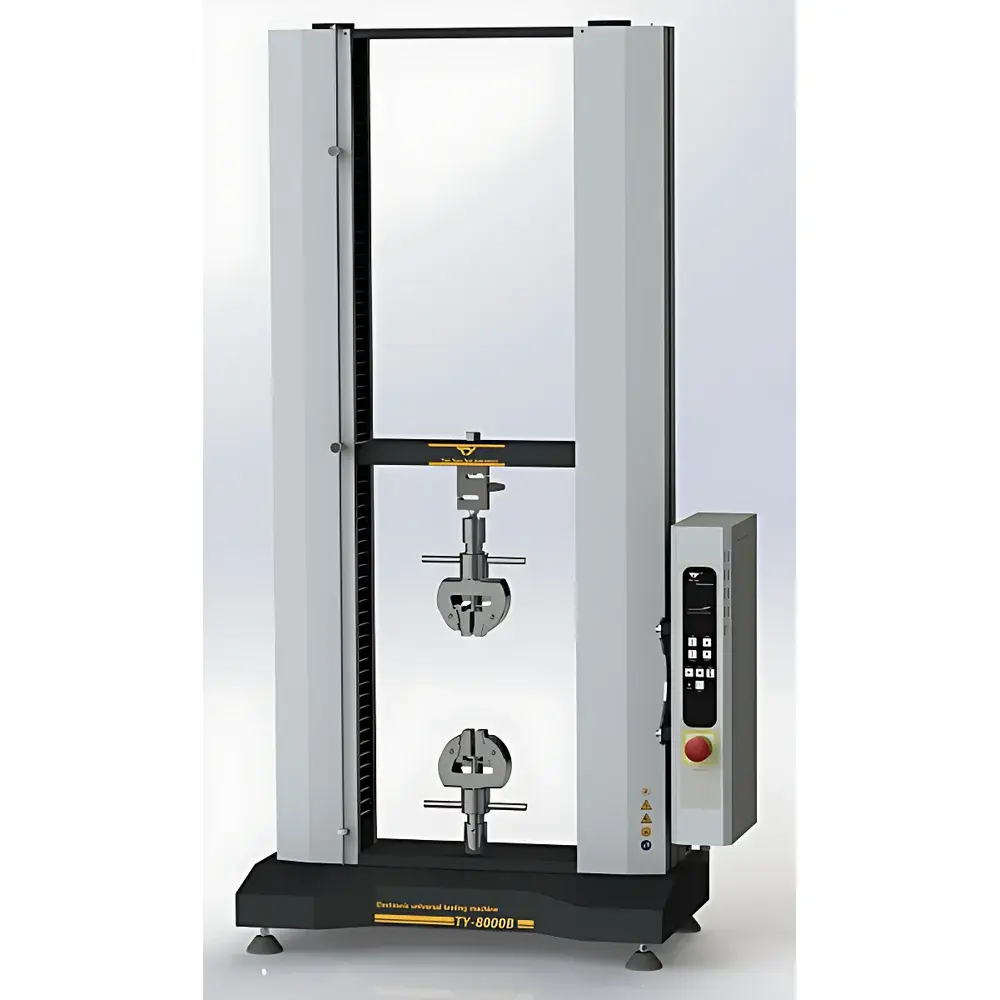
TianYuan TY8000B Series Electronic Tensile Testing Machine
| Brand | TianYuan |
|---|---|
| Origin | Jiangsu, China |
| Manufacturer Type | Direct Manufacturer |
| Country of Origin | China |
| Model | TY8000B |
| Instrument Type | Electronic Tensile Testing Machine |
| Maximum Test Load | 5 kN |
| Force Measurement Range | 1–100% FS |
| Force Accuracy | ≤ ±1% |
| Travel Distance (without fixtures) | 900 mm |
| Displacement Resolution | 0.01 mm |
| Load Resolution | 1/60000 |
| Speed Range | 1–500 mm/min |
| Speed Accuracy | ≤ ±0.8% |
| Effective Width | 360 mm |
| Dimensions (W×D×H) | 720 × 440 × 1550 mm |
| Weight | 180 kg |
| Power Supply | 220 V AC, 50 Hz |
Overview
The TianYuan TY8000B Series Electronic Tensile Testing Machine is a precision-engineered universal testing system designed for static mechanical property evaluation of polymeric, elastomeric, metallic, and composite materials. It operates on the principle of uniaxial force application via servo-controlled electromechanical actuation, conforming to fundamental standards of material mechanics including Hooke’s law, yield point determination, tensile strength, elongation at break, modulus of elasticity, and stress–strain curve generation. The system integrates a high-torque stepper-servo motor, precision-ground ball screw transmission, and a full-digital DSP+MCU control architecture to ensure stable load application, repeatable displacement control, and real-time data fidelity. Designed for laboratory and QC environments, the TY8000B meets structural and metrological requirements defined in GB/T 2611 (General Technical Requirements for Testing Machines), GB/T 16491 (Electronic Universal Testing Machines), and supports validation against international reference methods including ASTM E4, ASTM D412, ISO 527, ISO 37, DIN 53504, JIS K6251, and BS EN 10002.
Key Features
- High-resolution force measurement with 1/60000 internal resolution and ≤ ±1% full-scale accuracy across the 5 kN capacity range
- Adjustable crosshead speed from 1 to 500 mm/min, calibrated to ≤ ±0.8% deviation over the full range
- 900 mm vertical travel stroke (excluding fixture height), enabling extended elongation testing for elastomers and thermoplastics
- 0.01 mm displacement resolution supported by optical encoder feedback and closed-loop position control
- DSP+MCU dual-core digital controller for synchronized load–displacement acquisition, eliminating analog signal drift and timing jitter
- Modular fixture interface compatible with standard wedge-action, pneumatic, and hydraulic grips; initial set includes ASTM D412-compliant rubber tensile grips
- Robust cast-iron frame with reinforced column assembly, ensuring minimal deflection (< 0.02 mm/kN) under maximum load
Sample Compatibility & Compliance
The TY8000B accommodates specimens ranging from thin elastomeric strips (e.g., vulcanized rubber per ISO 37) to rigid polymer bars (e.g., ABS per ISO 527-2) and metallic foils (e.g., aluminum per ASTM E8). Its 360 mm effective test width and 900 mm stroke support multi-stage tests including tensile, peel, tear (ASTM D624), compression (ISO 604), flexural (ISO 178), and puncture (ASTM F1306). All hardware and firmware comply with GB/T 12160 (extensometer specifications) and GB/T 16825 (verification procedures for force-measuring systems). Calibration traceability follows ISO/IEC 17025 principles, and system verification reports include uncertainty budgets for force, displacement, and speed channels.
Software & Data Management
The embedded PC-based control software provides real-time graphical display of load–displacement, stress–strain, and time-based curves. Data acquisition occurs at ≥ 100 Hz sampling rate, with timestamped raw data stored in binary format for audit integrity. Post-test analysis modules support automatic yield point detection (0.2% offset method), modulus calculation (tangent/secant), and fracture energy integration. Export functionality includes CSV, XML, and native Excel (.xlsx) formats compliant with GLP documentation workflows. Audit trail logs record operator ID, test parameters, calibration events, and software version history—supporting alignment with FDA 21 CFR Part 11 requirements when deployed in regulated manufacturing settings.
Applications
- Rubber compound development: tensile strength, elongation at break, and permanent set evaluation per ASTM D412 and ISO 37
- Plastic film quality assurance: puncture resistance, seal strength, and peel adhesion per ASTM F88 and ASTM D1894
- Medical device component testing: suture tensile strength (ISO 10993-12), catheter shaft stiffness (ISO 80369)
- Automotive elastomer validation: dynamic hysteresis loops, compression set (ASTM D395), and low-temperature brittleness (ASTM D1329)
- Academic materials research: constitutive modeling input generation, creep-recovery profiling, and cyclic loading protocols
FAQ
What international standards does the TY8000B support for calibration and verification?
It complies with GB/T 16825 (verification of force systems), GB/T 12160 (extensometer requirements), ASTM E4 (load verification), and ISO 7500-1 (static calibration of tension/compression testing machines).
Can the system be integrated into a LIMS or MES environment?
Yes—raw data export in CSV/Excel format and optional OPC UA or Modbus TCP communication modules enable seamless integration with laboratory information management systems.
Is third-party calibration certification available?
TianYuan provides factory calibration certificates traceable to NIM (National Institute of Metrology, China); accredited third-party calibration (e.g., CNAS-certified labs) can be arranged upon request.
What maintenance intervals are recommended for long-term accuracy retention?
Biannual verification of load cell linearity and displacement encoder accuracy is advised; annual mechanical inspection of ball screw preload and guide rail lubrication ensures structural repeatability.
Does the software support multi-user role-based access control?
Standard configuration includes operator/administrator profiles with password protection; electronic signature and audit trail features meet basic 21 CFR Part 11 readiness requirements.



