
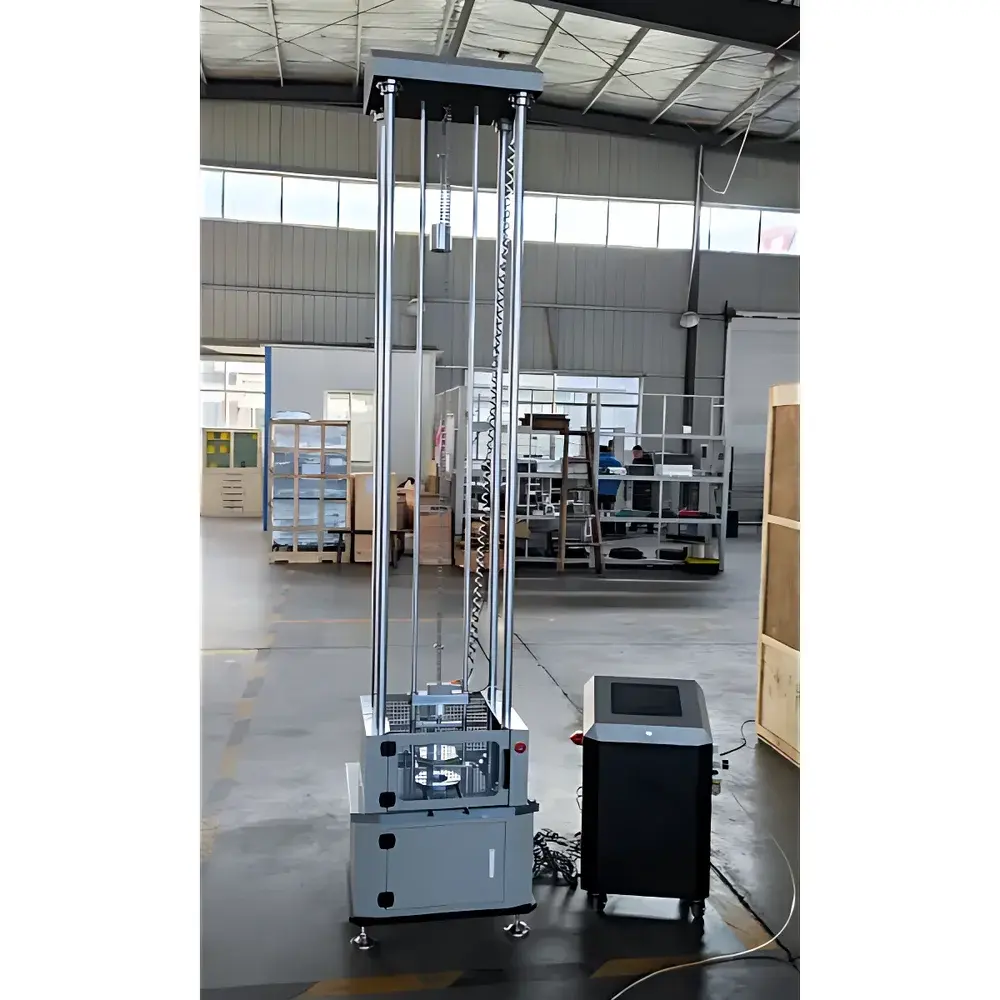
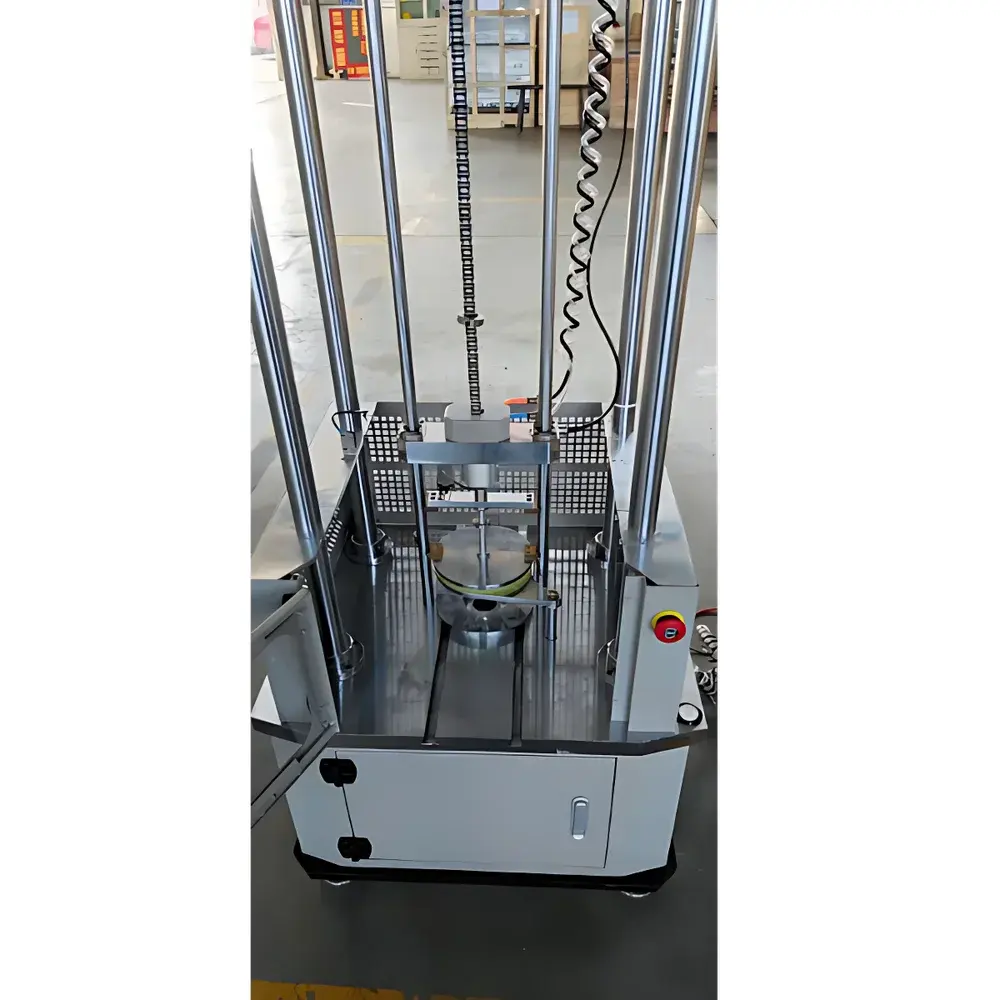
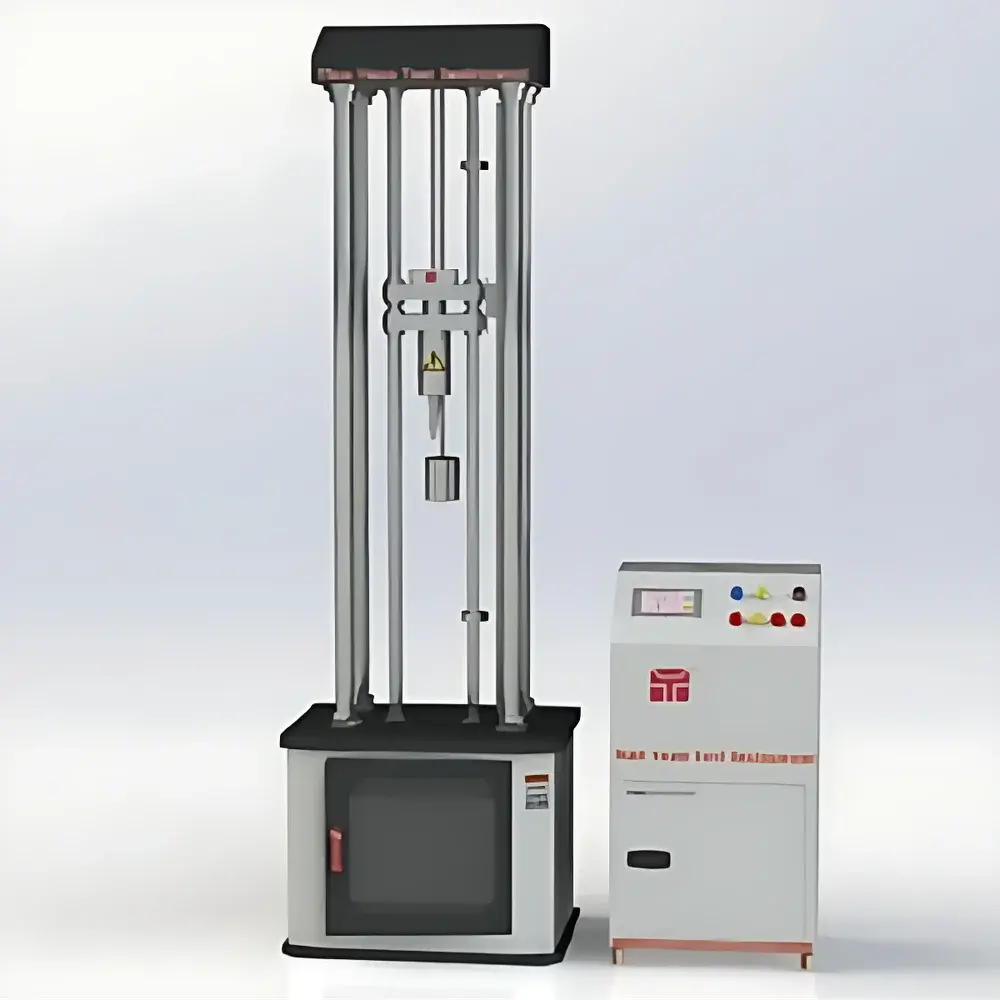
TYTESTER TY-8008 Drop Weight Impact Tester
| Brand | TYTESTER (TianYuan) |
|---|---|
| Origin | Jiangsu, China |
| Manufacturer Type | Direct Manufacturer |
| Product Category | Domestic |
| Model | TY-8008 |
| Instrument Type | Drop Weight Impact Tester |
| Impact Energy Range | 3–15 kg·m (with hammer masses: 3, 4, 5, 6, 7, 8, 9, 10, 15 kg |
| mass tolerance | ±5 g) |
| Impact Velocity | Free-fall acceleration (g = 9.80665 m/s²) |
| Maximum Lift Height | 2000 mm (±2 mm height accuracy) |
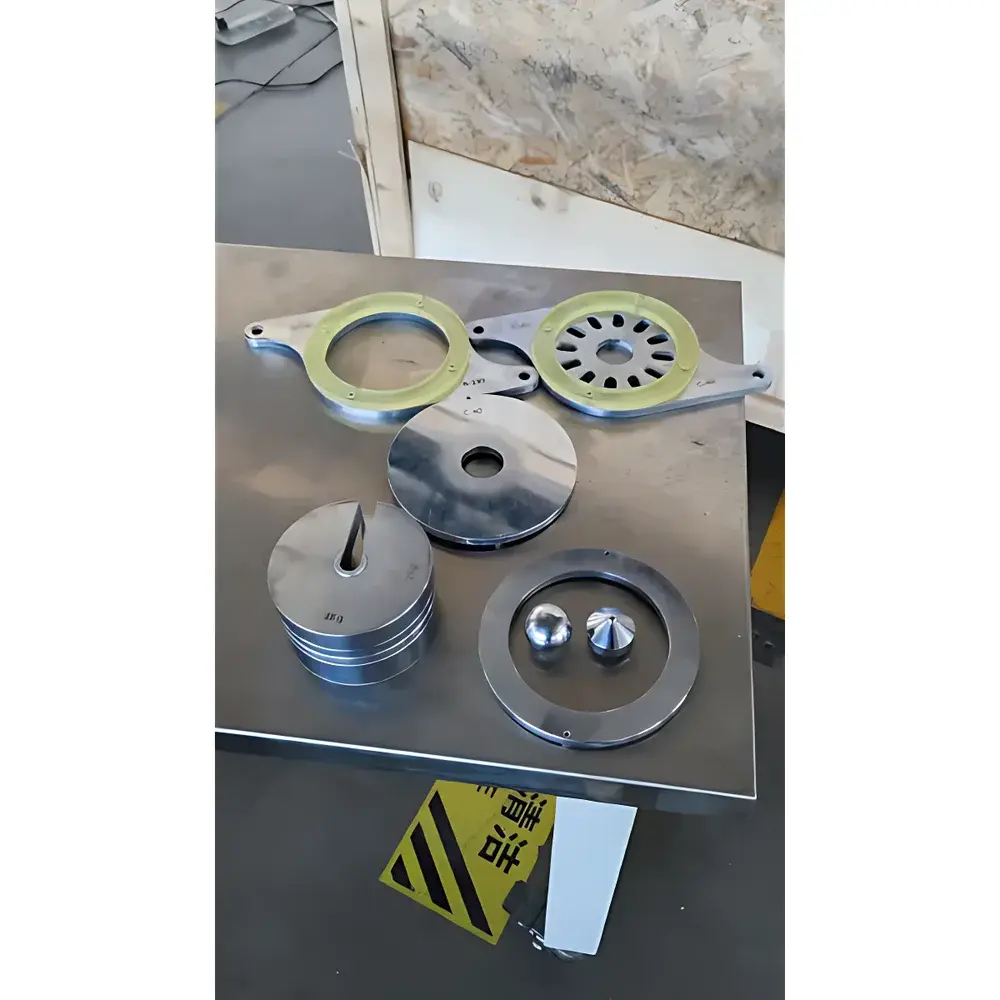
| Hammer Head Options | Type A, B, C (Rockwell hardness ≥ HRC 54) |
| Fixture Inner Diameters | 40 ± 1.0 mm (Type C), 80 ± 2.0 mm (Type A), 130 ± 2.5 mm (Type B) |
| Test Table Dimensions | 500 × 400 mm |
| Control System | PLC + 10-inch TFT touch HMI |
| Drive Motor | Stepper motor with gear reducer |
| Power Supply | AC 220 V, 50 Hz |
| Operating Temperature | 10–35 °C |
| Environmental Requirements | Low-vibration, low-EMI environment |
Overview
The TYTESTER TY-8008 Drop Weight Impact Tester is an engineered solution for standardized evaluation of external impact resistance in rigid plastic pipes and flat-sheet materials under controlled free-fall conditions. It operates on the fundamental principle of gravitational energy conversion: a calibrated mass is elevated to a precise height and released without propulsion, striking a horizontally clamped specimen at velocity determined solely by drop height (v = √2gh). This method aligns with classical impact mechanics used in ISO 6603-2, ASTM D3763, and—critically—the Chinese national standard GB/T 11548–1989 for rigid plastic sheet impact performance testing. Designed for laboratory and quality control environments, the TY-8008 delivers repeatable, traceable impact events with mechanical simplicity and operational robustness. Its dual-column vertical guidance system ensures axial alignment of the falling hammer, minimizing lateral deviation and torsional loading that could compromise result validity. The absence of pneumatic or hydraulic actuation eliminates pressure-related variability, making it particularly suitable for routine compliance verification where regulatory auditability and procedural transparency are required.
Key Features
- Modular hammer assembly with nine interchangeable mass options (3–15 kg), each certified to ±5 g tolerance per ISO/IEC 17025 traceable calibration protocols.
- Three standardized hammer head geometries (Type A, B, C) conforming to GB/T 11548–1989 and ASTM D3763 specifications—each hardened to ≥HRC 54 for consistent indentation behavior and minimal wear-induced drift.
- Dual-tube linear guidance structure with precision-ground stainless steel rods, ensuring vertical trajectory stability and eliminating pendulum-type deviations during impact.
- Automated lifting and release mechanism driven by a stepper motor and planetary gear reducer, enabling programmable height setting (0–2000 mm in 1 mm increments) and eliminating manual handling errors.
- Integrated electromagnetic hammer retention and anti-rebound lockout system prevents secondary impact events—a critical requirement for valid pass/fail determination per ISO 6603-2 Annex A.
- 10-inch industrial-grade TFT touchscreen HMI with PLC-based logic control supports multi-step test sequences, parameter logging, and real-time status feedback without external PC dependency.
Sample Compatibility & Compliance
The TY-8008 accommodates a broad spectrum of thermoplastic and thermoset sheet materials—including PVC-U, PE, PP, ABS, and polycarbonate—as well as profiled pipe specimens up to Ø315 mm when mounted on custom support fixtures. Its circular clamp design (three inner diameter variants: 40 mm, 80 mm, 130 mm) ensures uniform radial constraint and minimizes edge effects during impact. All fixture components contact samples only via chamfered edges (≤0.8 mm radius), preventing stress concentration unrelated to bulk material response. The system satisfies mandatory requirements of GB/T 11548–1989 and provides technical equivalence to ISO 6603-2:2021 (Plastics — Determination of puncture impact behaviour of rigid sheets — Part 2: Instrumented method) and ASTM D3763–22 (Standard Test Method for High Speed Puncture Properties of Plastics Using Load and Displacement Sensors). While the base configuration does not include integrated force transduction, its mechanical architecture is compatible with third-party piezoelectric load cells (e.g., PCB Piezotronics 208A03) for advanced energy absorption analysis under GLP-compliant workflows.
Software & Data Management
The embedded PLC firmware stores up to 1,000 test records locally, including date/time stamp, hammer mass, drop height, selected head type, fixture ID, operator code, and pass/fail outcome based on visual fracture assessment per GB/T 11548 criteria. Data export is supported via USB 2.0 interface in CSV format for integration into LIMS or statistical process control (SPC) platforms. Audit trail functionality logs all parameter modifications, user logins, and system resets—meeting foundational expectations of FDA 21 CFR Part 11 for electronic records in regulated manufacturing environments. No cloud connectivity or remote access capabilities are implemented, preserving data sovereignty and reducing cybersecurity surface area in industrial QA labs.
Applications
- Quality assurance of extruded PVC-U and PE water distribution pipes per GB/T 5836.1 and GB/T 10002.1.
- Evaluation of impact resistance in automotive interior trim panels and construction-grade plastic cladding sheets.
- Material qualification for medical device packaging trays requiring ISO 11607-1 puncture resistance validation.
- R&D screening of polymer blends and filled composites for toughness optimization under standardized impact loads.
- Third-party certification testing for CE-marked plastic building products under EN 13261 and EN 1462.
FAQ
What standards does the TY-8008 comply with?
It is fully aligned with GB/T 11548–1989 and technically equivalent to ISO 6603-2:2021 and ASTM D3763–22 for rigid sheet impact testing.
Can the system measure impact force or energy absorption in real time?
No—the base configuration is a non-instrumented drop tower. However, its structural design allows retrofitting with calibrated load cells and displacement sensors for advanced energy partitioning analysis.
Is height calibration traceable to national metrology institutes?
Yes—height encoder resolution is 0.1 mm, and full-scale verification (0–2000 mm) is performed using laser interferometry traceable to NIM (National Institute of Metrology, China).
What maintenance is required for long-term accuracy?
Annual verification of hammer mass calibration, guide rail lubrication (per ISO 6743-9), and HMI firmware updates—documented in the included GLP-aligned maintenance logbook.
Does the system support automated pass/fail decision logic?
It provides configurable visual pass/fail thresholds (e.g., crack length ≤ 5 mm = pass), but final judgment remains operator-assisted per GB/T 11548 requirements.



