
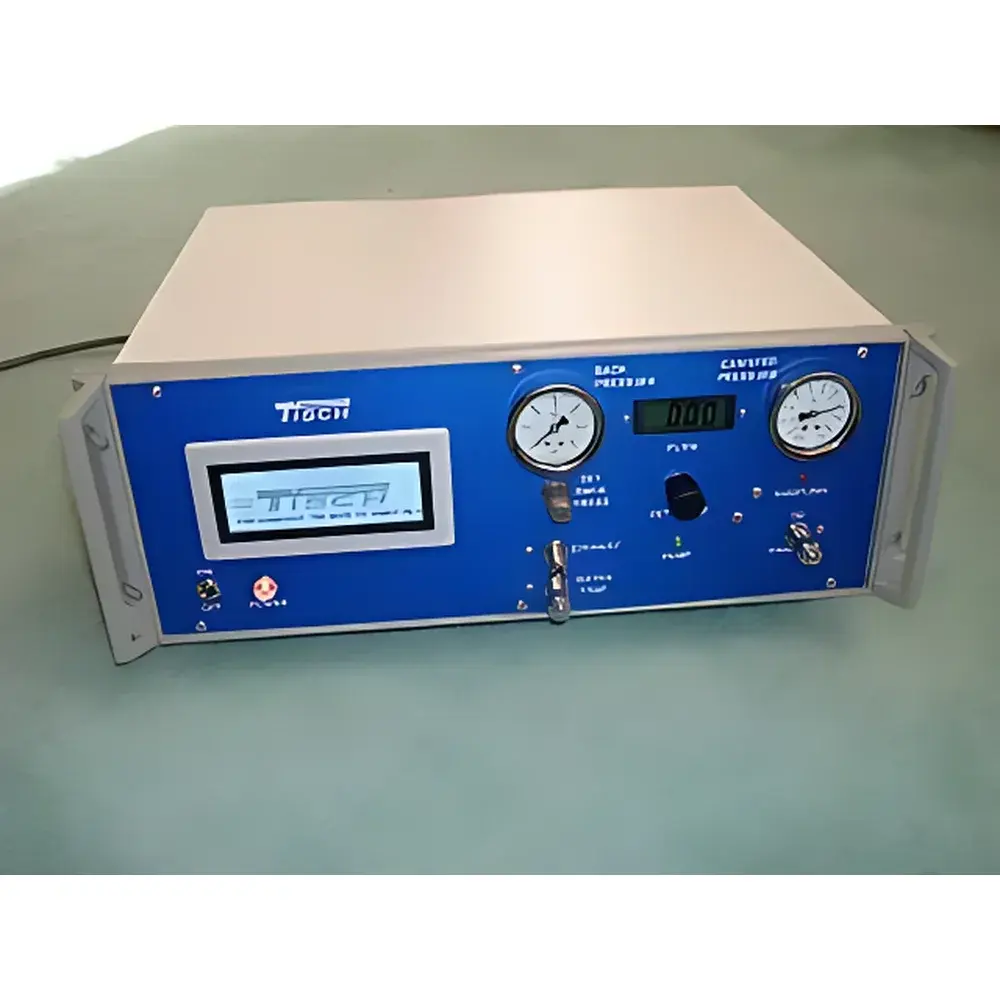
Tisch TE-123 & TE-323 Canister-Based Ambient Air Aerosol and VOC Sampling Systems
| Brand | TISCH |
|---|---|
| Origin | USA |
| Model | TE-123, TE-323 |
| Compliance | EPA TO-14/TO-15 |
| Flow Rate | 1–300 mL/min |
| Power Options | 240 VAC 50/60 Hz, 12 VDC, Solar Panel, UPS (TE-323), Battery Backup |
| Mounting | 19″ Rack or Desktop w/Rubber Feet |
| Condensate Trap | Integrated |
| Valve Configuration | 3-Way Stainless Steel Valves |
| Channel Capacity | Up to 7 (TE-123), Up to 8 (TE-323, Custom) |
| Display | Backlit LCD (4×20 chars), Touchscreen (TE-123), Siemens PLC Interface (TE-323) |
| Sample Line Purge Pump | High-Flow Integrated |
| Pre-Filter Material | PTFE |
| Pressure Gauge | Stainless Steel Vacuum Gauge |
| Data Logging | Time-Stamped Flow & Volume Integration |
| Enclosure | 304 Stainless Steel Canister Housing |
Overview
The Tisch TE-123 and TE-323 Canister-Based Ambient Air Sampling Systems are engineered for regulatory-grade collection of volatile organic compounds (VOCs) and semi-volatile organic aerosols—including polycyclic aromatic hydrocarbons (PAHs)—from ambient, indoor, or fugitive emission sources. Designed in strict conformance with U.S. Environmental Protection Agency (EPA) Method TO-14A and TO-15, these systems utilize inert, electropolished stainless steel canisters as primary sampling vessels, ensuring minimal analyte adsorption, catalytic degradation, or wall loss during storage and transport. The fundamental principle relies on quantitative, pressure-controlled draw-through sampling: ambient air is drawn at precisely regulated flow rates through a chilled condensate trap (to remove water vapor and particulate interference), then into evacuated, passivated canisters via pneumatically actuated 3-way stainless steel valves. This methodology preserves sample integrity for subsequent laboratory analysis by gas chromatography (GC) or high-performance liquid chromatography (HPLC), supporting trace-level quantification down to sub-ppbv concentrations when coupled with appropriate analytical instrumentation.
Key Features
- Regulatory-compliant architecture validated for EPA TO-14A and TO-15 applications, including calibration verification, leak integrity testing, and blank validation protocols.
- Modular multi-channel design: TE-123 supports up to seven independent sampling channels; TE-323 natively configures three channels—with scalable expansion to eight—each equipped with dedicated peristaltic or diaphragm sampling pumps and individual flow control.
- Integrated condensate trap with thermoelectric or passive cooling minimizes water co-collection without introducing sorbent artifacts or phase separation errors.
- Real-time volumetric integration via built-in mass flow sensors and time-stamped logging; total sampled volume calculated and stored with ISO 8601 timestamps for audit-ready chain-of-custody documentation.
- Dual power resilience: Operates on 240 VAC (50/60 Hz), 12 VDC, solar photovoltaic arrays (with charge controller), and uninterruptible power supply (UPS) support—enabling unattended deployment in remote or off-grid locations for extended monitoring campaigns.
- Human-machine interface includes backlit 4×20-character LCD (TE-323) or capacitive touchscreen (TE-123), programmable via Siemens S7-1200 PLC firmware; all operational parameters—including start/stop time, flow setpoint, channel sequencing, and valve actuation—are configurable and password-protected.
- Stainless steel construction (ASTM A240 304) throughout wetted surfaces, including vacuum-rated canister housings, PTFE-lined pre-filters, and tri-clamp fittings—ensuring corrosion resistance and long-term stability under field exposure.
Sample Compatibility & Compliance
These samplers accommodate standard 6-L, 3-L, and 1-L EPA-certified stainless steel canisters (e.g., SilcoCan®, Summa®-treated). All internal pathways maintain <0.5 µm surface roughness (Ra) and undergo helium leak testing (<1×10⁻⁹ atm·cm³/s) prior to shipment. The system meets requirements for GLP-compliant environmental laboratories and supports full traceability under 21 CFR Part 11 when paired with validated data acquisition software. Each channel’s sampling event generates a unique digital log file containing flow profile, pressure decay curve, elapsed time, ambient temperature/humidity (optional sensor input), and operator ID—exportable in CSV or XML for LIMS integration. Documentation packages include Factory Acceptance Test (FAT) reports, material certifications (EN 10204 3.1), and method-specific validation summaries aligned with ISO/IEC 17025:2017 clause 7.2.2.
Software & Data Management
The embedded control firmware provides local configuration and diagnostics via serial RS-485 or Ethernet TCP/IP (Modbus RTU/TCP). Optional Tisch DataLink™ software enables remote monitoring, scheduled firmware updates, and automated report generation compliant with EPA QA/G-5 and ASTM D6196-22 Annex A3. Audit trails record all parameter modifications, user logins, and system events with immutable timestamps. Data exports support NIST-traceable calibration certificate linkage and are structured for direct ingestion into ELN platforms (e.g., LabArchives, Benchling) or enterprise LIMS (e.g., Thermo Fisher SampleManager, LabWare LIMS). No cloud dependency is required; all logging occurs locally on industrial-grade microSD cards rated for -40°C to +85°C operation.
Applications
- Ambient air quality monitoring networks (e.g., State and Local Air Monitoring Stations—SLAMS)
- Industrial fence-line and fenceline monitoring per EPA OTM-42 and ASTM D7932
- Indoor air quality assessment in commercial buildings, schools, and healthcare facilities
- Emergency response sampling during chemical release incidents (e.g., rail derailments, refinery leaks)
- Method development and interlaboratory comparison studies for VOC speciation
- Long-term trend analysis of PAHs, BTEX, chlorinated solvents, and oxygenated VOCs in urban and rural settings
- Calibration gas preparation and reference standard generation for GC-MS laboratories
FAQ
What vacuum level must the canisters achieve prior to sampling?
Canisters must be evacuated to ≤10 mtorr (≤1.3 Pa) using a certified two-stage vacuum pump and verified with a capacitance manometer traceable to NIST standards.
Is flow calibration required before each sampling event?
Yes—per EPA TO-15 Section 8.2.1, flow meters must be calibrated annually against a NIST-traceable primary standard, and a field check using a bubble meter or electronic calibrator is mandatory prior to each deployment.
Can the TE-323 operate autonomously for 30 days without intervention?
Yes—when powered by a 100-W solar array with 100-Ah deep-cycle battery and configured for 15-minute sampling cycles, the TE-323 maintains full functionality and data logging for ≥30 days under typical insolation conditions (≥4 kWh/m²/day).
Are replacement parts such as valves and seals available with documented shelf life?
All critical wear components—including EPDM and Kalrez® valve seats, PTFE diaphragms, and stainless steel O-rings—are supplied with lot-specific CoA, expiration dating, and requalification intervals per ASTM F2028.
Does the system support dynamic spiking for recovery correction?
Yes—integrated permeation tube ports allow for certified standard addition directly upstream of the canister inlet, enabling real-time spike recovery calculation per EPA Method TO-17 Appendix A.
Related Products







