
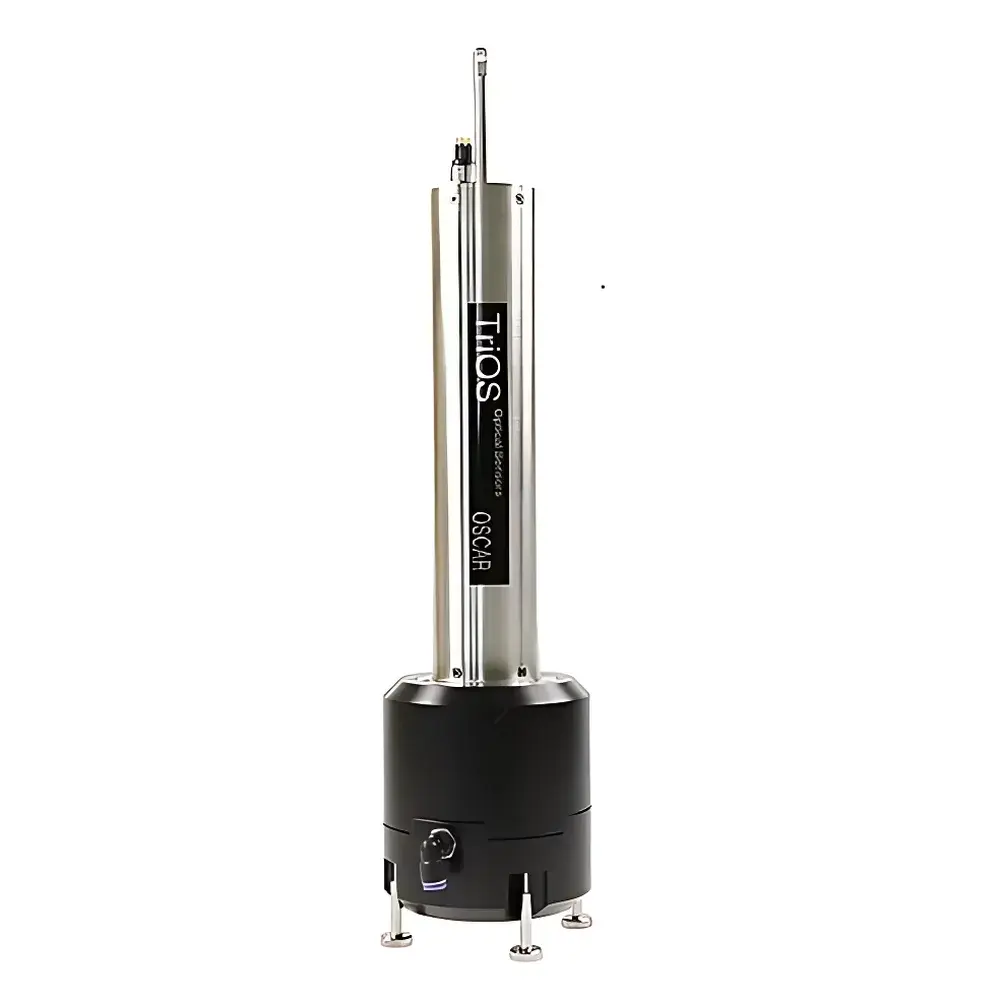
TriOS OSCAR G2 High-Spectral Absorption Meter
| Brand | TriOS |
|---|---|
| Origin | Germany |
| Model | OSCAR G2 |
| Wavelength Range | 360–720 nm |
| Detector | 256-channel miniature spectrometer |
| Spectral Resolution | 3.3 nm/pixel |
| Light Source | 12 LED array |
| Integration Sphere Diameter | 50 mm or 80 mm |
| Optical Path Length | Equivalent to several meters (via multiple diffuse reflections) |
| Turbidity Correction | Yes |
| Data Storage | 2 GB microSD card |
| Response Time (T₁₀₀) | ≤ 2 min |
| Minimum Measurement Interval | ≥ 1 min |
| Housing Material | Stainless Steel (1.4571/1.4404) or Titanium Alloy (3.7035) |
| Dimensions (L × Ø) | 450 mm × 135 mm (excl. connectors) |
| Weight | 6.2 kg (stainless steel), 5.5 kg (titanium) |
| Digital Interfaces | Ethernet (TCP/IP), RS-232/RS-458 (Modbus RTU) |
| Power Consumption | ≤ 4 W |
| Supply Voltage | 12–24 VDC (±10%) |
| Pressure Rating | SubConn connector: 30 bar |
| Integration cavity | +1 bar above ambient (flow rate 2–4 L/min) |
| IP Rating | IP68 |
| Operating Temperature | 2–40 °C (sample & environment) |
| Storage Temperature | −20–80 °C |
Overview
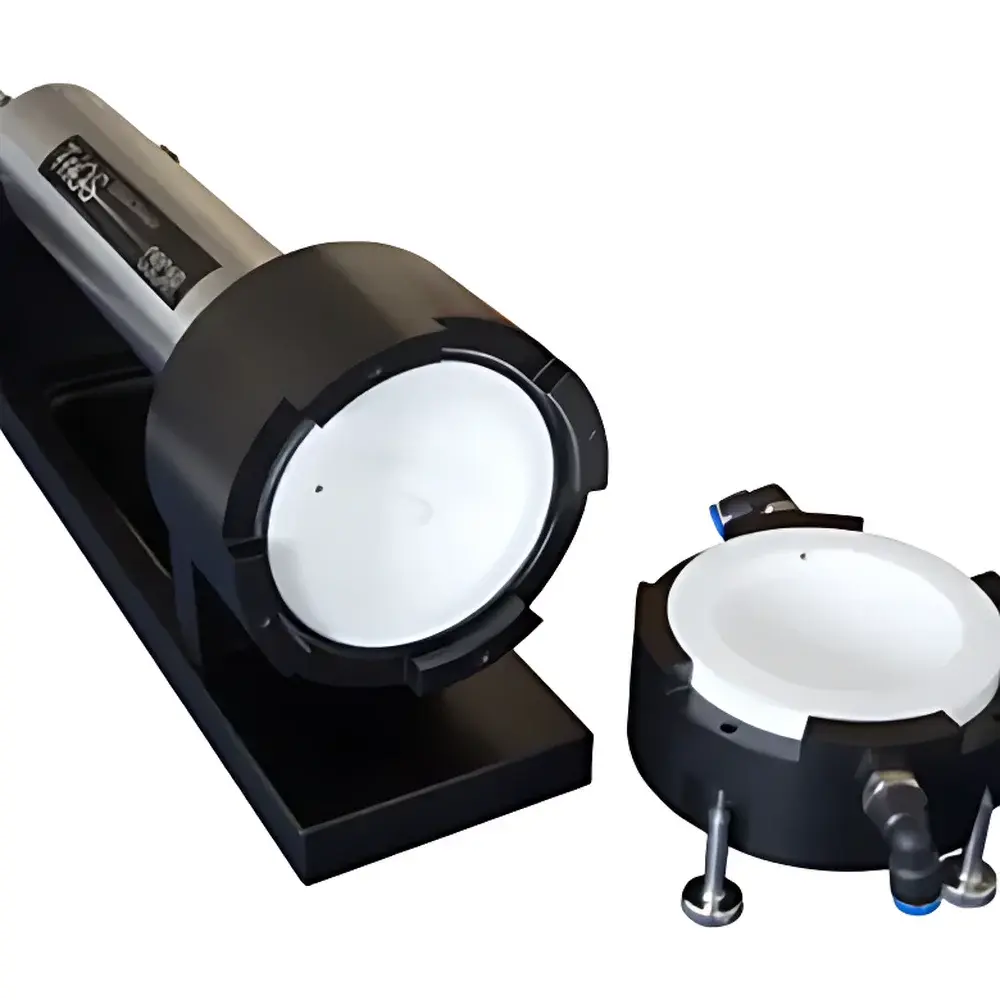
The TriOS OSCAR G2 High-Spectral Absorption Meter is an advanced, in-situ and laboratory-capable optical instrument engineered for precise, scatter-free measurement of spectral absorption coefficients in natural waters. It operates on the well-established Point Source Integrating Cavity Absorption Meter (PSICAM) principle—a physically rigorous methodology that eliminates reliance on empirical corrections or scattering assumptions common in conventional transmittance-based or integrating sphere approaches. Unlike conventional spectrophotometers, which suffer from significant errors due to Mie and Rayleigh scattering by suspended particles (e.g., phytoplankton, detritus, mineral sediments), the OSCAR G2 measures true absorption by fully enclosing the water sample within a highly reflective integrating cavity. A centrally mounted diffusing quartz sphere emits isotropic illumination, while the inner cavity surface—constructed from high-purity PTFE (reflectivity 94–97% at 10 mm thickness)—ensures uniform, multiply scattered photon paths. This geometry yields an effective optical path length of several meters, dramatically enhancing sensitivity for low-absorbance matrices such as oligotrophic seawater, glacial meltwater, or deep groundwater.
Key Features
- True absorption measurement via PSICAM architecture—no scattering correction algorithms required
- High sensitivity enabled by long effective pathlength (>2 m equivalent) and low-noise 256-channel miniature spectrometer (3.3 nm/pixel resolution)
- Dual cavity options: 50 mm and 80 mm internal diameter spheres—optimized for varying turbidity and concentration ranges
- Integrated flow-through cell design compatible with continuous monitoring or discrete sampling protocols
- User-accessible calibration routine using certified neutral density filters and reference standards—traceable to NIST-traceable references
- Robust pressure-rated housing (30 bar SubConn interface; cavity rated +1 bar above ambient) for deployment in coastal, estuarine, and deep-borehole environments
- Low-power operation (≤4 W) supporting long-term autonomous deployments when paired with external power management systems
- IP68-rated enclosure constructed from marine-grade stainless steel (1.4571/1.4404) or corrosion-resistant titanium alloy (3.7035)
Sample Compatibility & Compliance
The OSCAR G2 is validated for direct measurement of unfiltered, unpreserved natural water samples—including freshwater, brackish water, seawater, and groundwater—with turbidity up to 100 NTU. Its PSICAM geometry inherently compensates for particulate scattering effects, eliminating the need for centrifugation, filtration, or chemical pretreatment that may alter chromophore composition. The instrument conforms to best practices outlined in ISO 8213 (water quality — determination of absorbance), ASTM D5839 (standard test method for UV-visible absorption spectroscopy of aqueous samples), and supports GLP-compliant data acquisition when used with the G2 Interface Box’s audit-trail-enabled firmware. All firmware and calibration metadata are timestamped and stored with raw spectra, satisfying traceability requirements under FDA 21 CFR Part 11 when configured with secure user authentication and electronic signature modules.
Software & Data Management
Data acquisition, configuration, and real-time visualization are managed via the TriOS G2 Interface Box—available in Wi-Fi and wired Ethernet variants—supporting both Modbus RTU (RS-232/RS-485) and TCP/IP communication protocols. The embedded firmware enables scheduled measurements (≥1 min interval), automatic dark/light reference acquisition, and on-device spectral averaging. Raw hyperspectral data (absorbance vs. wavelength, 360–720 nm) are stored on a removable 2 GB microSD card in HDF5 format, preserving metadata including temperature, pressure, flow rate, and calibration history. TriOS’ proprietary OceanOptics-compatible software suite (OSCAR Control Suite v4.x) provides post-processing tools for CDOM (colored dissolved organic matter) deconvolution, phytoplankton pigment estimation (e.g., chlorophyll-a, phycocyanin), and QAA (quasi-analytical algorithm) input generation for satellite atmospheric correction workflows.
Applications
- High-fidelity in situ absorption profiling for ocean color validation and satellite sensor vicarious calibration
- Long-term monitoring of CDOM dynamics in river plumes, wetlands, and reservoirs
- Algal bloom detection and classification through spectral shape analysis of absorption peaks (e.g., 443 nm, 676 nm)
- Biogeochemical studies of light attenuation, photolysis rates, and photochemical reaction modeling
- Groundwater contamination assessment via humic substance fingerprinting
- Calibration and validation of autonomous platforms including gliders, moorings, and AUVs
FAQ
Does the OSCAR G2 require sample filtration prior to measurement?
No. Its PSICAM design inherently corrects for scattering by suspended particles; filtration is neither necessary nor recommended, as it may remove colloidal chromophores critical to accurate absorption characterization.
Can the OSCAR G2 operate autonomously for extended periods?
Yes—when powered via stable 12–24 VDC supply and coupled with the G2 Interface Box, it supports unattended operation for months. Battery-backed configurations require external power management; the unit itself does not include an internal battery.
Is the instrument suitable for high-pressure benthic deployments?
The SubConn-mated version is rated to 30 bar (≈300 m depth); the integration cavity must be maintained at +1 bar above ambient to prevent bubble formation—achievable via regulated flow-through plumbing.
How is wavelength calibration maintained over time and temperature?
The 12-LED source includes built-in reference diodes and thermal stabilization. Wavelength drift is monitored during each dark/light cycle and corrected using onboard polynomial calibration coefficients updated during factory recalibration.
What data formats are supported for export and interoperability?
Raw data are stored in HDF5 with embedded metadata compliant with CF-1.7 conventions. Export options include CSV (absorbance vs. wavelength), NetCDF, and MATLAB .mat files—enabling seamless integration with Python (xarray, h5py), R (rhdf5), and ENVI workflows.
Related Products







